

Recruiting is aligned with workforce planning when every requisition traces back to a business priority, a skills gap and a decision about how to close it. Talent acquisition leaders get there by joining the planning process early, agreeing on ownership with finance and business leaders, and measuring recruiting against the plan rather than against open requisitions. Peer benchmarking helps at each stage, because most of the decisions involved are easier to make with data from other large in-house recruiting functions.
This article covers the process, the roles and the measures. It is written for heads of talent acquisition, executive recruiting and HR in mid-size and large companies.
TL;DR
- Workforce planning looks three to five years out and asks which capabilities the business needs. Headcount planning covers the next 12 to 18 months and asks how many people at what cost. Recruiting needs both.
- The business owns the assumptions behind the forecast. HR and talent acquisition supply data on supply, gaps and the options for closing them.
- Each gap gets a lever: hire externally, develop, borrow contingent talent or automate. Recruiting plans only for the gaps that call for external hiring.
- Measure alignment with forecast accuracy, time-to-fill for critical roles, quality of hire and retention in key groups, and review them more than once a year.
- Benchmark these measures against peers. Internal trends show direction. Peer data shows whether the result is good.
Table of Contents
- What alignment between workforce planning and recruiting means
- A six-step process for aligning recruiting with the plan
- Who owns what
- Deciding when recruiting is the right lever
- Measures that show recruiting is aligned
- Where IX Communities fits
- Putting it into practice
- FAQ
- Sources
What alignment between workforce planning and recruiting means
Workforce planning and recruiting are often run as separate cycles. Finance sets headcount in the annual budget. Talent acquisition then receives requisitions and fills them. Alignment closes that gap. Recruiting capacity, sourcing strategy and hiring priorities follow from a documented view of what the business will need.
Two kinds of planning are usually involved, and they are easy to confuse.
| Headcount (operational) planning | Strategic workforce planning | |
|---|---|---|
| Horizon | About 12 to 18 months | Three to five years |
| Core question | How many people, at what cost | Which capabilities the business needs |
| Typical owners | HR and finance | Business leaders, with HR facilitating |
| Output | Budgeted requisitions | Gap analysis and talent action plan |
The horizons and questions in the table are drawn from Prodoscore's comparison of headcount and strategic planning and AIHR's description of strategic workforce planning. Bain & Company describes the strategic version as translating long-term business strategy into workforce implications at the job-family level. It starts from a six-year vision with a three-year midpoint. It treats the operational budget as a one-year exercise based on current headcount.
For a recruiting leader, the practical point is this: a requisition is the end of a planning chain. If the chain is missing, recruiting fills roles that may not matter most, and misses roles that will.
A six-step process for aligning recruiting with the plan
The steps below follow the structure in Workday's guide for talent leaders, with the supply and demand definitions taken from federal guidance where noted.
1. Confirm the business priorities
Start with the three to five priorities that will drive hiring and development over the next 12 to 24 months. Examples are entering a new market, launching a product line, or consolidating a function. Get them from the executive team in writing. Recruiting plans built on a verbal understanding drift as soon as priorities change.
Where it goes wrong: priorities that arrive as a list of departments rather than outcomes. "Grow engineering" does not say which skills, in which locations, by when.
2. Assess the current workforce
The U.S. Office of Personnel Management's Workforce Planning Guide describes a supply analysis covering current structure, competencies, staffing levels, demographics, attrition, retirements and engagement. The guide is written for federal agencies, but the categories apply to any large employer. Add a skills inventory with proficiency levels and a list of critical roles.
Talent acquisition holds data that others lack here: how long critical roles stay open, which sources produce hires that stay, and where offers are declined. Bring it to the table.
3. Model future demand in scenarios
Demand forecasting asks what drives workload and how many people with which skills the business needs to deliver each service or product. A single forecast is fragile. Model at least a baseline, a growth case and a contraction case, so recruiting knows which hiring is needed in every case and which depends on events.
4. Identify the gaps
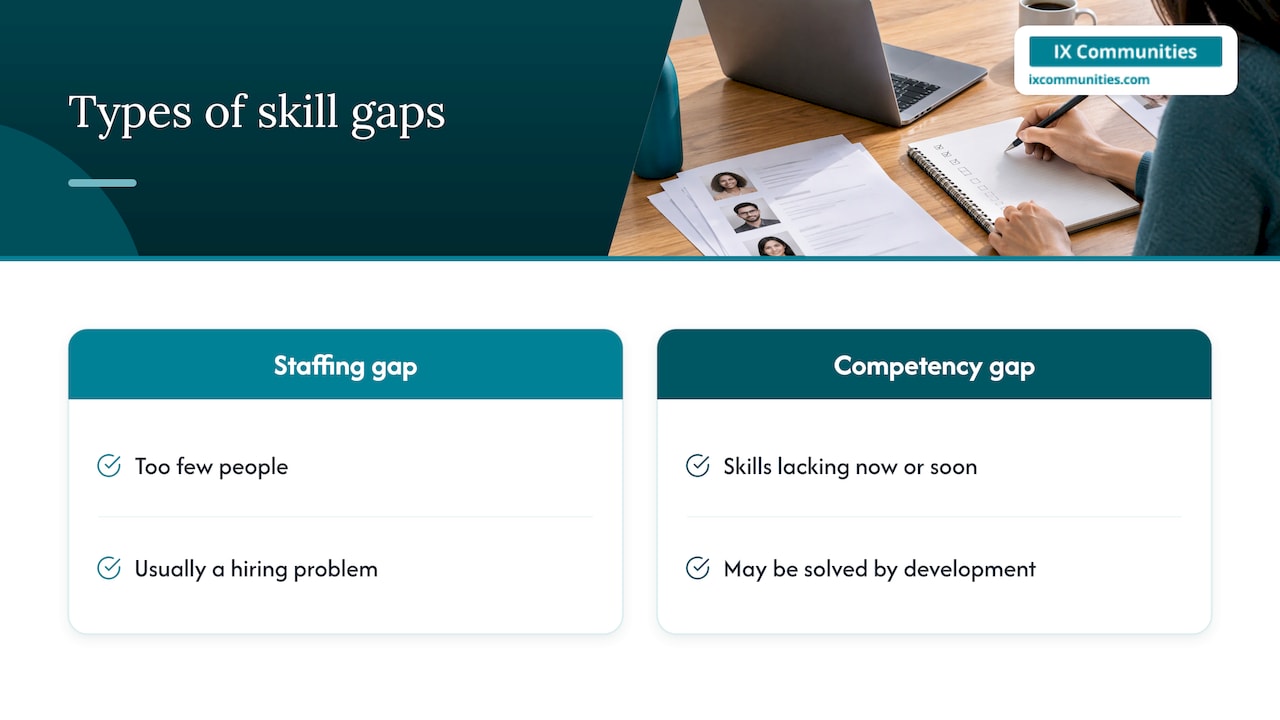
OPM's guide, citing a U.S. Government Accountability Office report, separates two kinds of skill gap. A staffing gap means too few people. A competency gap means people lack the skills needed now or soon. The distinction matters for recruiting because the two call for different responses. A staffing gap is usually a hiring problem. A competency gap may be better solved by development.
Lay gaps over function, location and skill level, and note the timing and business impact of each. Rank them by impact. Recruiting capacity is finite, and the ranking tells you where it goes first.
5. Assign a lever and an owner to each gap
This is the step where recruiting strategy is set. The next section covers the options. Each action needs an owner, a timeline and a way to track progress.
6. Review and adjust on a fixed rhythm
Plans age quickly. Build a review into the calendar at least quarterly for critical job families, with a standing item on the recruiting leadership agenda: which assumptions changed, which gaps closed, which hiring plans need to move.
Who owns what
Alignment fails most often at the handoff between functions. Bain & Company argues that without business ownership, strategic workforce planning becomes an HR exercise with limited influence on talent decisions. The business owns the strategic assumptions. HR facilitates and provides analysis.
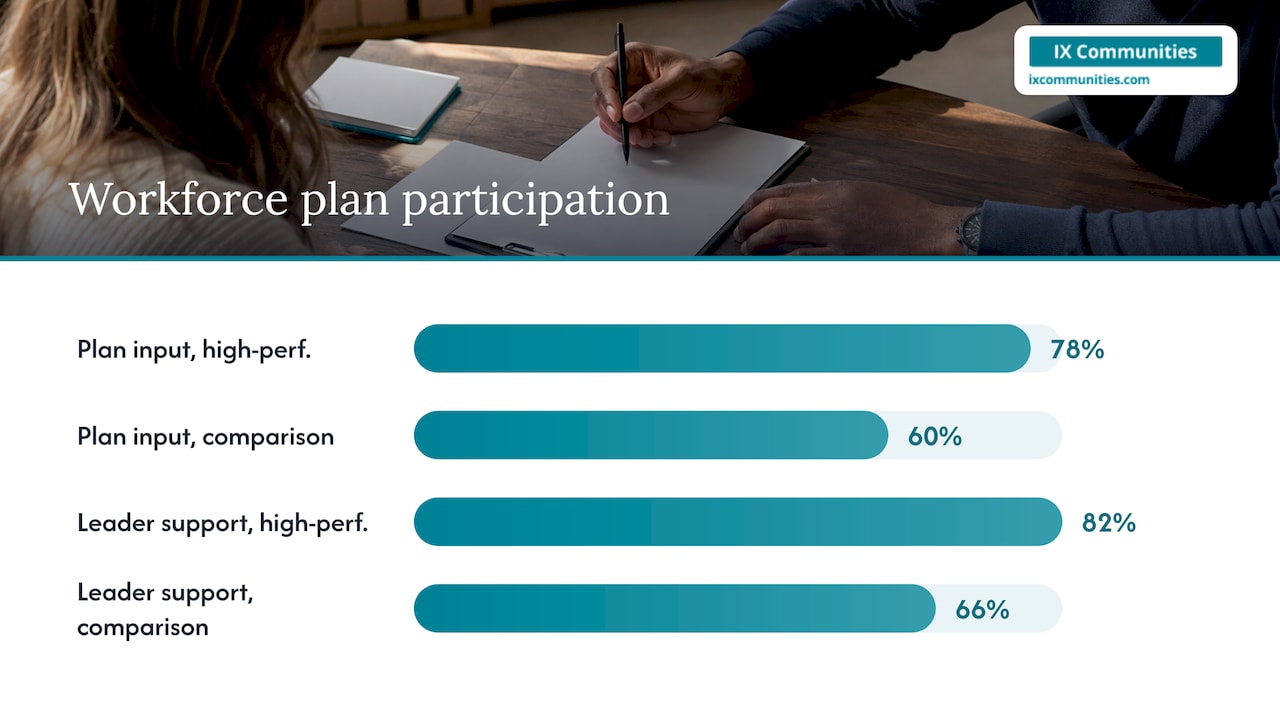
The data supports the point. In a survey of 259 workforce-planning respondents, conducted in 2020 by HCI and Workday, high-performing organizations were more likely to report that relevant business functions adequately contribute to workforce plans (78% against 60%). They were also more likely to report that business leaders support planning efforts (82% against 66%). The same survey found that HR typically heads most plan types, finance often partners on or owns headcount and cost plans, and learning and development guides learning plans.
A workable division for a large company looks like this:
- Business leaders: set priorities, own the demand assumptions, accept trade-offs between speed and cost.
- HR and workforce planning: run the process, provide supply data and gap analysis.
- Finance: validate cost and headcount envelopes, and tie scenarios to budget.
- Talent acquisition: advise on market availability, time-to-fill and sourcing feasibility, then execute the external hiring plan.
- Learning and development: own the build lever for competency gaps.
The link to the executive level matters as well. A Harvard Business Review Analytic Services survey of 168 U.S. companies in 2017 found that 67% of CEOs receive at least a basic set of human capital metrics. Only 24% receive analytics that connect people metrics to business metrics. Recruiting leaders who present hiring data in business terms, such as revenue at risk from a vacant critical role, fill that gap.
Deciding when recruiting is the right lever
Not every gap should become a requisition. Bain describes four levers for each critical job family: buy (hire externally), build (reskill and develop), borrow (use contingent talent) and bot (automate). Workday's 2026 talent playbook extends this with boomerang hires and redeployed employees. It reports that 35% of Medtronic's 12,000 hires in its last fiscal year were internal. Workday's own analysis found internal hires 82% more likely to be high performers by their first rating cycle.
Rockwell Automation's Patrick O'Rourke, quoted in the same playbook, suggests a decision tree before a role is approved. Will the work last 12 months? Is there a redeployment plan? Is a permanent employee needed at all? Asking these questions at approval is cheaper than discovering the answers halfway through a search.
For a recruiting leader this changes the conversation with hiring managers. Instead of accepting or declining a requisition, you bring options with timing and cost for each. Selection method matters too, especially for high-stakes roles: cognitive talent pipelines for high-stakes roles are one way to compare external hiring with development and redeployment on the same footing.
A short rubric helps:
| Situation | Usual lever |
|---|---|
| Stable, long-term role, skills not available internally | Buy |
| Skills adjacent to current roles, 6 to 12 months of lead time | Build or redeploy |
| Project work with a defined end | Borrow |
| Repeatable, rules-based tasks | Bot |
| Critical leadership or niche expertise | Buy, often through executive search |
The last row is where executive recruiting leaders spend most of their time. Search firm selection, fees and timelines are part of workforce planning, not separate from it.
Measures that show recruiting is aligned
A common mistake is to judge alignment by volume: requisitions closed, interviews held. Better measures compare recruiting outcomes with the plan.
- Forecast accuracy. How closely did actual hiring demand match the plan? Large misses signal weak assumptions upstream, not poor recruiting.
- Time-to-fill for critical roles. Track it separately for the roles the plan names as critical. SHRM's Talent Access Report reported a 44-day median for nonexecutive roles and a 60-day median for executive roles. Its data was collected from April to November 2021, so use it as a reference point and compare against current peer data.
- Quality of hire. The same report found only 27% of 1,143 organizations measure it. Among those that do, the most common measures were performance appraisal score (55%), the relationship between interview results and performance (51%) and retention rate (44%).
- Internal mobility and retention in key groups. These show whether build and redeploy levers are working alongside buy.
- Gap closure rate. The share of identified gaps closed by their target dates.
OPM's End to End Hiring Initiative also lists metrics worth considering: applicants per recruiting source, recruitment yield and the high-quality candidate ratio. It directs agencies to align the recruitment plan with the workforce, succession and retention plans. The principle carries over to the private sector: recruiting plans should not stand alone.
The HCI and Workday survey linked tracking to performance. High-performing organizations were more likely to track quality of hire (51% against 24%) and employee engagement (60% against 42%).
A metric is only useful with a reference. If your time-to-fill for senior finance roles is 75 days, whether that is a problem depends on what comparable companies see for the same roles. That is where peer benchmarking comes in.
Our view: benchmark against peers who share your position
Workforce plans are written inside one company, with one company's data. Recruiting leaders often have no way to tell whether a plan's hiring assumptions are realistic: how long a search for a particular executive role takes, what a peer function spends on training, or how other talent teams divide work between internal recruiters and outside search.
We run peer communities for in-house corporate talent leaders: TLIX for talent leaders, ESIX for executive recruiting and DSIX for diversity strategy. Membership is limited to in-house corporate recruiting leaders, and our environment is free of vendor influence. We have operated for nearly three decades. Our benchmarking is peer-sourced and confidential, so members can compare their own planning assumptions with those of similar functions without exposing company data.
Our view is that alignment with workforce planning improves when talent leaders arrive at the planning table with outside data. A forecast that says a critical search will take 60 days carries more weight when it is backed by peers' actual experience.
Simon
Where IX Communities fits
The three membership communities give talent leaders a confidential setting to compare approaches with peers at large companies. TLIX serves talent leaders. ESIX serves executive recruiting leaders. DSIX serves diversity strategy leaders. Memberships have no published price.
For executive hiring decisions, the ExecSmart Database and Talent Acquisition Books provide a proprietary search consultant database and guidebooks on recruiting practices. IX Academy recruiter training offers on-demand courses from $350, live online courses from $750 and team intact courses from $3,000, all one-off prices. Guest speaker sessions are described on the IX Communities guest speakers page.
Putting it into practice
A realistic first quarter for a recruiting leader looks like this:
- Request the current business priorities and the last workforce plan. If there is no plan, propose a pilot for two or three critical job families.
- Pull your own data on time-to-fill, offer acceptance and early attrition for those families.
- Agree with finance and the business on scenarios and on a review rhythm.
- Rank the gaps. For each, propose a lever and show the recruiting capacity required.
- Set the measures above, and compare them with peer benchmarks once the first results arrive.
Start narrow. A pilot in two job families builds credibility faster than a company-wide model that nobody owns.
FAQ
What is the difference between workforce planning and recruiting?
Workforce planning decides which roles and skills the business needs, when, and how to get them. Recruiting is the execution of one of those choices: hiring from outside. A good plan tells recruiting which roles to fill, in what order and by when. It also tells recruiting which gaps will be closed by other means.
How often should a workforce plan be reviewed?
At least quarterly for critical job families, and whenever business priorities shift. Annual one-time planning goes out of date as conditions change. Many organizations pair a longer three-to-five-year view with shorter review cycles for hiring plans.
Who should own workforce planning in a large company?
Business leaders own the assumptions, and HR facilitates the process and supplies analysis. Finance validates cost and headcount, and talent acquisition advises on market feasibility and delivers external hiring. Planning led by HR alone tends to carry little weight in talent decisions.
Which metrics should talent acquisition report to show alignment?
Forecast accuracy, time-to-fill for critical roles, quality of hire, retention in key groups and gap closure rate. Report them by job family rather than as company averages, and compare them with peer benchmarks where available.
Sources
- Bain & Company: What is Strategic Workforce Planning?
- AIHR: Strategic Workforce Planning framework and process
- Prodoscore: Strategic Workforce Planning vs. Headcount Planning
- Workday: Strategic Workforce Planning, a guide for talent leaders
- Workday: Expanding the Talent Playbook in the Age of AI
- U.S. Office of Personnel Management: Workforce Planning Guide
- U.S. Office of Personnel Management: End to End Hiring Initiative
- HCI and Workday: Break the Speed Limit survey
- Harvard Business Review Analytic Services: People to Business
- SHRM: Talent Access Report