

Secure peer discussions are closed, members-only forums where senior talent leaders benchmark performance, mentor one another, and stress-test hiring decisions under strong anonymization and governance. The right structure is a vetted membership community, not an open forum or informal roundtable, because confidentiality depends on formal controls, not goodwill. Some programs pair anonymized benchmarking with NDAs, minimum cell sizes, and membership screening to make candid conversation possible at the executive level.
TL;DR:
- Vetted membership and strict data anonymization are essential to prevent reverse identification in peer benchmarking groups.
- Membership should be defined by role, seniority, and organization size, with regular governance reviews to maintain confidentiality.
- Structured meetings with clear agendas, rotation of facilitators, and pre-distributed anonymized data improve trust and decision-making outcomes.
- Metrics such as quality-of-hire, time-to-fill, and retention provide tangible benefits that justify peer group participation.
- Built-in governance controls allow organizations to access the benefits of peer discussions without risking confidentiality lapses or trust erosion.
Table of Contents
- Why Confidential Peer Discussions Matter for Talent Leaders
- Core Security Controls Every Closed Peer Group Needs
- How to Design or Evaluate a Secure Peer Program
- Running Secure Sessions: Cadence, Format, and Facilitation
- Measuring the Return on Peer Participation
- Why a Vetted Membership Community Meets These Requirements
- What Actually Matters in Secure Peer Discussions
- Consider Membership Built for This Exact Problem
- Sources
Why Confidential Peer Discussions Matter for Talent Leaders
Talent leaders carry decisions that rarely get a second opinion inside their own building. A head of executive recruiting weighing a controversial compensation band, or a DEI leader deciding how far to push a sourcing pilot, usually has no one internally who has seen the same problem from the outside. Secure peer discussions fill that gap.
The evidence backs this up directly.
A 2025 SHRM survey found that roughly a majority of corporate recruiters who participate in peer networks report improved quality-of-hire compared to those working in isolation.
Peer groups also function as decision rehearsal spaces, where a leader can present a real, unresolved problem to people who have no stake in the outcome and nothing to gain from telling them what they want to hear.
Common use cases include:
- Rehearsing a new hiring strategy before presenting it to the board or CHRO
- Benchmarking compensation bands against organizations of comparable size and industry
- Comparing DE&I sourcing tactics and seeing which ones actually moved the numbers elsewhere
- Testing a reduction-in-force or reorganization plan for blind spots before execution
The value compounds because peer input reduces decision risk. A leader who checks an idea against three or four comparable peers before acting tends to move faster once committed, not slower, because the second-guessing happens earlier in the process instead of after launch.
Core Security Controls Every Closed Peer Group Needs
Confidentiality in a peer group is not a promise. It is a set of enforceable mechanics, and most groups that fail do so because they treat trust as a culture problem instead of a design problem.
- Membership vetting. Every applicant should be verified against role, seniority, and company size criteria before admission, with a formal review step rather than self-attestation alone.
- Contractual protections. A signed NDA and a written community charter should define what can and cannot leave the room, including explicit rules on sharing benchmark data outside the group.
- Data anonymization and aggregation. Benchmark figures should never trace back to a single company. Minimum cell sizes, typically requiring several organizations per data point, prevent reverse identification even when a figure looks unusual.
- Secure data ingestion. Pulling figures directly from ATS and HRIS systems into an automated benchmarking pipeline removes the manual copy-paste step where sensitive data most often leaks.
- Platform security. Encryption in transit and at rest, single sign-on, role-based admin controls, and audit logging are baseline requirements, not premium features.
- Periodic compliance review. Annual member attestation and a scheduled audit of who has access to what keeps a growing membership from quietly eroding the original controls.
Anonymization only works with real structure behind it. Groups following HR benchmarking best practices treat minimum cell sizes and data aggregation as non-negotiable, not optional polish added after the fact.
Pro Tip: Ask any peer network you're evaluating how many member companies must contribute to a data point before it's shown. If the answer is fewer than five, the anonymization is cosmetic.
How to Design or Evaluate a Secure Peer Program
The first design decision is who belongs in the room. Peer groups work best when membership is defined by parity, meaning comparable role level, remit, and organization size, rather than by industry vertical alone. A head of talent acquisition at a 40,000-person retailer gets little from benchmarking against a 500-person tech startup, even if both sell to consumers.
Governance model matters just as much as membership criteria:
- Closed, vetted membership with an application and review process produces the strongest trust, because every participant knows every other participant cleared the same bar.
- Invite-only cohorts built by a single sponsoring company offer more control but a narrower comparison set, which limits benchmarking value over time.
- Consortium models with rotating leadership spread governance risk but need clearer written charters to avoid drift.
Cadence should follow a two-speed rhythm. Standard practice across enterprise HR benchmarking is to update operational dashboards at least quarterly, covering metrics like time-to-fill and pipeline conversion, while strategic benchmark sets get a full refresh annually or whenever the market shifts meaingfully, such as a sudden change in compensation norms.
Mentorship needs the same intentional design as the data side. Structured peer mentoring, assigned facilitators, and scheduled guest speaker sessions consistently outperform loosely organized "let's grab coffee" pairings, and mentorship tied to formal talent strategy shows measurable retention gains among the leaders who receive it. Data inputs should be automated wherever possible, pulling from ATS extracts, HRIS records, and finance headcount reports rather than relying on someone manually compiling a spreadsheet before every meeting, as detailed in a practical video screening playbook that highlights automation in recruiting funnels.
Running Secure Sessions: Cadence, Format, and Facilitation
A peer group's security depends as much on how meetings run as on what data gets shared. The format matters.
- Monthly roundtables for open discussion of current challenges, kept small enough that every voice gets airtime.
- Quarterly data reviews where anonymized benchmark dashboards get walked through and interpreted as a group, not just distributed as a report.
- Pre-read distribution of anonymized data before each session, so the meeting time goes to discussion rather than data digestion.
- A dedicated agenda slot for decision rehearsal, where one member presents a live problem and the group works through it in real time.
- Secure breakout guidelines for any subgroup conversation that touches sensitive figures, with clear rules on what stays in the breakout.
Facilitation is the difference between a productive session and a complaint circle. Structured cohorts with clear agendas and rotating facilitators produce measurably higher follow-through on action items than unstructured groups. A good facilitator keeps the conversation anchored to decisions and evidence, redirects venting toward problem-solving, and enforces the confidentiality ground rules without needing to reference them every five minutes.
Onboarding new members deserves the same rigor as vetting them. A short orientation covering the charter, data rules, and meeting norms prevents the awkward moment three sessions in when someone asks why a figure can't be shared outside the room. Offboarding matters too: revoking platform access and confirming data deletion when a member leaves closes a gap that many groups overlook entirely.
Measuring the Return on Peer Participation
Peer group value shows up in a handful of measurable places, and leaders who can't point to numbers eventually lose the budget line.
- Quality-of-hire, tracked through manager satisfaction scores or performance ratings at the first few months and after one year
- Time-to-fill, compared against the anonymized peer median rather than an internal historical baseline
- Offer-acceptance rate, especially useful when benchmarked against peers facing similar compensation pressure
- Retention of key hires, the metric that most directly ties peer-informed decisions back to dollars saved
The same SHRM research showing 68% of peer-network participants reporting improved quality-of-hire gives budget conversations a real anchor point instead of a vague appeal to "networking value."
Review cadence should include regular operational checks, periodic trend reviews, and an annual strategic pass tied to board or CHRO reporting. When presenting results upward, anonymized case notes and simple delta charts, showing where your metric sits relative to the peer median, communicate more in thirty seconds than a paragraph of narrative ever will.
Why a Vetted Membership Community Meets These Requirements
Everything covered so far describes a design problem: anonymization, vetted access, structured mentorship, and disciplined cadence. Some peer networking and benchmarking organizations for talent leadership professionals bring together corporate talent acquisition, executive recruiting, and diversity recruiting leaders inside a members-only structure rather than an open forum.
Typical features include membership vetting to keep the room limited to genuine peers, guest speaker programming to bring outside expertise into the mentorship layer without diluting confidentiality, and benchmarking reports that run on anonymization logic aggregating figures rather than exposing any single company's numbers.
None of this replaces internal governance work. It does give talent leaders a working example of the model rather than a theory of it.
What Actually Matters in Secure Peer Discussions
Most advice on this topic treats confidentiality as a policy problem, solved by a longer NDA or a stricter access list. That misses where trust actually breaks down. The real risk isn't a leaked document. It's a room where people feel too exposed to say what they actually think, and the meeting quietly turns into a status update instead of a decision-rehearsal space.
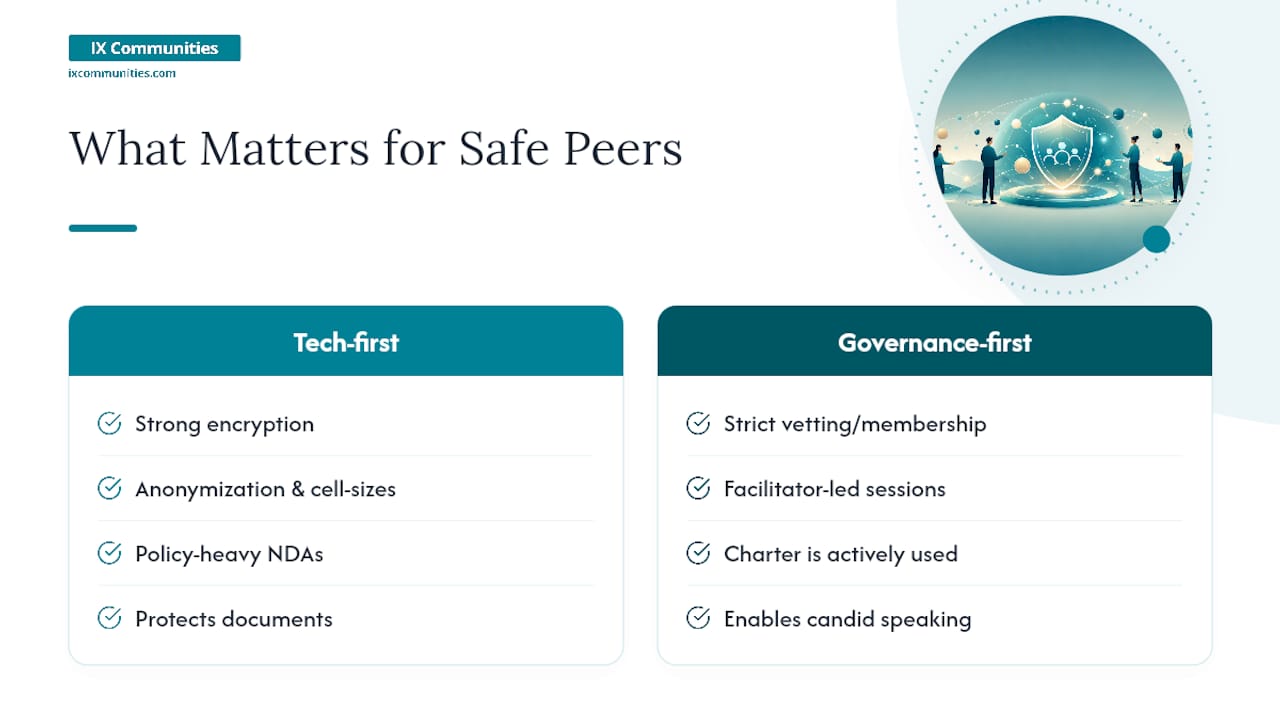
The research bears this out. Anonymization and minimum cell sizes make the data safe to share, but they don't make people safe to speak. That requires structure: a facilitator who redirects venting into problem-solving, a charter that gets referenced rather than filed away, and a membership bar strict enough that everyone in the room trusts everyone else by default rather than by proof.
If you're evaluating or building a peer program, prioritize governance discipline over feature checklists. A group with modest technology but a strict vetting process and a real facilitator will outperform one with excellent encryption and no structure. Confidentiality is the floor. What you build on top of it, mentorship, rehearsal, and honest benchmarking, is where the actual return comes from.
— Simon
Consider Membership Built for This Exact Problem
Controls such as vetted access, anonymized benchmarking, and structured mentorship exist inside some membership models rather than frameworks you have to build from scratch. That's the practical advantage: you get the governance infrastructure on day one instead of spending a year designing it internally.
If your organization is weighing whether to build an internal peer consortium or join an established one, the fastest way to decide is to see the model in action. Request a briefing to review anonymized sample benchmarks, sit in on a guest speaker session, or talk through which membership track fits your team's size and remit. Start by visiting Ixcommunities to see current membership options and take the next step toward a peer network built for confidential benchmarking from the ground up.