

A search firm scorecard is a weighted evaluation tool that scores executive search vendors on defined criteria instead of relying on gut feel about a pitch. It replaces subjective proposal reviews with side-by-side numeric comparisons across methodology, fees, and track record. This article gives you a copyable weighted template, the KPI benchmarks to fill it in with, and the step-by-step process for running it during an RFP.
TL;DR:
- The effectiveness of a scorecard depends on properly calibrated weights that reflect your company's priorities, such as methodology, diversity, or timeline.
- Independent, pre-discussion scoring minimizes bias and ensures evaluation criteria are consistently applied across all vendors.
- Benchmarking KPIs like placement success rates, days to placement, and 12-month retention provide realistic standards to assess vendor claims.
- Vague proposal answers and focus on reputation over firm-specific data signal potential red flags worth investigating further.
- Customizing the scorecard to include features like compliance, scalability, or revenue tracking ensures alignment with specific organizational needs.
Table of Contents
- What a Search Firm Scorecard Includes and Why Use One
- The Weighted Search Firm Scorecard Template
- How to Apply the Scorecard During Search Firm Selection
- Key KPIs and Benchmarks to Score Firms Against
- Evaluating Proposals: What to Look For and Red Flags to Avoid
- Why Peer Benchmarking Strengthens Your Scorecard Inputs
- Questions to Ask Search Firms Before You Score Them
- Customizing the Scorecard for Your Company's Hiring Needs
- Common Pitfalls and Biases That Distort Search Firm Scores
- Sample Scorecards: Two Completed Comparisons
- Building Hiring Manager and Candidate Feedback Into the Scorecard
- Weighting Criteria Based on What Actually Matters to Your Team
- What Search Firm Selection Mistakes Look Like in Practice
- Get Benchmarked Scorecard Inputs From Ixcommunities
- Sources
What a Search Firm Scorecard Includes and Why Use One
A search firm scorecard works because it forces every stakeholder to rate the same firm against the same fixed categories, rather than each person forming a separate impression from a different conversation. Standard categories on a well-built scorecard include:
- Search methodology and process rigor
- Delivery team experience and named-consultant availability
- Sourcing approach and diversity slate commitments
- Reporting cadence and data/analytics transparency
- Fee structure and replacement guarantees
- Reference quality and prior placement outcomes
Each category carries a weight tied to what actually matters for your organization. A company hiring for a high-turnover VP role might weight guarantees and time-to-fill heavily; one building a diverse leadership bench might weight sourcing more. Use the scorecard at three points: scoring RFP responses before you shortlist, structuring the proposal review meeting, and guiding the final selection panel discussion so the decision doesn't hinge on who presented best.
The Weighted Search Firm Scorecard Template
Build the scorecard around six categories, each weighted to reflect priority, with weights summing to 100 points total.
- Methodology (25 to 35 points): how the firm sources, assesses, and closes candidates.
- Delivery team (15 to 25 points): named consultants, their tenure, and availability for your search.
- Sourcing and diversity (10 to 20 points): breadth of outreach and diverse-slate track record.
- Reporting and analytics (10 to 15 points): what data the firm shares and how often.
- Timeline and fit (10 to 15 points): realistic days-to-placement estimate and cultural alignment.
- Fees and guarantees (5 to 10 points): cost structure and replacement terms.
Score each firm 0 to 5 per category (0 meaning unaddressed, 5 meaning exceptional and evidenced). Multiply the raw score by the category weight, divide by 5, and sum across categories to normalize to a 100-point total. A firm scoring 4 out of 5 on a 30-point methodology category earns 24 points there.
Practical items to convert from impression to number, drawn from a widely used executive search firm comparison tool, include:
- Responsiveness during the pitch process
- Quality and specificity of the questions the firm asked about your role
- Clarity of the written proposal
- Transparency of fee and payment terms
Build this in a shared Google Sheet or CSV so every evaluator scores independently before anyone discusses impressions out loud.
How to Apply the Scorecard During Search Firm Selection
Running the scorecard well matters as much as designing it. Follow this sequence:
- Calibrate weights before you see any proposals. Bring stakeholders together, agree on category weights, and write down any non-negotiables (a hard guarantee minimum, a required diversity commitment) separately from the scored categories.
- Collect identical inputs from every firm. Request the written proposal, two to three references, the names of consultants who will staff the search, and a sample slate or case study from a comparable role.
- Score independently, then reconcile. Each evaluator fills out their own scorecard before any group discussion. Compare scores, and where two evaluators differ by more than a point on a category, discuss and document why.
- Combine the number with moderated notes. The final recommendation uses the composite score as the anchor, with qualitative notes attached to explain any close calls or split decisions.
Pro Tip: Run the same scorecard through two quick scenarios, one where time-to-fill is weighted heaviest and one where 12-month retention is weighted heaviest. Watching the shortlist reshuffle tells you which firms are strong across the board and which only look good under one weighting.
Independent scoring before discussion is the step teams skip most often, and it's the one that prevents a strong presenter from dominating the room.
Key KPIs and Benchmarks to Score Firms Against
Numbers in a proposal are only useful if you know what a good number looks like. Retained executive search carries a placement success rate averaging approximately industry norms, with leading boutiques reporting higher success rates (https://peppereffect.com/blog/executive-search-kpis). A firm quoting a rate below that range for a comparable role should explain why.
Benchmark snapshot: Retained searches typically average a moderate duration for placement(https://recruitbpm.com/blog/data-analytics-for-executive-search-firms), though certain C-suite retained mandates close faster, often within a shorter time range, when the firm has deep bench strength in that function.
Beyond placement rate and days to placement, build these into your scorecard:
- 12-month retention or replacement guarantee: ask what happens if the placed candidate leaves within 12 months, and whether the firm tracks this metric internally.
- Repeat business rate: a firm with high repeat engagement from existing clients signals consistent outcomes, not just strong sales.
- Segment-specific data: the strongest boutiques track placement success by practice area rather than reporting one firm-wide average, so ask for the number specific to your function and level.
Placement rate, days to placement, and 12-month retention are the three starter metrics worth tracking first if your organization has never formalized search firm KPIs before.
Evaluating Proposals: What to Look For and Red Flags to Avoid
A strong proposal names the actual lead consultant, not just a firm brand, and commits to a specific timeline with milestones rather than a vague "typically 90 to 120 days." It also states fee structure plainly and defines the replacement guarantee window in writing.
Watch for these warning signs while reading proposals or talking with a firm's team:
- Methodology described in abstract terms with no mention of how candidates are actually sourced or assessed
- No willingness to share anonymized placement or retention data from past searches
- Reluctance to provide reference clients, or references that are clearly hand-picked success stories only
- No mention of a client-facing reporting cadence or dashboard during the search
If a firm's answers stay vague, ask direct follow-ups: "What percentage of your searches in this practice area placed a candidate who stayed past 12 months?" or "Can you show me a redacted pipeline report from a comparable search?" Firms with real analytics infrastructure answer those questions with numbers, not reassurance.
Why Peer Benchmarking Strengthens Your Scorecard Inputs
A scorecard is only as good as the benchmarks behind it, and this is where isolated hiring teams struggle. Peer benchmarking groups like Ixcommunities give talent acquisition leaders anonymized data on what placement rates, fee structures, and guarantee terms actually look like across comparable companies, not just what one vendor claims in a pitch.
That input feeds three parts of the scorecard directly: setting realistic weight ranges based on what peers prioritize, validating a firm's claimed placement rate or days-to-placement against what similar organizations have actually experienced, and cross-checking references through a wider network than your own past search history provides. Firms that install structured KPI reporting tend to place more mandates and generate more repeat business, and peer benchmarking is how you learn to tell that firm apart from one that just talks about data.
Questions to Ask Search Firms Before You Score Them
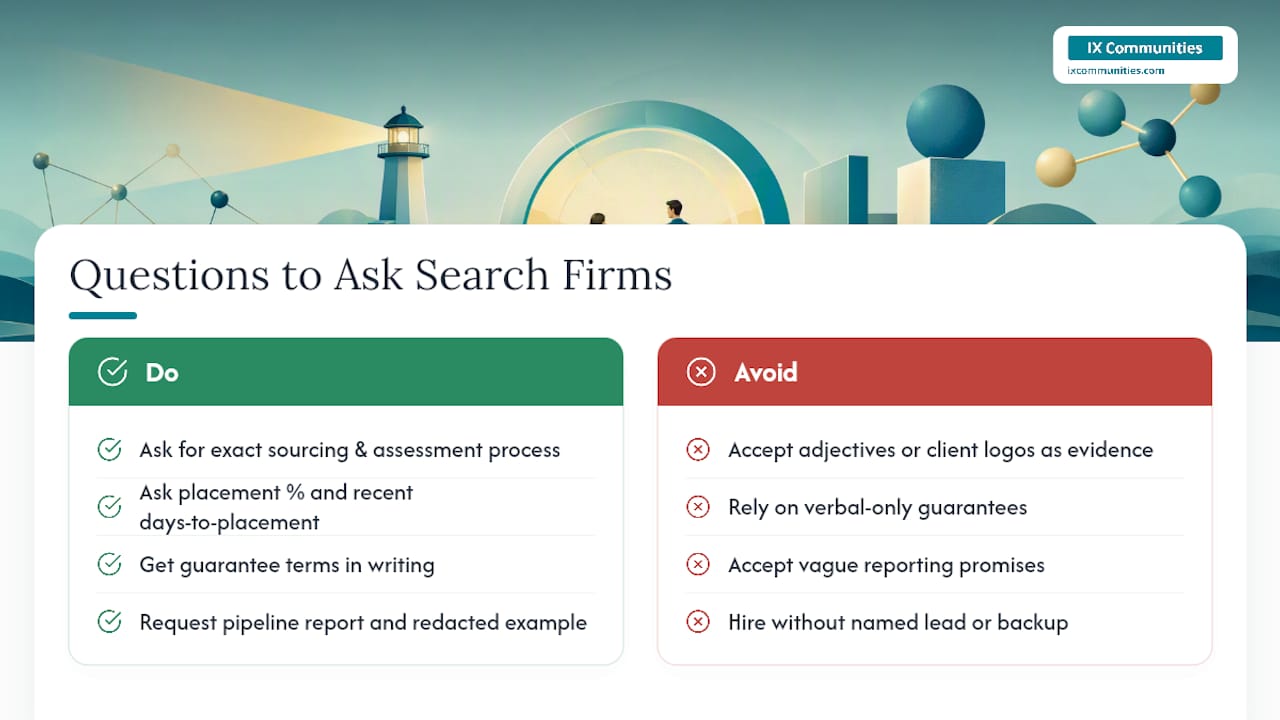
The quality of your scorecard depends entirely on the quality of the answers you collect, so ask questions that produce evidence, not adjectives. Start with process: "Walk me through exactly how you source, assess, and present candidates for a role like this one." A firm that answers with a repeatable process, not a list of past client logos, is giving you something scoreable.
Follow with accountability questions. Ask what percentage of their searches in your function and level actually placed a candidate, and what their average days-to-placement looked like on the three most recent comparable searches. Ask directly what happens if the candidate leaves within 12 months, and get the guarantee terms in writing rather than verbally.
Ask about the team: who is the named lead consultant, how many active searches are they running concurrently, and who backs them up if they leave mid-search. Ask about sourcing: what does their diverse-slate track record look like for this specific function, not company-wide.
Finally, ask for reporting specifics. Will you receive a pipeline report, and how often? Can they show a redacted example from a past search? A firm that hesitates on this question is telling you something important about how they'll communicate once the retainer is signed. Every answer here maps directly to a scorecard category, which is the point: vague answers produce vague scores, and vague scores produce a weak recommendation.
Customizing the Scorecard for Your Company's Hiring Needs
The six-category template is a starting point, not a fixed rule. A company hiring primarily for revenue-generating roles might add a category for the firm's track record placing candidates who hit quota or revenue targets within their first year, since a technically qualified hire who underperforms commercially still counts as a bad placement.
Companies with heavy regulatory exposure, in financial services or healthcare, often add a compliance and background-verification category, scoring how rigorously a firm vets credentials and disclosure history. Organizations further along in diversity recruiting maturity sometimes split the single sourcing and diversity category into two, scoring diverse slate delivery and long-term diverse retention separately, since a firm can excel at one without the other.
If your company runs frequent searches across multiple business units, consider adding a category for scalability, whether one firm relationship can service several concurrent roles without diluting attention on any single search. Startups and fast-growing companies sometimes weight timeline and fit more heavily than large enterprises do, since a slow search has a proportionally bigger cost when a leadership seat sits empty during a growth phase.
Whatever you add, keep total weights at 100 and revisit the weighting annually. Priorities shift, and a scorecard calibrated for last year's hiring plan may not reflect this year's.
Common Pitfalls and Biases That Distort Search Firm Scores
The most common failure is chemistry bias, where a firm that presented confidently and built rapport during the pitch scores well across every category regardless of what the proposal actually says. Separate the "did I like this person" reaction from the scored criteria by requiring evaluators to cite specific proposal language or data when they assign a score above 3.
Recency and last-impression bias also skew results when firms present sequentially over several weeks. Evaluators tend to remember the most recent pitch most vividly, which is why independent scoring immediately after each conversation, rather than a group ranking exercise weeks later, produces more reliable results.
Watch for halo effects from brand recognition, where a well-known firm name gets a scoring boost on categories like methodology or reporting that the proposal never actually addressed in detail. Score only what was demonstrated, not what you assume a reputable name implies.
Inconsistent scoring across evaluators is a structural pitfall, not just an individual bias. If one evaluator interprets a 4 as "good" and another reserves 4 for "exceptional," the composite score becomes noise. Fix this by defining what each number on the 0 to 5 scale means in writing before scoring begins, and by reconciling any category where evaluators differ by more than one point.
Sample Scorecards: Two Completed Comparisons
Seeing a filled-in scorecard clarifies how the math plays out better than an abstract template does. Consider two firms competing for a VP of Engineering search, scored against the six standard categories.
Firm A wins on the composite score, driven by a stronger delivery team and clearer reporting commitments, even though Firm B scored higher on fees and diversity sourcing. That's the value of the weighted total: it prevents a single strong category, like a lower fee, from overriding weaker performance on the categories your stakeholders agreed matter more. Run this same table for every serious candidate firm, and the shortlist decision becomes a document you can defend to any stakeholder who wasn't in the room.
Building Hiring Manager and Candidate Feedback Into the Scorecard
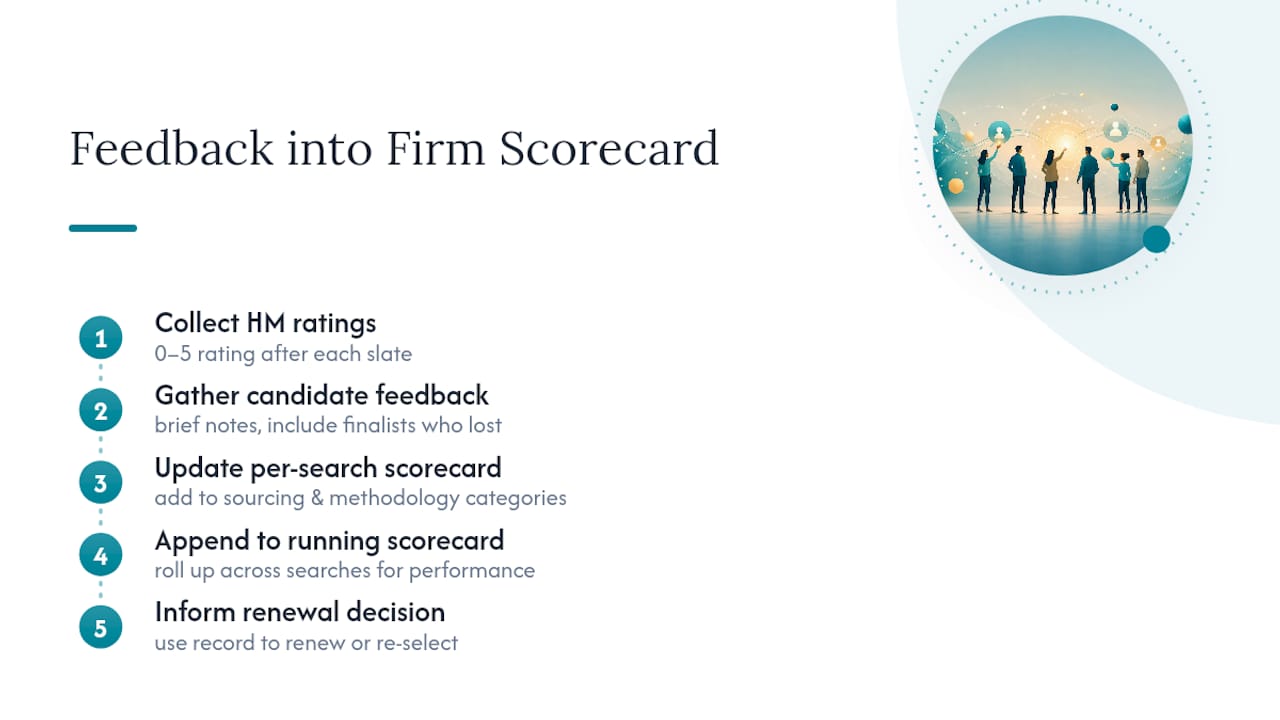
A scorecard built only from the RFP and proposal stage misses information that only surfaces once the search is underway. Add a feedback loop that runs during and after the search, not just before you select the firm.
Ask hiring managers to rate the quality of candidates presented, on a simple 0 to 5 scale, after each slate. Did the firm actually understand the role, or did the slate suggest they were sourcing broadly and hoping something stuck? This becomes a running addendum to the sourcing and methodology categories, useful both for this search and for renewing or re-selecting the firm next time.
Where possible, gather brief candidate-side feedback too, particularly from finalists who didn't get the offer. Candidates often notice things hiring teams don't, like how well the firm communicated during the process or whether the role was represented accurately. A pattern of candidates saying the role was misrepresented is a methodology problem worth scoring down, even if the firm ultimately placed someone.
Feed this feedback into a running scorecard file per firm, not just a one-time RFP snapshot. Over multiple searches, this turns the tool from a selection instrument into a genuine performance record, which matters most when you're deciding whether to renew a firm relationship or open the search to competitors again.
Weighting Criteria Based on What Actually Matters to Your Team
Weighting is where most scorecards go wrong, usually by defaulting to equal weights across all six categories because nobody wants to have the harder conversation about priorities. Equal weighting feels fair, but it quietly tells every evaluator that fees matter as much as methodology, which is rarely true for a senior leadership search.
Start the weighting conversation by asking stakeholders to rank, not score, the six categories from most to least critical for this specific role. Ranking forces trade-offs in a way that assigning numbers directly doesn't. Once you have a rough order, assign weights within the suggested ranges (methodology 25 to 35, delivery team 15 to 25, and so on) so the top-ranked category sits at the high end of its range and lower-ranked categories sit at the low end.
Document the reasoning behind unusual weightings. If your team weights timeline heavily because the seat has been empty for four months, write that down. Six months from now, when someone questions why fees only carried 5 points instead of 10, the documented rationale prevents the conversation from becoming a retroactive argument.
Revisit weights for every new search rather than reusing last year's spreadsheet by default. A CFO search and a Chief Diversity Officer search legitimately call for different priorities, and the weighting should reflect that each time.
What Search Firm Selection Mistakes Look Like in Practice
The mistake we see most often isn't a bad firm getting hired. It's a good firm getting hired for the wrong reasons, chemistry and confident presentation, while a stronger firm on methodology and data gets passed over because their pitch was drier. A structured scorecard doesn't eliminate chemistry as a factor. It just stops chemistry from silently outweighing everything else.
Inconsistent scoring across evaluators causes more bad decisions than any single biased individual does. One evaluator's "solid" is another's "exceptional," and without a shared rubric, the final number means nothing. Peer conversations across talent leaders consistently surface the same pattern: teams that document scoring criteria before the first pitch make better, more defensible hires than teams that discuss impressions after the fact.
— Simon
Get Benchmarked Scorecard Inputs From Ixcommunities
Building a scorecard is straightforward. Ixcommunities gives corporate talent acquisition leaders access to secure peer communities where members share real placement rates, fee structures, and guarantee terms across comparable companies, not marketing claims from the firms pitching you.

Membership also includes a proprietary search consultant database, guidebooks on recruiting best practices, and expert sessions where practitioners discuss what's actually working in vendor selection right now. Recruitment marketing resources like AMW Media's staffing and recruitment guidance can help you understand how firms position themselves, but validating whether those positioning claims hold up against real performance data is what a peer network is built for.
Visit the Ixcommunities membership page to see how benchmarking access and the consultant database can strengthen the inputs behind your next search firm scorecard.