

A search consultant roster is a curated list of executive-search firms and independent consultants your organization pre-vets and keeps on call for senior hiring. The immediate step: name a few firms or consultants, require each to name the partner who will personally run the work, and confirm recent comparable searches in your function. Ixcommunities members shorten this curation step using a proprietary consultant database and peer validation.
TL;DR:
- A vetted search consultant roster saves time through pre-approved contracts, confirmed partner accountability, and recent relevant placements within 18 months.
- Building a focused roster involves selecting only a few trusted firms or consultants, plus stakeholder alignment and standardized onboarding procedures.
- Always require a named lead consultant, detailed conflict policies, and transparent reporting cadence to avoid delivery gaps and conflict risks.
- Insist on scope and fee clarity in contracts, including milestones, guarantees, expenses, and conflict disclosures to prevent scope creep and disputes.
- Using a peer-validated, community-based database ensures more reliable vetting of consultants than traditional reference checks or reactive firm calling.
Table of Contents
- What Is a Search Consultant Roster, and Why Does Your Team Need One?
- Who Belongs on the Roster and How Do You Vet Them?
- How Do You Build and Maintain an Operational Roster?
- Running a Retained Search Off the Roster
- What Should Your Contract Cover Before You Sign?
- Why the Roster Model Beats the "Call a Firm When You Need One" Approach
- Access a Vetted Search Consultant Roster Through Ixcommunities
- Sources
What Is a Search Consultant Roster, and Why Does Your Team Need One?
A search consultant roster, in the executive-hiring sense, is a pre-approved list of retained search firms, boutique specialists, and independent consultants that your talent function has already vetted for quality, fit, and contracting terms. It is not the same thing as a public-sector vendor roster used to source contracted labor. This is a private, internal tool built around trust in named people, not a procurement portal open to any bidder.
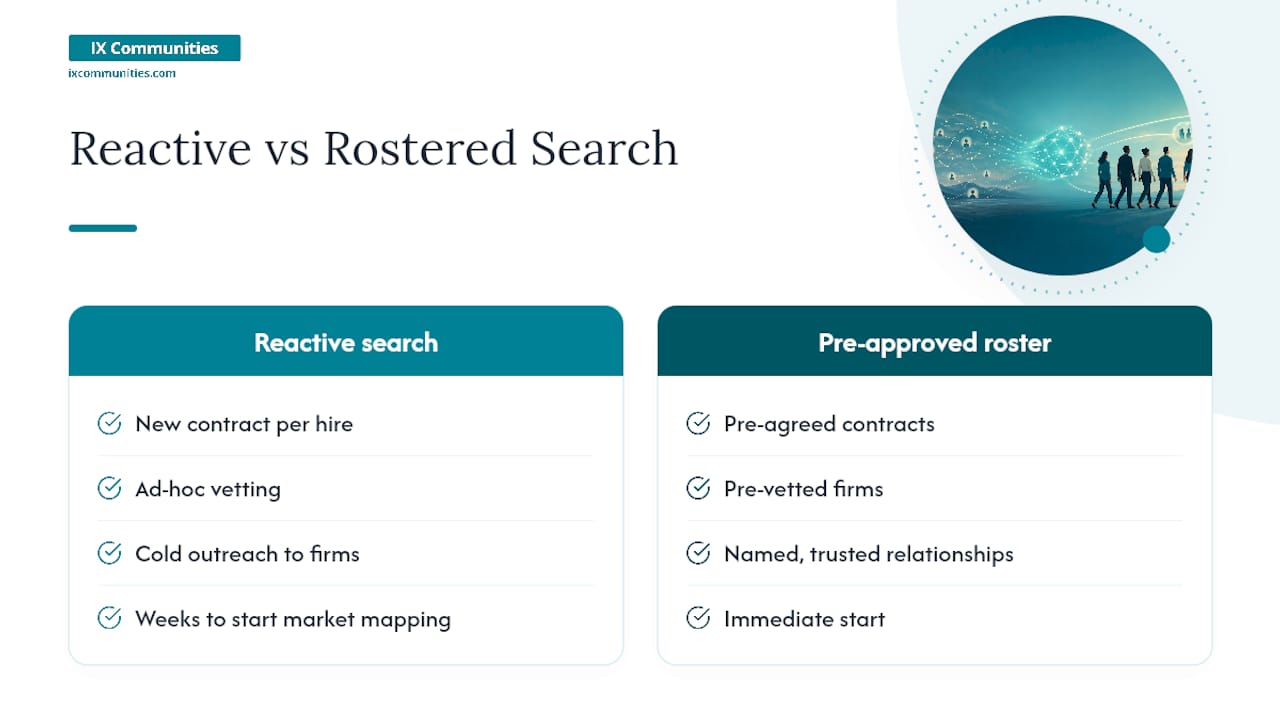
The case for building one is speed and consistency. Without a roster, every senior search starts with a scramble: legal reviewing a new contract, HR cold-calling firms, and a hiring manager losing weeks before anyone even begins market mapping. A roster collapses that lag because the contracts, the vetting, and the relationships already exist.
It also protects confidentiality on sensitive searches, board seats, C-suite replacements, and reorganizations where a leak can cost you candidates or credibility. Use a roster whenever a role is senior, specialized, or discreet enough to warrant retained search. Save contingency recruiting or internal sourcing for volume roles where speed matters more than depth of market mapping.
Who Belongs on the Roster and How Do You Vet Them?
Not every firm that pitches you belongs on the list. A defensible roster runs on a short set of non-negotiable checks, applied the same way to every candidate firm or consultant.
Start with the person, not the logo. Practitioner guidance is consistent on this point: you are buying a named individual's network and judgment, and the firm behind them matters mainly as support infrastructure. Get that person's name in the engagement letter, not just referenced in a pitch deck.
From there, run every entrant through the same filter:
- Named partner accountability. Confirm in writing which specific consultant leads delivery, and that they will not hand the search to a junior researcher after the pitch.
- Recent comparable work. Ask for evidence of placements in your function or sector within roughly the last 18 months, not a five-year-old case study. The KORE1 buyer guide treats this as a baseline screen, not a nice-to-have.
- Structural fit for the role. Global firms bring scale and cross-border reach; boutique specialists often produce stronger slates for narrow technical or functional seats because their networks run deeper in that niche.
- Off-limits and conflict policy. Require a written conflict policy naming excluded target companies and the percentage of the firm's client base that creates overlap risk.
- Reporting discipline. Ask for redacted live reporting or a standing weekly update cadence before you sign, not after the first missed deadline.
Membership in the Association of Executive Search and Leadership Consultants is a fast, credible filter here. AESC vets its more than 16,000 member professionals across 1,200-plus offices against a professional code of conduct, which makes the member directory a genuine shortcut in your vetting process rather than a marketing badge.
Pro Tip: Ask every prospective consultant the same three questions in the same order, in writing. Inconsistent answers to identical questions surface gaps faster than any reference call.
How Do You Build and Maintain an Operational Roster?
A roster that exists only as a spreadsheet nobody updates is worse than no roster at all. Treat it as a governed asset with an owner, a review cycle, and clear access rules.
- Align stakeholders inside the first week. Get the hiring executive, HR business partner, and legal or procurement sign-off before you approach any firm, not after you've already started conversations.
- Standardize the onboarding packet. Every approved firm submits the same file: named lead consultant, comparable-search evidence, fee model, conflict disclosures, and agreed reporting cadence.
- Review on a fixed cadence. Quarterly or biannual reviews against placement outcomes, time-to-slate, and reporting quality keep underperformers from lingering on the list by default.
- Control access and redaction. Decide who inside your organization can request outreach on your behalf, and set clear rules for what candidate information gets redacted in shared reporting.
- Document the internal-candidate carve-out on day one. Add an internal-candidates appendix at signing, not mid-search. Guidance on internal-candidate handling is blunt about this: buyers who wait to raise the carve-out lose leverage once the search is already underway.
Running a Retained Search Off the Roster
Pulling a name off the roster is the easy part. What determines whether the search actually works is how you scope and manage it once the engagement starts.
Insist the named partner attends the intake meeting personally, not an account manager standing in. That conversation is where target-company alignment gets set, and it is worth doing properly: ask the hiring manager directly which companies they respect and want to pull candidates from, a step practitioner research flags as underused but genuinely high-value for sharpening the market map.

Expect a written market mapping deliverable early, showing target companies, rough candidate volume, and initial compensation benchmarks. If a firm can't produce this within the first two weeks, that's a signal, not a delay to tolerate.
A few situational calls to get right:
- Document the internal-candidate carve-out before outreach starts, never after a candidate emerges internally.
- Reserve retained search for board, C-suite, confidential, or cross-border roles; a fractional or interim leader can often bridge a gap faster and cheaper for shorter-term needs.
- Watch for undisclosed junior delivery, stale comparable-search evidence, or a firm that goes quiet between reporting cycles. Any one of these is grounds to pause the engagement.
What Should Your Contract Cover Before You Sign?
Contracting is where a well-vetted roster earns its value. The same key terms belong in every agreement, regardless of firm size.
- Fee model and inclusions. Confirm whether the fee is a flat retainer, a percentage of first-year compensation, or milestone-based, and exactly what research and reporting it covers.
- Payment schedule. Tie each payment tranche to a specific deliverable: kickoff, slate presentation, offer stage.
- Guarantee terms. Get replacement or refund triggers in writing, including the window during which they apply.
- Cancellation terms. Know what you owe if the role is paused or the search is called off midway.
- Expense policy. Cap travel and research expenses explicitly rather than leaving them open-ended.
- Off-limits and conflict disclosure. Require named excluded companies and a stated percentage of client overlap risk, in writing, before the search begins.
A procurement-focused executive search guide treats these six points as the minimum standard for avoiding scope creep and post-search disputes. Standardizing them across your roster also makes legal review faster on every future search, since the paper stays consistent from one vendor to the next.
Why the Roster Model Beats the "Call a Firm When You Need One" Approach
Most talent leaders build their search consultant roster the hard way: after a search goes badly. A CHRO gets burned by a firm that handed a search to a junior researcher, or a legal team spends three weeks negotiating terms that should have been standardized years earlier. The roster model exists specifically to remove that reactive scramble, but most organizations under-invest in the vetting step that makes it work.
The overlooked risk isn't picking a bad firm. It's picking a good firm and getting the wrong person inside it. A named-partner requirement sounds like a formality until you've watched a strong brand deliver a mediocre slate because the partner who pitched you delegated the actual sourcing. Recent comparable-search evidence catches this before the contract is signed, which is why it deserves more weight in vetting than firm reputation alone.
The other place organizations underinvest is validation. Cold-calling references a firm hands you is weak diligence, they're chosen because they'll say something positive. Peer benchmarking inside a trusted community gets you closer to the truth: unfiltered feedback from other talent leaders who've actually worked with that named consultant on a comparable search.
— Simon
Access a Vetted Search Consultant Roster Through Ixcommunities
Skip the cold outreach and reference-chasing that normally eats the first month of building a roster. Ixcommunities membership gives your team direct access to a proprietary search consultant database built from peer-validated engagements, so you're checking a named partner's track record against feedback from other talent leaders who've actually worked with them, not a curated reference list the firm handed you.

Membership also includes benchmarking reports on fee structures and placement timelines, secure calibration sessions with peer talent leaders facing the same hiring decisions, and training programs for building internal search governance. It is a faster, more reliable route to the vetting work this guide walks through, drawn from a community of Heads of TA and Chief People Officers doing the same evaluation right now.
Visit Ixcommunities to start a membership conversation and see the consultant database firsthand before your next senior search lands on your desk.