

A search consultant database lists executive search firms and the consultants who work in them, so an in-house recruiting team can select the right outside partner for a senior role. Pricing for this kind of resource is rarely posted as a single number. It is usually set by access model, team size and contract term, and it is separate from the fees a search firm charges for a placement. IX Communities offers the ExecSmart Database, which is available through its membership pages and has no published price.
This article explains what the term means for a corporate talent function, how data resources are commonly priced, what drives total cost, and how to compare quotes.
TL;DR
- A search consultant database is a research tool about search firms. It is not a candidate database and it is not a search engagement.
- Prices for specialized data resources are commonly set by quote. Billing units include seats, subscription terms, usage and license rights.
- ExecSmart Database and the memberships have no published price. IX Academy courses start at 350 USD (on-demand), 750 USD (live online) and 3000 USD (team intact).
- Total cost depends on user count, term, export and sharing rights, and internal time spent on selection.
- Placement fees paid to search firms are a different budget line and follow fee schedules tied to the hired candidate's salary.
Table of Contents
- What a search consultant database is
- How data resources are usually priced
- What IX Communities publishes
- What drives the total cost
- Database cost versus search fees
- How to compare quotes
- Where training and benchmarking fit
- Perspective
- Next step for corporate teams
- FAQ
- Sources
What a search consultant database is
Three things are often confused in this search.
Search consultant database. A reference resource about the search industry. It helps a head of TA or executive recruiting choose which search firms and which individual consultants to engage, based on specialty, sector and track record. The buyer is the corporate recruiting function.
Candidate or people-data database. A tool that returns profiles and contact details of individuals. These products are usually sold by seat or by credits and are used for sourcing.
Executive search service. An engagement in which a firm runs a search for a specific role and charges a fee for it.
The pricing logic differs for each. A reference resource for selecting search partners is bought once per team or per membership. A people-data tool is bought per recruiter. A search engagement is paid per role. Mixing the three produces misleading comparisons, such as setting a per-seat sourcing subscription beside a placement fee.
How data resources are usually priced
Most providers of specialized data do not publish a rate card for enterprise buyers. A guide to data license pricing lists seven common billing units:
- Per record
- Per query or API call
- Subscription term
- Platform usage
- Tiered by rights
- Outcome or match based
- Per seat
For a corporate recruiting team, three of these matter most.
Subscription term. The team pays for a period, usually a year, with access for the agreed users. Budgeting is simple because the amount is fixed for the term.
Per seat. Each named user is charged. The same guide notes that seat pricing raises practical questions: export limits, service-account access, whether a seat can be reassigned when a recruiter leaves, and whether downstream use needs a separate license. These terms change the real cost more than the headline seat rate.
Tiered by rights. The price rises with what the team may do with the data: internal reference only, sharing across business units, or use in other systems. The guide advises that permissions should be stated explicitly rather than assumed from the file format.
Many providers in the wider people-data market also sell annual contracts on a custom quote based on features, licenses and credits. That is why a search for a single price tends to return ranges and "contact sales" pages rather than figures.
What IX Communities publishes
The published pricing at IX Communities, read from the site in September 2026, is as follows.
| Offer | Published price | Format |
|---|---|---|
| On-demand courses | From 350 USD | One-off |
| Live, online courses | From 750 USD | One-off |
| Team intact courses | From 3000 USD | One-off |
| TLIX Membership | No published price | Annual membership |
| ESIX Membership | No published price | Annual membership |
| DSIX Membership | No published price | Annual membership |
| ExecSmart Database | No published price | Through the membership page |
| Talent Acquisition Books | No published price | Through the membership page |
The course prices are the figures listed on the IX Academy recruiter training page. Courses are paid for individually and are open to members and non-members. The ExecSmart Database is the proprietary search consultant database offered by IX Communities. Details and access are on the membership page.
The three communities serve different functions:
- TLIX is for corporate talent leaders.
- ESIX is for corporate executive recruiting leaders.
- DSIX is for diversity recruiting and strategy leaders.
Membership is for in-house corporate recruiting leaders at mid-size to large companies. It is not designed for independent recruiters, small business owners or job seekers.
What drives the total cost
When a quote is custom, the useful question is which inputs set it. For a corporate recruiting team, six variables matter.
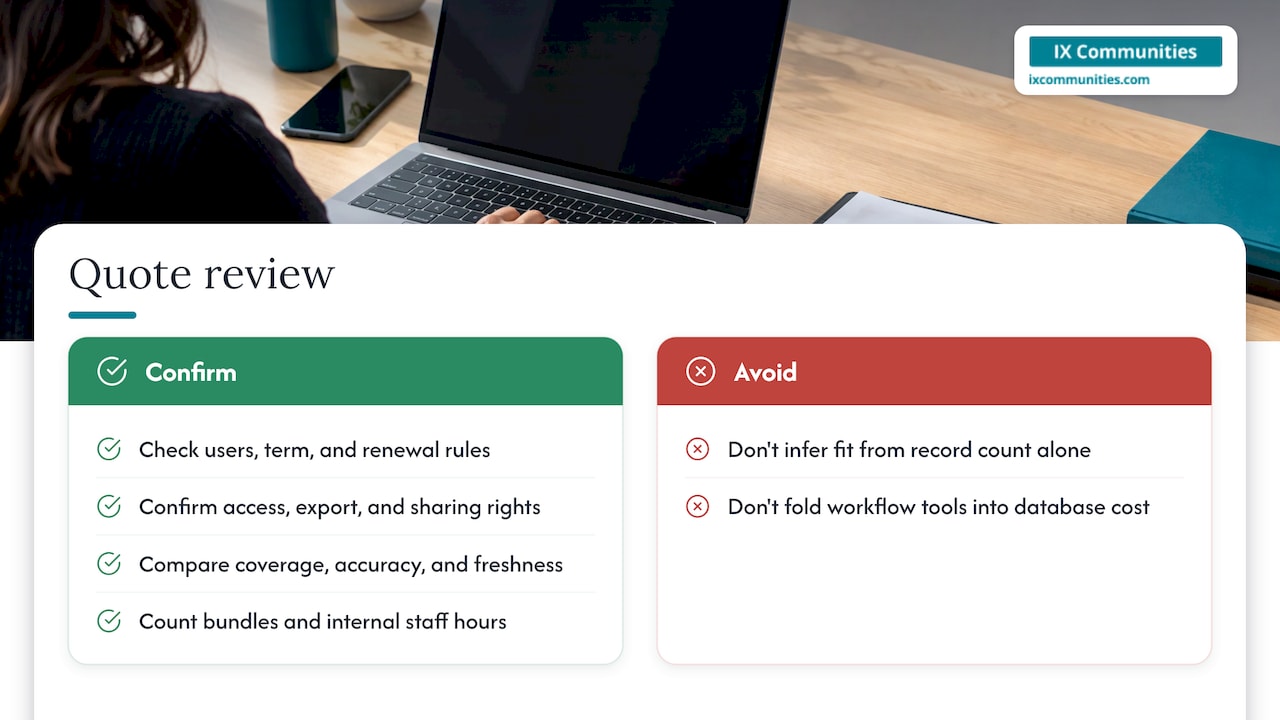
Number of users. A head of executive recruiting and two senior recruiters have different needs from a full global TA function. Confirm whether access is per person or per team.
Term and renewal. Annual terms are common. Ask how renewal pricing is set and whether the term is fixed or can be changed mid-year.
Access and export rights. Viewing records in a platform is different from exporting them. If the team wants to move data into an internal system or share it with hiring managers, confirm that this is allowed.
Coverage. Coverage, accuracy and freshness answer different questions. A larger count of records does not by itself show that the right consultants are included for your sectors and regions.
Bundled services. A database may come with community access, benchmarking, guest speakers or training. Count what is included so that the comparison is between the same things.
Internal time. Selecting a search partner costs recruiter and leader hours. A resource that shortens shortlisting reduces that cost even if the subscription is higher. Tools that manage the recruiting workflow around it, such as project management tools for recruitment, are a separate budget line and should not be folded into the database comparison.
Database cost versus search fees
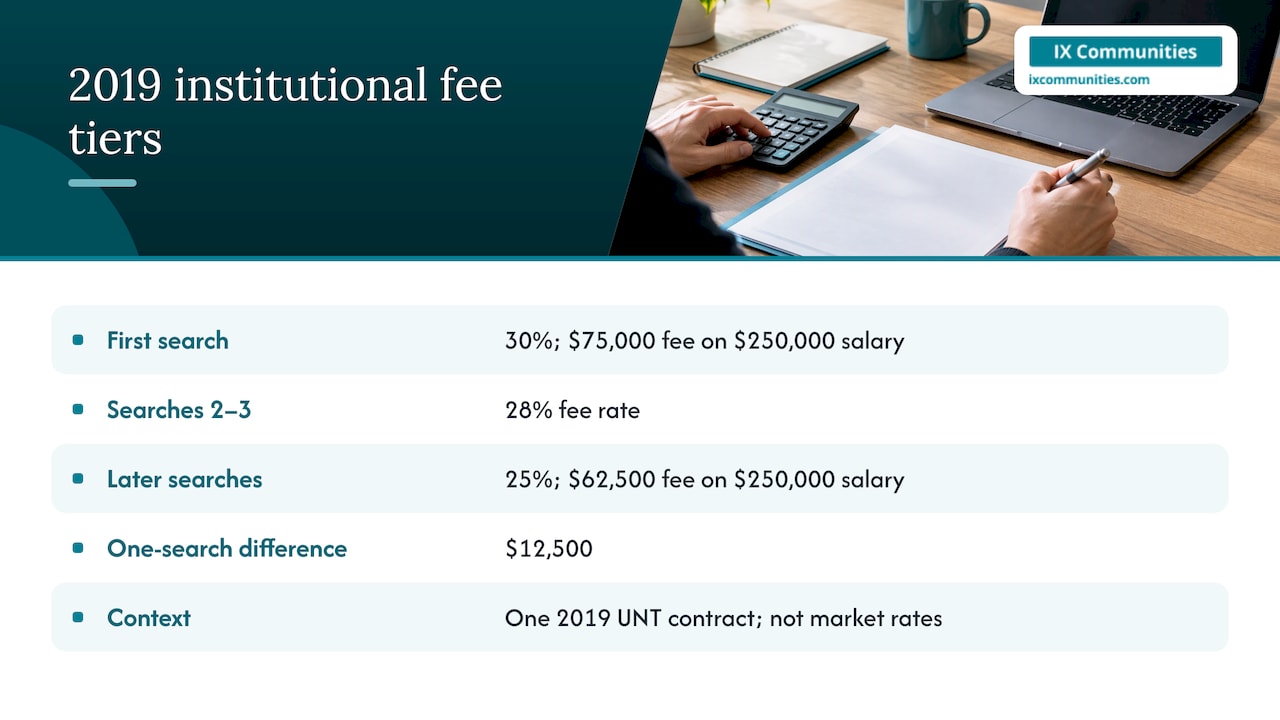
The database is a decision aid. The larger spend is the fee paid to the search firm that is chosen. A public example shows how those fees are built. A 2019 executive search vendor contract from the University of North Texas System lists one firm at 30% of the hired candidate's salary, with a minimum of 45,000 USD, for the first search in a year. The rate falls to 28% for the second and third searches and 25% for later ones. Fees are billed in installments, and travel, advertising and background checks are billed at actual cost.
That is one institutional schedule from 2019, not a market rate. It shows the structure: a percentage of first-year pay, a floor, volume tiers and pass-through expenses.
Worked example: a search for a role with a 250,000 USD salary at the 30% rate would carry a fee of 75,000 USD before expenses. At the 25% tier it would be 62,500 USD. A difference of 12,500 USD on one search is larger than the published price of a team course. Choosing the right firm and negotiating on informed terms therefore carries more financial weight than the cost of the reference resource itself.
How to compare quotes
Use the same checklist for every provider.
- Define the use case. Write down whether the aim is selecting search firms, sourcing candidates or both. Compare only like with like.
- List the users. Name the roles that need access now and those likely to need it within the term.
- Request the billing unit in writing. Seat, subscription, usage or rights tier, with the term and renewal terms.
- Confirm permitted use. Internal reference, export, sharing with hiring managers and storage in other systems.
- Review coverage against your hiring. Check the sectors, functions and regions where the team uses outside search.
- Check for vendor influence. Ask who supplies the data and whether it is shaped by firms that want to be selected. Peer-sourced information from corporate peers differs from information supplied by the firms themselves.
- Estimate time saved. Count the hours spent per search on shortlisting partners and compare with the annual cost.
Where training and benchmarking fit
Teams that build an in-house executive recruiting capability often pair the database with training. IX Academy courses are priced individually: 350 USD or more for on-demand, 750 USD or more for live online, and 3000 USD or more for a team intact course delivered to a whole group. A team intact course is a single session for an existing team, which keeps the cost fixed for the group rather than per participant.
The communities add peer benchmarking, mentorship and guest speaker sessions. IX Communities guest speakers are one of the member resources listed on the site.
Perspective
Our members are in-house leaders who choose and manage outside search firms. They ask us the same question each year: how do we know which firm to use for a given role?
We built the ExecSmart Database for that decision. It sits alongside communities that have no vendors in them. IX Communities has operated for nearly three decades, and our environment is exclusive to corporate recruiting leaders. Benchmarking is peer-sourced and confidential.
That separation from vendor influence is the reason we think the resource is worth the investment. A price is easy to compare. Whether the information was shaped by the firms being evaluated is harder to see, and it affects the outcome of a search that may carry a six-figure fee.
For leaders pricing the database, we suggest asking the questions in the checklist above of every provider, including us. Membership and database access are arranged directly, and the team can explain what is included for your function.
Simon
Next step for corporate teams
Heads of TA, executive recruiting and diversity recruiting who want to price ExecSmart Database access alongside a community membership can start on the IX Communities membership page. Team training is listed on the IX Academy page, with published starting prices.

FAQ
Is there a published price for the ExecSmart Database?
No. The ExecSmart Database has no published price. Access and terms are arranged through the IX Communities membership page. Teams should ask for the user count, term and permitted use to be stated in writing.
Is a search consultant database the same as a candidate database?
No. A search consultant database supports the choice of search firms and consultants. A candidate or people-data database returns profiles of individuals for sourcing. They are priced on different units, so their costs should not be compared directly.
What do IX Academy courses cost?
Published prices start at 350 USD for on-demand courses, 750 USD for live online courses and 3000 USD for team intact courses. Each is a one-off payment. Courses are open to members and non-members.
Who is IX Communities membership for?
Membership is for corporate talent and recruiting function heads at mid-size to large companies, such as heads of TA, Chief People Officers, Chief Talent Officers, and heads of executive or diversity recruiting. It is not designed for independent recruiters or job seekers.