

For reliable, defensible hires, use rubric-backed scorecards plus a short calibration exercise and a strict debrief protocol, not more interview rounds. Pilot this on one role family first: agree on a scorecard, run one 90-minute calibration session, and enforce that scores get submitted before any debrief begins. Peer benchmarking groups like IXCommunities, ESIX, and TLIX can supply templates and comparative norms to help teams start from tested material rather than a blank page.
TL;DR:
- Using tested scorecard templates and external benchmarks speeds up calibration and helps define clear thresholds for candidate evaluation.
- Conducting a 90-minute calibration session with independent scoring and anchored examples ensures consistent interpretation of competencies across interviewers.
- Automating scorecard submission within 30 minutes and tracking inter-rater reliability improves the objectivity and trustworthiness of evaluations.
- A 2-point or greater scoring gap on the same evidence indicates a calibration failure and warrants a review of rubric or evidence.
- Peer benchmarking groups like IXCommunities provide valuable data and facilitation to accelerate the adoption of calibrated, rubric-backed hiring practices.
Table of Contents
- What Scorecards and Rubrics Are, and Why You Need Both
- How Do You Build a Calibration Process Step by Step?
- What's the Right Debrief Protocol for Scoring Disagreements?
- What Do Effective Calibration Sessions Actually Look Like?
- How Do You Operationalize Calibration in Your ATS?
- Why Peer Benchmarking Speeds Up Calibration Adoption
- How IXCommunities Supports Scorecard Calibration
- Sources
- FAQ
What Scorecards and Rubrics Are, and Why You Need Both
A scorecard is the form an interviewer fills out for one candidate: the competencies being assessed, the score for each, and space for evidence. A rubric is the shared definition behind that form. It spells out what a "3" actually looks like for "stakeholder influence" versus what a "1" looks like, so two interviewers scoring the same answer land on the same number. Without a rubric, a scorecard is just a container for opinion dressed up as data.
Behavioral anchors are what make rubrics usable in practice. Instead of asking interviewers to rate "communication skills" from gut feeling, an anchored rubric ties each score to observable behavior, like whether the candidate quantified impact or named specific stakeholders they had to convince.
A few operational rules keep this from sprawling:
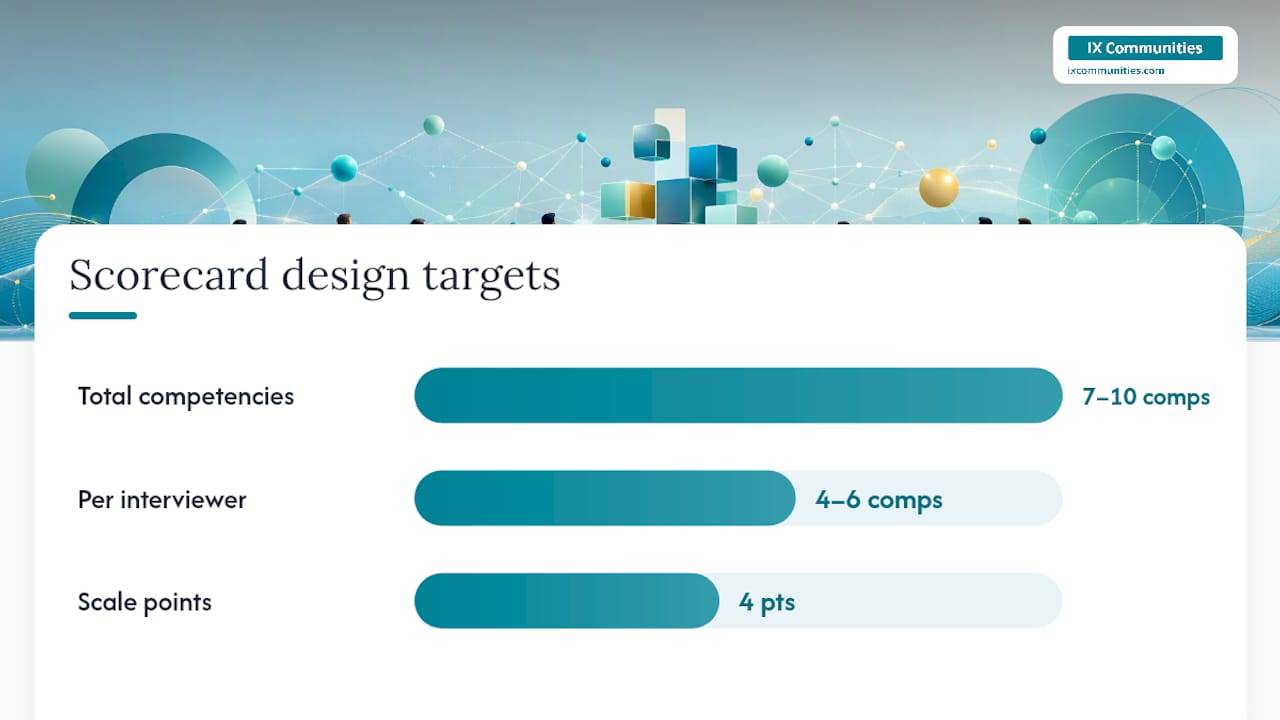
- Limit scorecards to 7 to 10 competencies total, with no more than 4 to 6 assessed by any single interviewer.
- Use a 4-point labeled scale (Strong Hire, Hire, No Hire, Strong No Hire) rather than a 5-point scale, since the extra midpoint invites indecisive clustering rather than sharper distinctions, according to interview scorecard guidance.
- Require a written evidence line for every score to ensure transparency and consistency.
Structured evaluations built this way aren't a nice-to-have layer on top of hiring. Companies using structured processes with defined criteria see a significant improvement in hire quality over unstructured interviewing.
How Do You Build a Calibration Process Step by Step?
Calibration fails most often because teams write a scorecard, hand it to interviewers, and assume shared understanding. It rarely happens automatically. Here's the sequence that actually gets a role family to consistent scoring:
- Design. Start from the outcomes the role needs to produce in its first year, not a generic competency library. Pick 7 to 10 competencies per scorecard and write one anchored example per rating level for each.
- Assign. Map each competency to a specific interviewer or interview stage. No two panelists should own the same competency unless you want a deliberate cross-check. Standardize the question bank so every candidate hears comparable prompts.
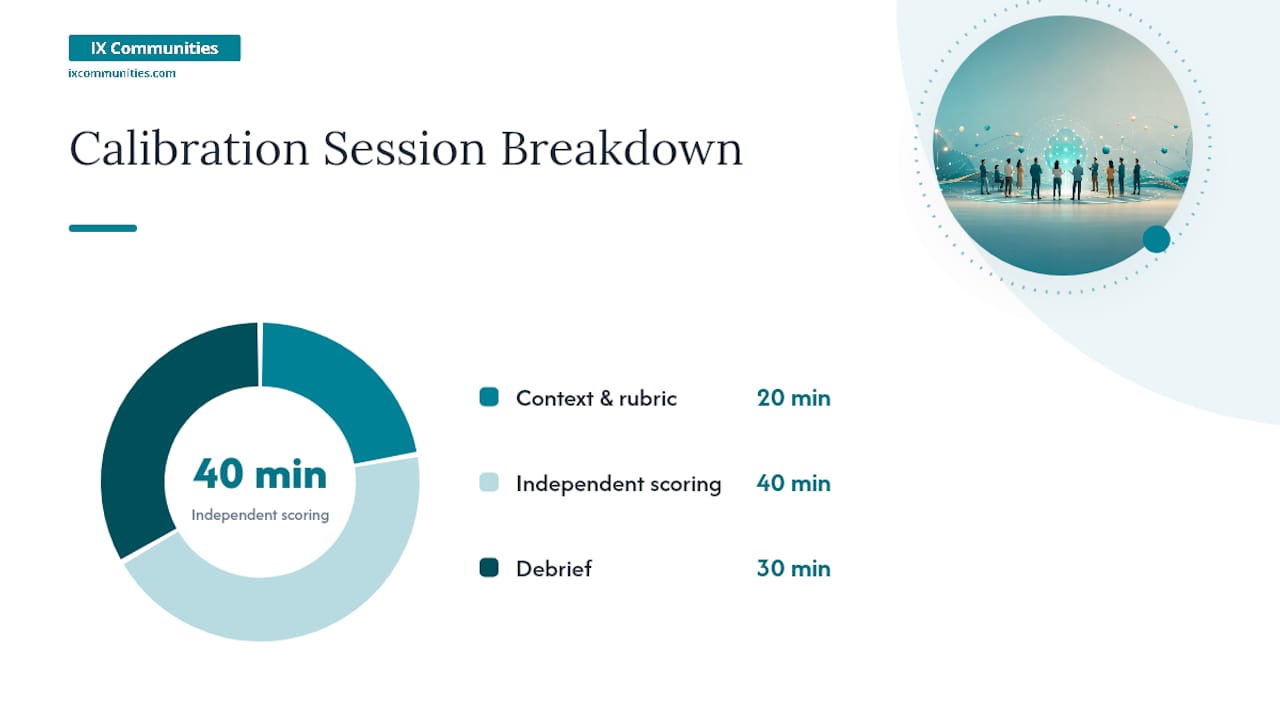
- Train. Run a 90-minute calibration session before the scorecard goes live: roughly 20 minutes on context and rubric walkthrough, 40 minutes of interviewers independently scoring the same recorded interview, and 30 minutes debriefing where those scores diverged, following the structured calibration agenda many TA teams now use as a baseline.
- Run. Scores get submitted before the group debrief starts. Where possible, interviewers score during or immediately after the call rather than at the end of a long interview day, when memory blurs between candidates.
- Verify. Review scorecard distributions quarterly, and run a 90-day post-hire check comparing scorecard predictions against actual performance ratings.
Pro Tip: Record one "gold standard" mock interview per role family and reuse it every time you onboard a new interviewer. It turns calibration from a one-time event into a repeatable five-minute check.
Skipping the training step is the most common shortcut, and it's the one that costs the most later. A scorecard without a shared rubric behind it just formalizes disagreement instead of resolving it.
What's the Right Debrief Protocol for Scoring Disagreements?
The debrief is where calibration either holds or collapses, and the sequence matters more than the discussion itself. Get the order wrong and the loudest voice in the room becomes the rubric.
- Every interviewer submits scores before the debrief opens. A recruiting coordinator compiles them beforehand and flags where panelists diverged.
- Walk through competencies one at a time, not candidate-by-candidate. Surface any gap of 2 or more points on a single competency first, since that's where the real signal is.
- Never average two extreme scores to split the difference. If one interviewer rates "problem solving" a 4 and another rates it a 1 on the same answer, that gap points to a rubric or evidence problem, not a middle ground.
- Publish minimum total scores and any knockout competencies before interviews start, not after scores come in, so the bar can't shift to fit a favored candidate.
Practitioners generally treat a 1-point gap between interviewers as normal variation, while a 2-point or larger gap on identical evidence is treated as a calibration failure worth investigating before the hiring decision moves forward. That distinction, gap size as a diagnostic rather than a nuisance, is what separates teams that improve their scorecards over time from teams that just argue their way to a decision every cycle.
What Do Effective Calibration Sessions Actually Look Like?
The 90-minute format works because it forces independent scoring before any group conversation contaminates it. Here's how to run one without reinventing the agenda each time:
- Context (20 minutes). Walk the group through the rubric, the anchored examples, and the role's actual performance outcomes. Skip the theory and go straight to what "good" looks like on the job.
- Independent scoring (40 minutes). Everyone scores the same recorded interview alone, no talking, no peeking at neighbors' forms. This is the step that reveals where interpretations actually diverge.
- Debrief practice (30 minutes). Compare scores competency by competency, following the same protocol you'll use in real debriefs, so interviewers practice the discipline before it counts.
Pick or build sample recordings where the candidate gives a mixed performance, strong on one competency and weak or ambiguous on another. A uniformly excellent or terrible sample teaches nothing about edge cases. When reviewing evidence notes, look for at least two lines per score: a paraphrase of what the candidate actually said, plus the behavioral inference drawn from it. Anything vaguer than that should get challenged.
Pro Tip: Recalibrate annually as a default, and immediately if quarterly audits show an interviewer consistently scoring at the extremes compared to their panel.
How Do You Operationalize Calibration in Your ATS?
Calibration only sticks when it's measurable, not just a training memory that fades after a few hiring cycles. Three metrics carry most of the weight.
- Inter-rater reliability: how closely independent scores on the same candidate or sample converge.
- Scorecard completion latency: how long after the interview the scorecard actually gets submitted.
- Post-hire validation: the correlation between scorecard scores and actual performance ratings at 90 days.
Realistic operational targets, drawn from practitioner guidance on effective scorecard structure, include submitting scorecards within 30 minutes of the interview ending and automatically flagging any inter-rater gap of 2 points or more for coordinator review.
| Metric | What it measures | Suggested target |
|---|---|---|
| Inter-rater reliability | Score agreement across panelists on same evidence | Gaps under 2 points on 90%+ of competency scores |
| Completion latency | Time from interview end to scorecard submission | Under 30 minutes |
| Post-hire validation | Correlation between scorecard score and 90-day performance rating | Reviewed quarterly per role family |
Push scorecards directly into the ATS rather than relying on side spreadsheets, and surface divergence flags on a shared dashboard so coordinators see them before the debrief rather than during it. Automating that handoff, similar to the workflow logic covered in this HR automation overview, removes the manual chasing that causes completion delays in the first place. Keep candidate evidence notes access-restricted; they're detailed enough to need the same handling as other sensitive personnel records. SHRM's guidance on data-driven recruiting makes a similar point: tracking metrics like time-to-hire and candidate quality only helps if the underlying data, in this case scorecard scores, is trustworthy to begin with.
Why Peer Benchmarking Speeds Up Calibration Adoption
Most TA teams underestimate how much time gets lost debating whether their thresholds are reasonable, because they're building rubrics in isolation. Peer benchmarking groups shortcut that debate. When a group of large employers has already tested a competency framework and shared how their score distributions actually look, a new rubric stops being a guess and starts being a calibrated instrument from day one.
The bigger shift is political, not technical. A pilot backed by external benchmark data gets hiring manager buy-in faster than the same pilot presented as an internal HR initiative, because the thresholds carry outside validation instead of one team's opinion.
— Simon
How IXCommunities Supports Scorecard Calibration
Building a calibrated scorecard from scratch, then defending its thresholds to skeptical hiring managers, is slower without outside reference points. Peer communities provide benchmark reports showing how peer organizations structure competencies and score distributions, facilitated calibration workshops, and facilitator guides that turn a 90-minute session into a repeatable program instead of a one-off event.

Membership tends to fit teams running enough hiring volume that inconsistent scoring actually shows up in outcomes, and that want peer data to set defensible knockout scores rather than internal guesses. If that's where your team is, visit the IXCommunities landing page to request a benchmarking session or workshop for your next role family rollout.
Sources
- Interview Scorecards vs Rubrics: 5-Step Guide (2026)
- SHRM: Complete guide to effective recruiting
- Metaview: create effective interview scorecards
FAQ
What Is the Difference Between a Scorecard and a Rubric?
A scorecard is the form an interviewer completes for one candidate. A rubric is the shared standard behind it that defines what each score actually means, so different interviewers rate the same answer consistently.
How Long Should a Scorecard Calibration Session Take?
A single 90-minute session works well: roughly 20 minutes on rubric context, 40 minutes of independent scoring on the same sample recording, and 30 minutes practicing the debrief protocol.
How Many Competencies Should One Scorecard Include?
Cap the full scorecard at 7 to 10 competencies, with no single interviewer responsible for more than 4 to 6 of them.
What Score Gap Between Interviewers Should Trigger Review?
A 1-point gap is generally normal variation. A gap of 2 points or more on the same evidence should trigger a rubric or evidence review rather than an averaged score.
Where Can TA Teams Get Scorecard Templates and Benchmarks?
Peer communities such as IXCommunities, ESIX, and TLIX provide tested scorecard templates, anonymized benchmark distributions, and facilitated calibration workshops for large corporate recruiting teams.