

Recruitment marketing strategy is the practice of applying marketing discipline, funnel stages, audience segmentation, content, and measurement, to attract and warm up candidates before a role opens. The primary outcome is a stronger, faster pipeline: candidates already know your employer brand and have engaged with your content by the time a requisition posts. Companies that do this well see lower cost per qualified applicant, shorter time-to-pipeline, and higher offer-acceptance rates because candidates arrive pre-sold on the role.
This matters more than most talent leaders assume. A majority of job candidates rank employer brand as the deciding factor when applying for a job, according to SHRM-hosted research on recruitment marketing. Peer benchmarking through groups like Ixcommunities gives talent leaders a way to validate their targets against comparable organizations instead of guessing.
A functioning recruitment marketing plan delivers on three fronts:
- Lower cost per qualified applicant, because candidates self-select before applying
- Faster time-to-pipeline for hard-to-fill or recurring roles
- Higher offer-acceptance rates, since candidates already understand the role and culture
Key Takeaways
A recruitment marketing strategy succeeds when role-specific EVPs, persona-driven channel choices, and disciplined weekly measurement work together rather than in isolation.
| Point | Details |
|---|---|
| Define the outcome first | Set measurable targets for cost per qualified applicant, time-to-pipeline, and offer-acceptance before choosing channels. |
| Build personas from data you already have | Triangulate top performers, silver-medal candidate surveys, and ATS-source analytics instead of commissioning new research. |
| Fix attribution before scaling spend | Tag every campaign source at first touch since many companies do not measure recruitment marketing ROI properly. |
| Diversify channels by persona | Avoid single-channel reliance; niche communities often outperform generic platforms for specialized roles. |
| Benchmark against peers, not guesses | Ixcommunities gives talent leaders peer data to validate KPI targets and shortcut planning through its benchmarking and training programs. |
Table of Contents
- What Is a Recruitment Marketing Strategy?
- What Are the Building Blocks of a Recruitment Marketing Plan?
- How Do You Build a Recruitment Marketing Strategy Step by Step?
- Which Channels and Tactics Actually Work?
- What Content Should You Publish and How Often?
- How Do You Measure Recruitment Marketing Performance?
- What Mistakes Undermine Recruitment Marketing Programs?
- How Does Peer Benchmarking Strengthen a Recruitment Marketing Strategy?
- What Compliance and Ethics Issues Should Recruitment Marketing Address?
- What Trends and Challenges Are Shaping Recruitment Marketing Now?
- How Should You Budget and Allocate Resources for Recruitment Marketing?
- How Is Technology and Automation Changing Recruitment Marketing?
- What's the Real Lesson Behind Successful Recruitment Marketing for Talent Teams?
- How Can Ixcommunities Help You Build a Recruitment Marketing Strategy Faster?
- Sources
What Is a Recruitment Marketing Strategy?
A recruitment marketing strategy is the deliberate use of marketing methods, audience segmentation, content, channels, and nurture, to build candidate demand ahead of open requisitions. It treats hiring as a pipeline problem rather than a posting problem. Traditional recruiting waits for a job to open, writes a posting, and starts sourcing. Recruitment marketing builds awareness and interest continuously, so the pipeline already exists when the requisition lands.
The model rests on a funnel with five stages, and each one has a distinct job to do:
- Awareness — candidates encounter your employer brand through content, ads, or word of mouth, often with no active job search underway
- Interest — candidates engage with specific content (a culture video, a role page, an employee story) and start forming an opinion
- Consideration — candidates compare your opportunity against alternatives, often researching Glassdoor reviews or talking to current employees
- Application — candidates convert, and friction here (a clunky application form, unclear next steps) kills conversion fast
- Hire — the candidate accepts an offer, and the experience they had through the funnel affects whether they stay
This staged model, described in detail by Serendi's recruitment marketing guide, is what separates a marketing approach from a posting approach. Recruitment marketing activates your employer value proposition (EVP) and employer brand at every stage rather than treating them as a static careers page nobody reads.
The distinction between employer branding and recruitment marketing trips people up. Employer branding is the reputation and promise. Recruitment marketing is the operational machine, campaigns, content, channels, and nurture sequences, that puts that promise in front of the right candidates at the right time. You cannot run recruitment marketing without an EVP to communicate, but having an EVP with no distribution plan is just a document nobody sees.
This work rarely sits with one team alone. It usually spans TA, employer branding or communications, and sometimes a dedicated marketing function borrowed from the CMO's org. The most effective setups have a single owner for the recruitment marketing plan, with recruiters feeding persona and objection data upward and marketing supplying production and channel expertise.
What Are the Building Blocks of a Recruitment Marketing Plan?
Before any campaign work starts, six components need to exist in some form, even a rough one. Skipping straight to channel selection without these is the most common reason programs stall.
- Role-specific EVPs. A single corporate EVP flattens what actually motivates different candidates. Engineers care about tech stack and autonomy; sales candidates care about comp structure and ramp support. Serendi's guide notes that role-specific EVPs consistently outperform one generic message because each version maps to the audience's top motivator instead of a lowest-common-denominator pitch.
- Candidate personas built from real data. The strongest personas come from triangulating three sources: interviews with top performers already in-role, post-interview surveys with your silver-medal candidates, and ATS-source analytics showing where your best hires actually came from, a method detailed by Lever's recruitment marketing guide.
- Channel mix mapped to funnel stage. Awareness channels (social, programmatic display) differ from application-stage channels (career site, direct outreach). Choosing channels by persona behavior, not by habit, is what makes the mix work.
- Content built for each stage, not one generic "why work here" page repurposed everywhere.
- Nurture sequences that keep warm candidates engaged between first touch and an open role, often through a talent community or a simple email cadence.
- A measurement rhythm with clear ownership, so someone actually reviews the KPIs weekly rather than quarterly.
Pro Tip: Build your first-round personas from exit interviews with candidates who declined offers. Rejection reasons reveal more about your EVP gaps than acceptance reasons do.
Channel selection deserves its own scrutiny here. Every channel choice should be justified by where a specific persona actually spends time and how they behave at that funnel stage, a principle Lever's team emphasizes repeatedly: LinkedIn is not the default answer for every role, and niche communities frequently outperform generic platforms for specialized technical or clinical hiring.

ATS integration closes the loop. Without tagging campaign source at the point of application, none of the downstream KPI work is trustworthy. Set this up before launch, not after the first report is due.
How Do You Build a Recruitment Marketing Strategy Step by Step?
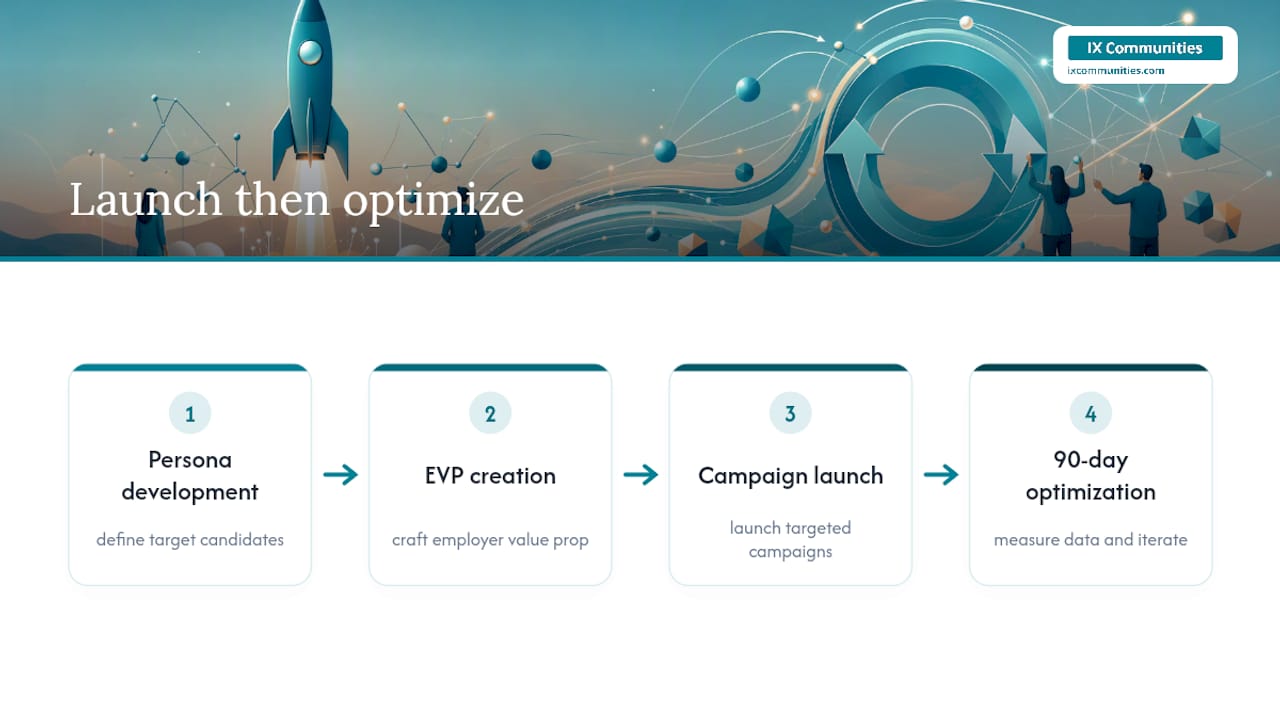
Most programs fail not from lack of ideas but from skipping the sequencing. Here's the order that actually works, broken into a launch phase and a 90-day optimization window.
Phase one: build the foundation (weeks 1 to 3)
- Set measurable goals. Define what success looks like in numbers: target cost per qualified applicant, target time-to-pipeline for priority roles, target offer-acceptance rate. Vague goals like "improve employer brand" produce vague results.
- Build 2 to 4 personas fast. Pull from existing hire data, exit interviews, and recruiter notes rather than commissioning new research. A rough persona built this week beats a perfect one built in a month.
- Draft role-specific EVPs and messaging pillars. Write three to four pillars per role family (engineering, sales, operations) grounded in what actually motivated your last five accepted offers in that family.
- Map channels to personas and stages, then set initial budgets. Decide which channels serve awareness versus application for each persona, and allocate a starting budget you're willing to revise after 30 days.
Phase two: launch (weeks 3 to 5)
- Build a content calendar and launch supporting landing pages or role hubs. Even a single well-built role hub per job family, with video, employee quotes, and clear next steps, outperforms a generic careers page split across dozens of postings.
- Integrate tracking into your ATS and marketing systems. Tag every campaign with a source code before the first candidate applies. Retrofitting attribution after launch is far harder than building it in.
Phase three: run and optimize (weeks 5 to 13)
- Hold weekly operational checks. A 20-minute weekly review of five KPIs, applications by source, cost per qualified applicant, funnel drop-off by stage, keeps small problems from becoming missed quarterly hiring targets. This weekly rhythm is one of the most consistently cited practices in operational reviews, according to Aristek Consulting's recruitment marketing framework.
- Run a structured 30/60/90 plan:
- Day 30: Review channel performance by persona; kill or reallocate budget from underperforming channels.
- Day 60: Test at least one new content format (video testimonial, employee takeover) based on what engaged candidates most in month one.
- Day 90: Compare cost per qualified applicant and time-to-pipeline against your original targets; adjust the following quarter's budget allocation accordingly.
Pro Tip: Run inbound and outbound activation in parallel from day one rather than sequencing them. Outbound sourcing gives you pipeline immediately while inbound content compounds and lowers cost per hire over time, a structure Serendi's guide recommends for exactly this reason.
Don't wait for a perfect persona or a finished EVP deck before launching something. The teams that get stuck are usually the ones trying to perfect phase one instead of getting into market and adjusting with real data.
Which Channels and Tactics Actually Work?
Channel choice should follow persona and funnel stage, not habit or what a competitor is doing. A senior engineering candidate at the consideration stage behaves nothing like an entry-level operations candidate at the awareness stage, and treating them the same wastes budget on both sides.
- Allocate paid budget toward the top and bottom of the funnel, awareness ads for brand reach, and application-stage retargeting for candidates who visited a role page but didn't convert. Owned content (your career site, employee blog, talent community) carries the middle of the funnel more efficiently.
- Use programmatic advertising for volume roles with clear cost targets. Programmatic can optimize spend automatically once you've set a target cost per application or cost per qualified application, according to Adway's step-by-step playbook, but it performs poorly without that target set up front.
- Lean on employee amplification and referrals. Employee-generated content and referral programs are consistently the highest-leverage, lowest-cost channel for both awareness and pipeline quality, a point echoed across Toggl's recruitment campaign research.
- Go where the specialists already gather for technical or niche roles. A data science candidate is more likely to notice a targeted post in a specialized Slack community or a conference sponsorship than a generic LinkedIn ad. This is where content built around employee stories and workplace culture tends to outperform standard job ads for technical hiring.
- Treat your career site as a content asset, not a form. Role hub pages that rank organically for "[job title] at [company]" searches capture candidates already close to applying, and small SEO fixes, clear job titles, structured data, fast load times, compound over months.
- Build an InMail or personalized outreach checklist for outbound sourcing: reference something specific about the candidate's background, lead with what the role solves rather than a title, keep the first message under 100 words, and always name a clear next step.
Pro Tip: Test one low-budget, high-creativity campaign per quarter, an employee takeover video, a targeted local event, before committing to a bigger paid spend. Creative, low-budget campaigns can meaningfully lift both awareness and candidate quality without a large budget commitment, per Toggl's research on recruitment campaigns.
Don't run a single-channel strategy even if one channel is currently converting well. Diversifying two or three channels per persona protects you when platform algorithms shift or costs spike, and it gives you real comparison data for the next planning cycle.
What Content Should You Publish and How Often?
Content mix should follow a rough ratio rather than an even split across categories, since not every content type carries equal weight for candidate decision-making. A workable starting distribution, drawn from practitioner benchmarks, is culture content at roughly 40%, thought leadership at 25%, career-opportunity content at 20%, and social proof at 15%, according to a 2026 recruitment marketing guide. Culture content dominates because it does the heaviest lifting at the awareness and interest stages, where candidates are forming a first impression.
- Culture content: short employee-day-in-the-life videos, team photos, behind-the-scenes posts. Cheap to produce, high engagement.
- Thought leadership: posts or interviews from hiring managers on industry trends, positions your company as a place where smart people work.
- Career-opportunity content: role hub pages, "what you'll actually do" breakdowns, salary transparency where legally required.
- Social proof: Glassdoor highlights, employee testimonial clips, awards or certifications.
A simple monthly calendar might run two culture posts per week, one thought-leadership piece every two weeks, one role hub refresh per month, and one social-proof asset every two weeks. Repurpose aggressively: one 90-second employee interview becomes a LinkedIn clip, a career-site testimonial, and three social captions.
Build an employee-share playbook alongside the calendar: pre-write two or three caption options per post, tag employees who opted in to amplify, and track which employees consistently drive the highest engagement so you can invite them into future content.
| Point | Details |
|---|---|
| Content ratio | Aim for roughly 40% culture, 25% thought leadership, 20% opportunity, 15% social proof. |
| Repurpose everything | Turn one video asset into clips, captions, and a testimonial page instead of producing new content each time. |
| Refresh role hubs monthly | Update role-specific landing pages at least once a month to keep SEO signals and content current. |
How Do You Measure Recruitment Marketing Performance?
Only some companies measure recruitment marketing ROI properly, according to the same 2026 guide, which means most teams are running campaigns without knowing which ones actually work. That gap is the single biggest reason budgets get cut during downturns: nobody can prove the spend produced hires.
A tiered KPI structure fixes this. Track a small number of metrics at each funnel stage rather than dozens of vanity numbers:
| Funnel tier | Example KPI | What it tells you |
|---|---|---|
| Awareness | Impressions, reach, career-site traffic | Whether your brand is visible to the right audience |
| Engagement | Click-through rate, time on role page | Whether content resonates once seen |
| Pipeline | Impression-to-application rate, applicants per source | Whether interest converts to action |
| Quality | Cost per qualified applicant, interview-to-offer ratio | Whether the pipeline is actually hire-ready |
| Efficiency | Time-to-pipeline, cost per hire | Whether the whole system is getting faster or cheaper |
Two calculations matter most. Cost per qualified applicant is total campaign spend divided by the number of applicants who pass initial screening, not total applicants, which filters out noise from low-quality volume. Impression-to-application rate is total applications divided by total impressions, and tracking it by channel tells you fast which channels are burning budget on visibility without converting.
ATS integration is what makes any of this trustworthy. Tag every campaign with a source parameter at first touch, and audit monthly that the tags are actually flowing through to hire data, not just application data. Attribution breaks most often at the handoff between marketing platform and ATS, so build a monthly reconciliation check rather than assuming the pipes stay connected.
Run weekly operational reviews on the pipeline and quality tiers, and reserve monthly reviews for the efficiency tier and budget reallocation decisions. Weekly reviews catch a broken landing page or a stalled campaign before it costs a full month of spend.
What Mistakes Undermine Recruitment Marketing Programs?
Most failed programs share a small set of root causes, and every one of them is fixable within a quarter once identified.
- No personas, generic messaging for every role. Fix: build rough personas from existing hire data before writing another job ad.
- Over-indexing on vanity metrics like impressions or follower growth instead of pipeline quality. Fix: replace top-line dashboard metrics with cost per qualified applicant and time-to-pipeline.
- Single-channel reliance, usually LinkedIn, because it's familiar rather than because it performs best for every persona. Fix: test one alternative channel per persona each quarter.
- Poor ATS integration or missing attribution, which makes every other metric unreliable. Fix: audit source tagging monthly, not annually.
- Treating the careers page as a static asset instead of a content property that needs regular refreshes. Fix: assign ownership and a monthly update cadence.
The common thread across all five is a lack of a feedback loop. Programs that review data weekly catch these issues in month one. Programs that review quarterly often don't notice until the hiring targets are already missed.
How Does Peer Benchmarking Strengthen a Recruitment Marketing Strategy?
Building a recruitment marketing plan in isolation means guessing at what "good" looks like. Peer benchmarking solves that by giving talent leaders real comparison points from organizations facing the same hiring pressures. Ixcommunities operates as a peer network for corporate talent acquisition, executive recruiting, and diversity recruiting leaders specifically, giving members access to benchmarking reports, mentorship, expert guest sessions, and a search consultant database rather than generic industry surveys.
The value shows up most clearly in target-setting. A talent leader planning next year's cost-per-qualified-applicant target has two options: pick a number from a vendor's marketing page, or compare notes with peers running similar-sized programs in similar labor markets. The second option produces targets that hold up under scrutiny.
Peer benchmarking works because it replaces assumption with comparison. A cost-per-hire target set against five peer organizations in your sector carries far more credibility with finance than a number pulled from a single vendor report.
Members use these comparisons to sanity-check budget requests, validate channel mix decisions before committing spend, and shortcut the trial-and-error most teams go through building a program from scratch.
What Compliance and Ethics Issues Should Recruitment Marketing Address?
Recruitment marketing content sits close to employment law in ways general marketing doesn't. Job ads and role content must avoid language that implies preference based on protected characteristics, age, gender, disability status, national origin, even unintentionally. A phrase like "looking for recent graduates" can read as age discrimination in some jurisdictions.
Pay transparency requirements now apply in a growing number of U.S. states and cities, and role hub pages need to reflect whatever disclosure rules apply where the role is based, not a single national default. Check current requirements with legal counsel before publishing salary ranges broadly, since rules vary significantly by location.
Employee-generated content raises a separate set of questions. Get explicit consent before featuring an employee's name, image, or quote in recruitment content, and give employees the ability to opt out later without friction. This matters doubly for testimonials and video content, which tend to circulate long after an employee has left the company.
Targeting decisions in paid channels deserve scrutiny too. Programmatic and social platforms allow granular audience targeting that can inadvertently exclude protected groups from seeing job ads at all, a risk that has drawn regulatory attention in several ad platforms. Review targeting parameters periodically with whoever owns compliance, not just with the marketing team running the campaign.
What Trends and Challenges Are Shaping Recruitment Marketing Now?
Budget scrutiny is the dominant pressure across most talent organizations right now. Finance leaders are asking TA teams to prove recruitment marketing spend converts to hires, which is exactly why the measurement gap matters: teams that built attribution early are defending their budgets with data, and teams that didn't are defending them with anecdotes.
AI-assisted content production is changing how fast teams can build role-specific messaging. Drafting first-pass EVP language, generating job description variants, and personalizing outreach at scale are all faster than they were even two years ago, though the output still needs a human edit pass to sound like your actual employees rather than a generic template.
Candidate expectations around transparency have risen sharply. Pay range disclosure, honest culture content instead of stock photography, and responsive communication throughout the process now function as baseline expectations rather than differentiators, particularly among younger candidates comparing multiple offers.
Talent communities and nurture programs are getting more attention as inbound costs stay volatile. Rather than starting from zero every time a role opens, more mid and large companies are building standing communities of warm candidates they can activate quickly, reducing dependence on expensive last-minute paid campaigns.
The consistent challenge underneath all of this: recruitment marketing still competes for budget and headcount against demand generation and brand marketing inside most organizations, and TA teams that can't show a clear KPI trail lose that competition regularly.
How Should You Budget and Allocate Resources for Recruitment Marketing?
Budget allocation should follow funnel stage and role priority, not an even split across categories. A reasonable starting framework allocates the largest share to owned content production (career site, video, role hubs) since that asset compounds over time, followed by paid awareness and application-stage retargeting, with a smaller reserved amount for experimentation.
Headcount matters as much as media budget. A program with strong content but no one dedicated to weekly reporting and channel optimization will drift within a quarter. Mid-size programs typically need at least a fractional content producer and a dedicated analyst reviewing KPIs, even if that analyst role is shared with broader TA operations.
Prioritize budget toward roles with the highest hiring volume or the longest time-to-fill first, since that's where the return on a warmed pipeline shows up fastest. A role that fills in ten days from a strong applicant pool doesn't need the same nurture investment as one that's been open for four months.
Reserve 10 to 15% of the working budget for quarterly experiments, a new channel test, a creative format trial, rather than committing the entire budget to proven channels. Programs that never experiment plateau once their initial channel mix saturates.
How Is Technology and Automation Changing Recruitment Marketing?
ATS platforms, programmatic ad tools, and content management systems now integrate closely enough that source-level attribution is achievable for most mid-size TA teams, something that required custom engineering just a few years ago. The technical barrier has dropped; the operational discipline to actually configure and audit that integration is now the bigger gap.
Automation helps most with the repetitive parts of the funnel: automated nurture emails to talent community members, programmatic bid adjustment toward roles with the highest cost-per-qualified-applicant targets, and chatbot-assisted first-round screening on career sites. None of this replaces the strategic work of building personas and EVPs, but it frees up recruiter time for higher-value conversations.
The risk with automation is treating it as a substitute for strategy rather than an accelerant. A well-configured programmatic campaign against a poorly defined persona still wastes budget efficiently. Set the strategic inputs, the persona, the EVP, the funnel mapping, before layering automation on top, not the other way around.
What's the Real Lesson Behind Successful Recruitment Marketing for Talent Teams?
The conventional advice treats recruitment marketing as a content and channel problem: publish more, post more, spend more on ads. That misses where programs actually break. The teams that succeed treat it as a measurement and attribution problem first, and a content problem second.
Here's what gets underweighted: most organizations already have enough raw material, employee stories, exit interview data, ATS analytics, to build workable personas and EVPs this month, without commissioning new research. What they lack is the discipline to tag campaigns properly and review a short KPI set weekly. That's not a creative gap. It's an operational one.
Prioritize the boring infrastructure first: source tagging, a weekly review rhythm, role-specific EVPs built from data you already have. Content and channel experiments matter, but they only produce usable signal once you can actually measure what's working. Skip that step and you're just spending faster, not smarter.
— Simon
How Can Ixcommunities Help You Build a Recruitment Marketing Strategy Faster?
Building the framework described above from scratch, personas, role EVPs, a measurement rhythm, takes most TA teams months of trial and error to get right. Ixcommunities shortens that timeline by giving talent leaders direct access to peer benchmarking data instead of building targets from guesswork alone.
Membership includes secure peer communities where members compare recruitment marketing benchmarks with organizations facing similar hiring conditions, mentorship programs, market benchmarking reports, expert guest speaker sessions, a proprietary search consultant database, and recruiter training courses covering the exact playbook elements outlined in this article. Instead of setting a cost-per-qualified-applicant target off a vendor blog post, members validate it against real peer data from comparable talent organizations, which shortens planning cycles and gives finance a more defensible number.
If you're heading into a planning cycle and need realistic KPI targets or a faster way to build role-specific EVPs, explore Ixcommunities membership to see what peer benchmarking and training options fit your team.