

A recruiting playbook template is a repeatable, role-specific system that runs a hire from intake to onboarding on a fixed set of documented steps. Used consistently, it shortens time-to-fill, keeps interview decisions on the same criteria across panels, and gives talent acquisition leaders and hiring managers a shared record they can measure and improve. The immediate step is simple: pick or build a one-page scorecard and sourcing plan before adding anything more complex.
TL;DR:
- Prioritizing the accuracy of the role scorecard and sourcing plan before adding complexity delivers the most significant early improvements in recruiting efficiency.
- Assigning a dedicated owner for the playbook's version control and reviewing it regularly is essential to avoid outdated or inconsistent hiring processes.
- The most common mistakes include overloading scorecards with competencies, skipping scheduled debriefs, and neglecting to adapt the playbook to changing market conditions.
- Built-in DEI considerations should be integrated into sourcing, interview scoring, and compliance fields from the start, not added later as an afterthought.
- Benchmarking key hiring metrics against similar organizations helps set realistic goals and prevents inefficiencies caused by inaccurate industry comparisons.
Table of Contents
- What Is a Recruiting Playbook Template, and What Belongs in It?
- How Do You Adapt and Run a Recruiting Playbook Template?
- Copyable Templates and a Quick-Start Checklist
- Measure, Iterate, and Govern the Playbook Over Time
- Roundtable Notes: What Practitioners Actually Get Wrong
- Customizing the Playbook for Company Size and Industry
- Who Owns What: Recruiter, Hiring Manager, and HR Roles
- Building DEI Into the Playbook Instead of Bolting It On
- Common Pitfalls That Undermine a Recruiting Playbook
- Why Most Playbooks Fail Before They Ever Get Used
- Get Peer Benchmarks Before You Finalize Your Playbook
- Sources
What Is a Recruiting Playbook Template, and What Belongs in It?
A recruiting playbook template is not a policy binder. It is an operating document, closer to a hiring strategy guide than a compliance manual, and it works only when every section connects to a decision someone will actually make during the search. The strongest templates share six components, and skipping any one of them tends to show up later as a missed deadline or a mismatched hire.
- Role definition and 90-day success scorecard. List the three to five outcomes the hire must produce in their first quarter, weighted by importance, not just a list of duties.
- Headcount forecast tied to business outcomes. Every requisition should trace back to a revenue target, a project deadline, or a retention gap, not a vague sense that "the team is stretched."
- Sourcing plan with channels, owners, and budgets. Name who is responsible for each channel and what volume of qualified candidates they're expected to produce in the first two weeks.
- Screening and interview structure with numeric scorecards. Fields like "Communication (1 to 5)" or "Domain expertise (weighted 30%)" replace gut-feel debriefs with comparable data.
- Offer strategy and onboarding handoff checklist. Pre-approved salary bands and a clear list of what recruiting hands to HR and the hiring manager at offer acceptance.
- Data and compliance fields. An EEO tracking note and a candidate-data handling statement belong in the template itself, not in a separate policy nobody opens.
A recruitment plan example from Manatal breaks down these same fields with sample entries, which is useful if you're building your first version rather than adapting an existing one. Getting the role scorecard and sourcing plan right before layering on more structure produces the biggest early gain, according to Manatal's own template guidance. Everything else compounds from there.
How Do You Adapt and Run a Recruiting Playbook Template?
A template only earns its name once it's been run through a live search. Here's the sequence that keeps a hiring team from stalling between steps, adapted from staffing process templates used across mid-size and enterprise teams.
- Run an intake session and align on the business case. Get the hiring manager, a recruiter, and whoever signs off on budget in one meeting. Separate must-haves from nice-to-haves in writing, because this is where scope creep starts if it isn't stopped early.
- Populate the role scorecard and lock the budget and timeline. No sourcing starts until the scorecard has weighted criteria and a target close date attached.
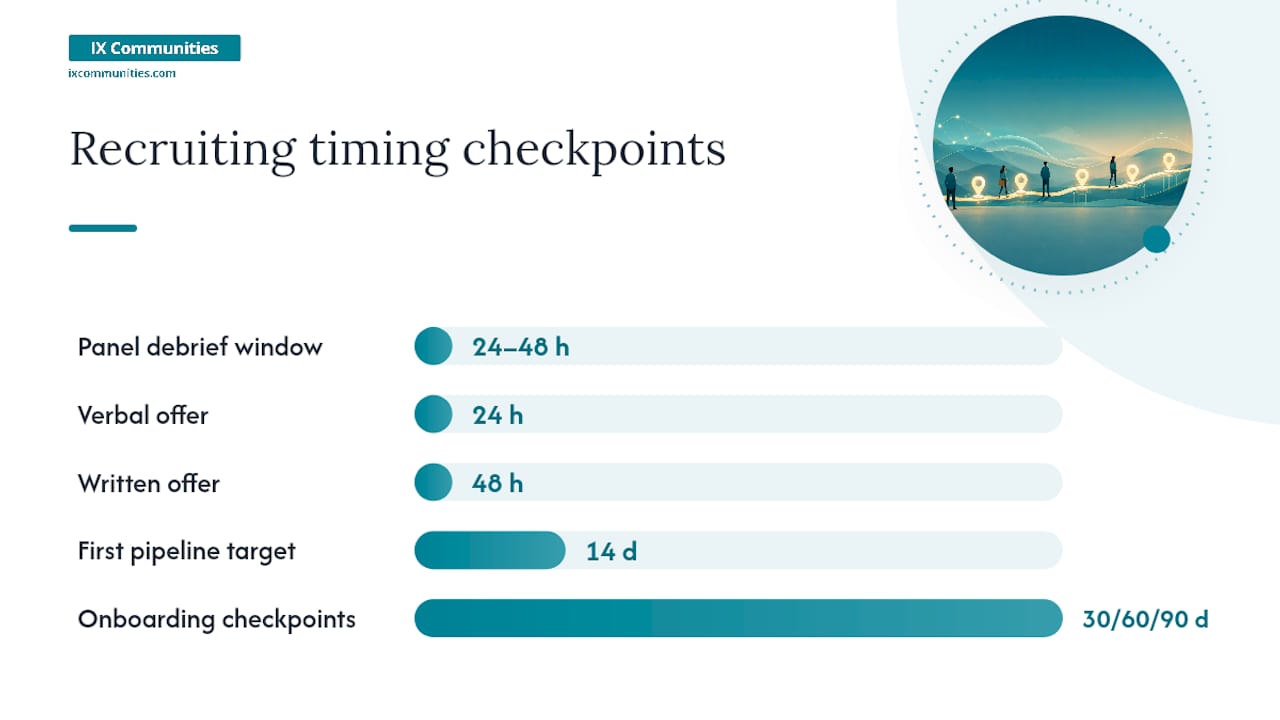
- Launch sourcing and set a first-14-day pipeline target. A reasonable benchmark is several qualified candidates in the pipeline within the first two weeks, adjusted for role seniority and market scarcity.
- Screen against the calibrated scorecard. Every interviewer scores the same fields, so a debrief compares numbers instead of impressions.
- Hold panel debriefs within 24 to 48 hours of the last interview. Waiting longer than that lets memory drift and lets your best candidate accept somewhere else.
- Apply decision rules and move through the offer cadence. Verbal offer within 24 hours of the final decision, written offer within 48, with the approved range already signed off in step 2.
- Hand off to onboarding with a 30/60/90 success plan. This is where the recruiting playbook template becomes an employee onboarding playbook. If there's no handoff checklist, the new hire's first month runs on improvisation.
Pro Tip: Build the panel debrief window into your calendar invites before the search even starts. Teams that schedule the debrief in advance close roles days faster than teams that try to find time after the fact.
A 7-step hiring plan framework from Prepzo covers a similar checkpoint structure if you want a second reference point for sequencing. The step that gets skipped most often is the panel debrief window, and it's usually the one that costs the most when it's missing.
Copyable Templates and a Quick-Start Checklist
You don't need custom software to run this. A spreadsheet, a Notion page, or your existing applicant tracking system will hold every field below.
- One-page job scorecard fields: role title, reports to, three weighted outcomes (e.g., "Close 15 enterprise deals in year one, weight 40%"), must-have skills, nice-to-have skills, approved salary band.
- Sourcing plan table: columns for channel (referral, LinkedIn, agency, community database), owner, weekly budget, and week-one candidate target.
- Interview scorecard rubric: competencies listed down the left (technical skill, collaboration, problem-solving), weights across the top, and a 1 to 5 numeric field for each interviewer to fill during the debrief, not after.
- Hiring timeline checklist: intake date, sourcing launch, first pipeline review, interview loop dates, target offer date, and onboarding kickoff, each with a named owner.
The Notion recruitment playbook template is a common quick-start format because it lets recruiters and hiring managers edit the same live document instead of emailing spreadsheet versions back and forth. If your search involves a hiring event rather than a single role, the Radancy hiring-event playbook adds sections for event objectives, promotion plans, and floor capacity that a standard role-based template doesn't need. Treat it as a variant, not a separate system.
Measure, Iterate, and Govern the Playbook Over Time
A playbook that never changes after launch stops being useful within a quarter. Treat it as a living system with a defined review rhythm, not a document you file away once the first hire closes.
- Time-to-fill and time-to-offer flag where a search is stalling.
- Offer acceptance rate tells you whether your compensation bands or candidate experience need attention.
- Source quality (applicants per channel who reach the interview stage) tells you where to spend sourcing budget next quarter.
- Quality-of-hire proxies, like 90-day manager satisfaction scores, close the loop back to the scorecard you wrote in step one.
Set a cadence: weekly pipeline checks during an active search, monthly playbook updates across all open roles, and a quarterly retrospective where you decide whether sourcing channels or role scope need to change. Hiring playbook guidance from Seilers makes the same point directly, that KPI review during an active search should drive real sourcing adjustments, not wait for a post-mortem. Assign one owner for playbook versioning. Without that, you end up with three "final" versions floating around three different inboxes.
Roundtable Notes: What Practitioners Actually Get Wrong
Peer conversations inside groups like ESIX, TLIX & IXCommunities tend to surface the same three failure patterns. First, playbooks with no named owner drift out of date within two hiring cycles. Second, scorecards get overloaded with 12 or 15 competencies instead of the four or five that actually predict performance, which slows debriefs down rather than sharpening them. Third, teams skip version control entirely, so nobody can say which scorecard weighting produced last quarter's results. Benchmarking your KPIs against peer organizations, rather than guessing at what "good" looks like, is often the fastest way to catch these problems before they compound.
Customizing the Playbook for Company Size and Industry
A 50-person startup and a 5,000-person enterprise cannot run the same recruiting playbook template, even if the core sections stay identical. Smaller companies usually need a lighter version: one recruiter, one hiring manager, and a scorecard with three or four weighted outcomes rather than ten. Speed matters more than process depth when every hire changes team dynamics.
Larger organizations need the opposite adjustment. Multiple recruiters working the same requisition, layered approvals for offer bands, and a sourcing plan that spans several business units require more structure, not less, to keep the process consistent across teams. A talent acquisition framework built for one division often breaks when a second division tries to adopt it without adjusting owner assignments.
Industry changes the sourcing and screening sections more than the scorecard structure. Technical roles in software or engineering usually need a coding assessment or a technical panel built into the interview structure. Regulated industries like healthcare or financial services need compliance fields (licensing checks, background screening timelines) built directly into the timeline checklist, not bolted on afterward. Retail and hospitality, where volume hiring is common, benefit from a simplified version of the hiring-event playbook format rather than the full role-by-role template.
The fix isn't building a separate document for every scenario. It's keeping one core structure and treating company size and industry as variables that adjust owner count, approval layers, and screening fields, while the scorecard and sourcing plan logic stays the same.
Who Owns What: Recruiter, Hiring Manager, and HR Roles
A recruiting playbook template fails fast when responsibilities aren't assigned by name. Recruiters typically own sourcing execution, initial screening, and pipeline reporting. They're the ones running the channels listed in the sourcing plan and keeping the weekly pipeline numbers current.
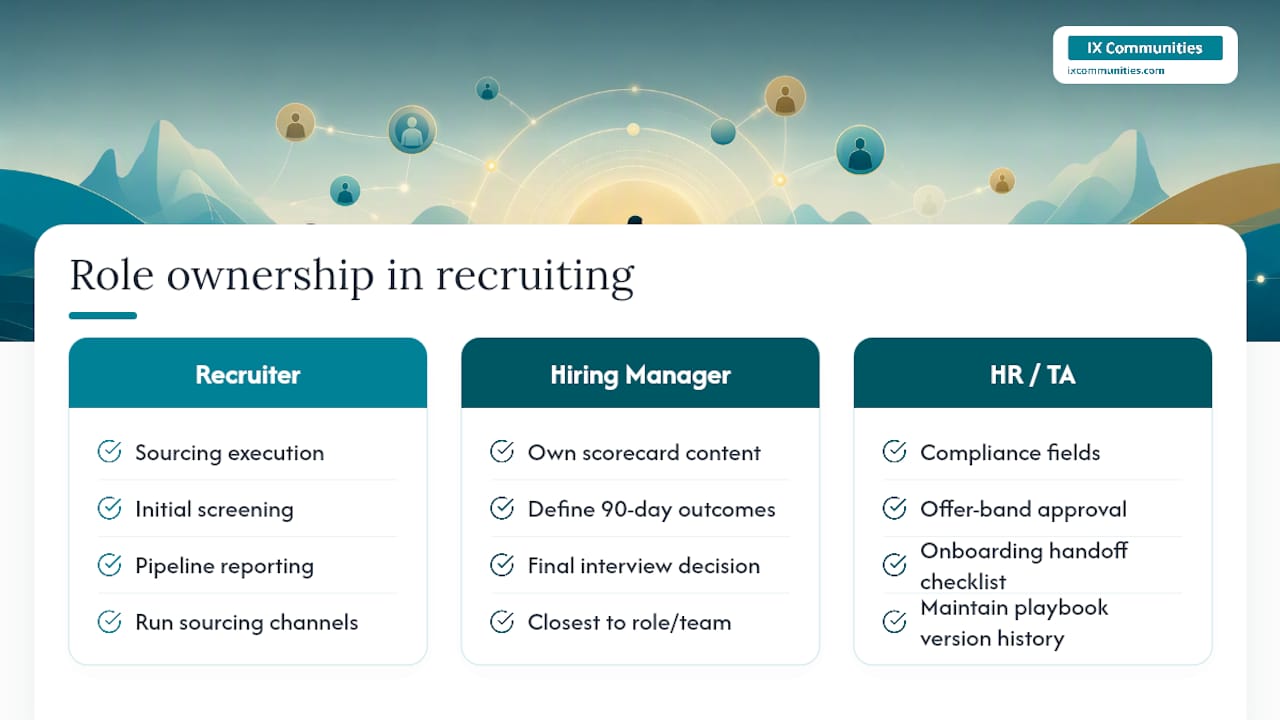
Hiring managers own the scorecard content and the final interview decision. They're closest to the role and the team, so they should define what the 90-day success outcomes actually are, not just approve them after the recruiter drafts them. Skipping this step is one of the fastest ways to end up with a scorecard that doesn't match what the manager actually needs.
HR, or a centralized talent acquisition function, typically owns compliance fields, offer band approval, and the onboarding handoff checklist. They're also usually the ones who maintain the playbook's version history across multiple open roles, since they see patterns a single hiring manager won't catch from one search alone.
None of this works if the recruiting SOP template doesn't state these assignments explicitly. A shared document with no named owner for each section defaults to whoever remembers to check it, which is rarely nobody's job by design and rarely anybody's job in practice.
Building DEI Into the Playbook Instead of Bolting It On
DEI strategy works best when it's written into the template's existing fields rather than added as a separate initiative that runs alongside the hiring process. The sourcing plan is the first place it belongs: naming specific channels aimed at broadening the candidate pool, and setting a target for pipeline diversity by week two rather than reviewing it only after the slate is final.
The interview scorecard is the second place. Weighted, numeric criteria reduce the room for unconscious bias that unstructured "culture fit" conversations tend to leave open. If every interviewer scores the same competencies on the same scale, a debrief becomes a comparison of evidence instead of a comparison of impressions, and that structural change does more for equitable outcomes than a policy statement ever will.
The compliance section is the third. EEO tracking fields should already be part of your template's data section, which means DEI reporting isn't a special request at the end of a search. It's a field that gets filled in the same week the requisition opens. Building it in from the start, rather than retrofitting it after a hiring push, is what separates a playbook that supports DEI goals from one that only references them.
Common Pitfalls That Undermine a Recruiting Playbook
Most playbook failures trace back to a handful of repeatable mistakes, and nearly all of them are avoidable with a bit of upfront discipline.
Overcomplicated scorecards are the most common. Twelve weighted competencies sound thorough but slow every debrief down and dilute the criteria that actually predict success. Trim to four or five outcomes and weight them honestly.
Infrequent reviews are the second. A playbook built in January and never touched again drifts out of sync with market reality by summer. Build the monthly and quarterly review cadence into the document itself, not into someone's calendar reminder that eventually gets skipped.
Lack of version control is the third, and it's the quietest killer. When three people are editing three copies of the same template, nobody can say which scorecard weighting or sourcing budget produced last quarter's results. Assign one owner and one canonical file location.
The fourth pitfall is treating the playbook as a compliance document instead of an operating one. If nobody consults it during an actual search, it's not a recruiting checklist. It's paperwork. The fix for all four is the same: keep it short, assign an owner, review it on a fixed schedule, and make sure the fields tie to decisions someone actually has to make.
Why Most Playbooks Fail Before They Ever Get Used
The conventional advice on recruiting playbooks focuses almost entirely on structure: what sections to include, what fields to add. That advice isn't wrong, but it misses the actual failure point. Most playbooks don't fail because they're missing a section. They fail because nobody owns them after the launch meeting.
A template with no assigned owner and no review date is a document, not a system. The research on this is consistent: playbooks framed as living systems, with a monitoring cadence and someone accountable for updates, outperform static ones regardless of how polished the original fields were.
If you're building or adapting a recruiting playbook template this quarter, prioritize three things in order: get the scorecard and sourcing plan right first, assign a named owner for version control, and set a review date on your calendar before the first hire even closes. Everything else, DEI integration, event-specific sections, compliance fields, layers on top of that foundation. Skip the foundation and the rest becomes decoration.
— Simon
Get Peer Benchmarks Before You Finalize Your Playbook
Guessing at whether your time-to-fill or offer acceptance rate is competitive is the fastest way to set the wrong targets in your playbook's KPI section. Peer benchmarking communities exist where corporate talent acquisition and executive recruiting leaders can compare those numbers against organizations of similar size and industry, rather than against a generic industry average pulled from a blog post.
Membership can include access to market benchmarking reports, mentorship programs, and recruiter training courses tailored for heads of TA and senior recruiting leaders managing multiple open searches at once. If your team is also managing onboarding handoffs at scale, pairing your playbook with onboarding automation tools can tighten the 30/60/90 process further once the hire closes. For teams still deciding where to store and version their templates, comparing HR software options alongside your ATS is worth a look before you scale a single-team template company-wide.
Check current membership details and community access at Ixcommunities.