
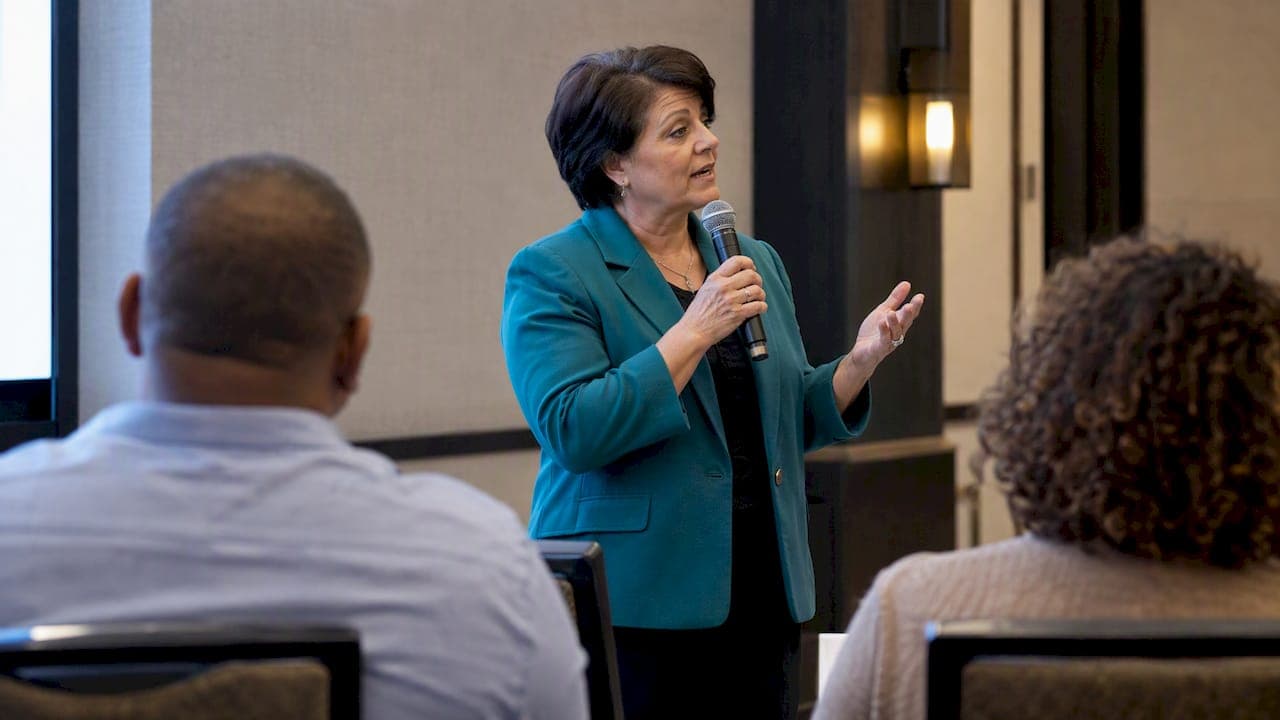
This article provides 35 ready-to-use, trend-aligned speaking topics for recruiting leaders, organized by theme, along with the formats, tailoring steps, and packaging tools needed to turn one into a conference-ready session. The topic bank draws on SHRM benchmarking and our own peer-sourced data at IXCommunities. Scan the list below, then use the sections that follow to shape, format, and deliver the talk.
TL;DR:
- Choose 30 to 45 minute keynotes for strategy, 60 to 90 minute workshops for templates, or 15 to 20 minute micro sessions for one tactic.
- Executives need business impact and cost or revenue KPIs; managers need process metrics and usable templates; recruiters need practical scenarios and one habit to change.
- AI use in HR tasks rose from 26% in 2024 to 43% in 2025, while internal talent marketplace use climbed from 25% to 35%.
- Build the proposal around a real problem, a framework, two or three examples, and a clear action; keep the abstract to 50 to 75 words.
- Reserve the final 10 to 15 minutes for questions, and add a poll or small group exercise to sessions longer than 45 minutes.
Table of Contents
- 1. Speaking Topics Organized by Theme
- 2. Choosing the Right Format and Session Length
- 3. Tailoring One Topic to Different Audiences
- 4. Trend-Driven Topic Angles Worth Addressing Now
- 5. Packaging a Topic Into a Conference-Ready Talk
- 6. Delivery Tactics That Keep Recruiting Audiences Engaged
- 7. Why Peer Benchmarking Strengthens Every Talk
- 8. Why Recruiting Leaders Should Be Speaking Now
- Where IXCommunities Fits Into Your Speaking Plans
- FAQ
- Sources
1. Speaking Topics Organized by Theme
Below is a bank of talk ideas grouped into six themes relevant to recruiting leadership audiences. Each entry includes a one-line hook, a target audience, and a takeaway attendees can act on.
Strategy and leadership
- Building a recruiting function that survives budget cuts, for CHROs, with a takeaway on prioritizing roles by business impact.
- Aligning talent acquisition with workforce planning, for TA leaders, with a takeaway on connecting headcount forecasts to hiring plans.
- Why recruiting leaders belong in the boardroom, for CHROs, with a takeaway on framing hiring metrics as business metrics.
- Succession planning for recruiting teams, for TA directors, with a takeaway on documenting institutional knowledge before it walks out the door.
- Managing recruiter burnout during hiring surges, for TA managers, with a takeaway on workload rebalancing tactics.
AI and technology
- What AI actually changes in the hiring process, for TA leaders, with a takeaway on separating automation hype from practical use.
- Auditing your recruiting tech stack for bias, for recruiting managers, with a takeaway on a simple audit checklist.
- Upskilling recruiters for an AI-assisted workflow, for TA directors, with a takeaway on identifying the first three skills to train.
Talent pipelines and sourcing
- Building an internal talent marketplace from scratch, for TA leaders, with a takeaway on a 90-day pilot structure.
- Sourcing strategies when the labor market tightens, for recruiting managers, with a takeaway on diversifying sourcing channels.
- Reducing time-to-fill without sacrificing quality, for TA directors, with a takeaway on stage-by-stage funnel analysis.
DEI and inclusive hiring
- Structuring interviews to reduce bias, for hiring managers, with a takeaway on standardized scorecards.
- Measuring diversity outcomes beyond hiring, for CHROs, with a takeaway on tracking retention by cohort.
Employer brand and candidate experience
- Turning rejected candidates into future applicants, for TA managers, with a takeaway on a re-engagement email sequence.
- Mapping the candidate journey for friction points, for recruiting managers, with a takeaway on a journey audit template.
People analytics
- Choosing recruiting KPIs that executives actually care about, for TA leaders, with a takeaway on a three-metric executive dashboard.
- Using benchmarking data to justify headcount requests, for CHROs, with a takeaway on framing requests around peer comparisons.
Pro Tip: Pick one topic and rewrite its hook to reference the host conference's audience by name, such as swapping "recruiting managers" for "mid-market TA leaders," to make the pitch feel built for that room.
2. Choosing the Right Format and Session Length
Match the topic type to a format before writing a single slide. Strategic and trend topics suit keynotes; tactical, template-heavy topics suit workshops.
- Keynotes run 30 to 45 minutes, fit large audiences, and work best for strategy, AI, and trend topics where the goal is inspiration and direction.
- Workshops run 60 to 90 minutes, fit smaller groups of 20 to 50, and work best for template-driven topics like interview scorecards or candidate journey mapping.
- Panels run 45 to 60 minutes, fit any audience size, and work best when a topic benefits from multiple perspectives, such as DEI outcomes or tech adoption.
- Micro-sessions run 15 to 20 minutes, fit breakout tracks, and work best for a single tactic, like one sourcing channel or one metric.
Reserve the final 10 to 15 minutes of any format for questions, and build in one structured interaction point, a poll or small-group exercise, for sessions over 45 minutes.
3. Tailoring One Topic to Different Audiences
The same topic needs a different shape depending on who is in the room. Adjust tone, evidence, and the call to action for each audience level.
- For CHROs and executives, lead with business impact, use benchmarking data over anecdotes, and close with a decision they can make this quarter.
- For TA managers and directors, lead with process detail, use case comparisons, and close with a template they can implement this month.
- For individual recruiters, lead with day-to-day friction points, use relatable scenarios, and close with one habit to change tomorrow.
Executives expect KPIs tied to cost or revenue, managers expect process metrics like time-to-fill, and practitioners expect tools they can use immediately.
Pro Tip: Build one slide per audience segment that restates the same takeaway in that audience's own metrics, so a single deck serves a mixed-audience session.

4. Trend-Driven Topic Angles Worth Addressing Now

Three recruiting trends give speakers built-in credibility because they are backed by current data, not opinion.
AI adoption in HR tasks climbed from 26% in 2024 to 43% in 2025, making it one of the fastest-moving topics in the field.
- AI in recruiting: angles include "what to automate first," "auditing AI tools for bias," and "training recruiters to work alongside AI," for TA leaders, with a takeaway on a tool evaluation checklist.
- Internal mobility: angles include "building a talent marketplace," "measuring internal fill rates," and "manager resistance to internal moves," for CHROs, with a takeaway on a pilot program outline.
- Skills-based hiring: angles include "replacing degree requirements," "building skills matrices," and "assessing skills at scale," for recruiting managers, with a takeaway on a skills audit template, supported by CIPD's resource and talent planning research.
Internal talent marketplace usage grew from 25% to 35% of organizations between 2024 and 2025, a shift that gives internal mobility talks a timely, defensible hook.
5. Packaging a Topic Into a Conference-Ready Talk
A usable submission needs four parts: an opening hook tied to a real problem, a framework or model, two to three supporting examples, and a closing call to action.
- Spend 10% of the talk on the hook, 20% on the framework, 50% on examples and data, and 20% on the close and questions.
- Write a 50 to 75 word abstract that states the problem, the framework, and the single outcome attendees will leave with.
- Draft three learning objectives, each starting with an action verb such as "identify," "build," or "measure."
- Plan one slide per two minutes of talk time.
- Use one chart or visual per data point instead of dense text blocks.
- Keep text per slide under 20 words wherever possible.
6. Delivery Tactics That Keep Recruiting Audiences Engaged
Recruiting leaders respond well to live interaction rather than passive listening.
- Open with a live poll asking attendees to benchmark their own metrics against the room.
- Anchor at least one data point to a recognizable source, then follow with a short case example.
- Run a five-minute small-group exercise on a real scenario, such as prioritizing three open roles.
- Close with a one-line commitment card attendees fill out before leaving.
Pro Tip: Send a one-page downloadable template tied to the talk's main framework so attendees have a reason to follow up after the session.
7. Why Peer Benchmarking Strengthens Every Talk
ESIX, TLIX, and IXCommunities are the preeminent peer networking and benchmarking groups for talent leadership professionals worldwide, where large corporate talent and recruiting departments share, benchmark, and learn in a secure environment. Speakers can draw on peer benchmarking data and member experience to ground a talk in verified practice rather than general advice. Where available, add proprietary case studies demonstrating the effectiveness of these communities and a short author biography establishing relevant expertise in talent leadership.
8. Why Recruiting Leaders Should Be Speaking Now
The pace of change in recruiting, from AI adoption to internal mobility, gives recruiting leaders more to say than they often realize. Sharing practical lessons with peers, rather than polished theory, is what conference programmers are actively looking for right now. If a topic above resonates, consider pitching it to a peer community for feedback before the first submission.
— Simon
Where IXCommunities Fits Into Your Speaking Plans
Readers preparing a talk or looking to book one can draw on our IX Communities Guest Speakers program, which connects recruiting leaders with vetted peer speakers and session partners.
For recruiters sharpening the skills behind these talks, our on-demand, live online, and team intact courses are available at current prices listed on the pricing page. Ongoing peer benchmarking and speaking opportunities are available through TLIX Membership, ESIX Membership, and DSIX Membership. Reach out to request a session brief and start building your talk.
FAQ
What are the four P's of recruitment?
The four P's commonly used in recruitment frameworks are planning, people, process, and performance, covering how roles are forecast, who sources and interviews candidates, the steps candidates move through, and how outcomes are measured. Definitions vary across organizations, so a talk referencing this framework should state which version it uses.
What are some unique recruiting ideas worth presenting on?
Strong talk ideas include building an internal talent marketplace, auditing recruiting technology for bias, and turning rejected candidates into a future applicant pipeline. Each works well because it pairs a concrete problem with a template attendees can apply immediately.
What is the 80/20 rule in recruiting?
The rule in recruiting generally refers to focusing the majority of sourcing and screening effort on the roles or channels that produce the most hires, rather than spreading effort evenly. It is a practical heuristic rather than a fixed statistic, and talks using it should frame it as a prioritization principle.
What key skills should a recruiter have?
Core recruiter skills include communication, decision-making, and attention to detail, according to the Bureau of Labor Statistics, which also notes recruiters often handle screening, interviewing, and elements of benefits or training administration. A talk on recruiter capability can use this as a baseline before layering in AI literacy and data interpretation.
How long should a recruiting leadership keynote run?
Most recruiting leadership keynotes run 30 to 45 minutes, leaving time for a structured Q&A segment at the end. Shorter micro-sessions of 15 to 20 minutes work well for breakout tracks focused on a single tactic.
Sources
- 2025 Talent Trends (SHRM)
- Human resources specialists (BLS Occupational Outlook)
- Resource and talent planning report 2026 (CIPD)