
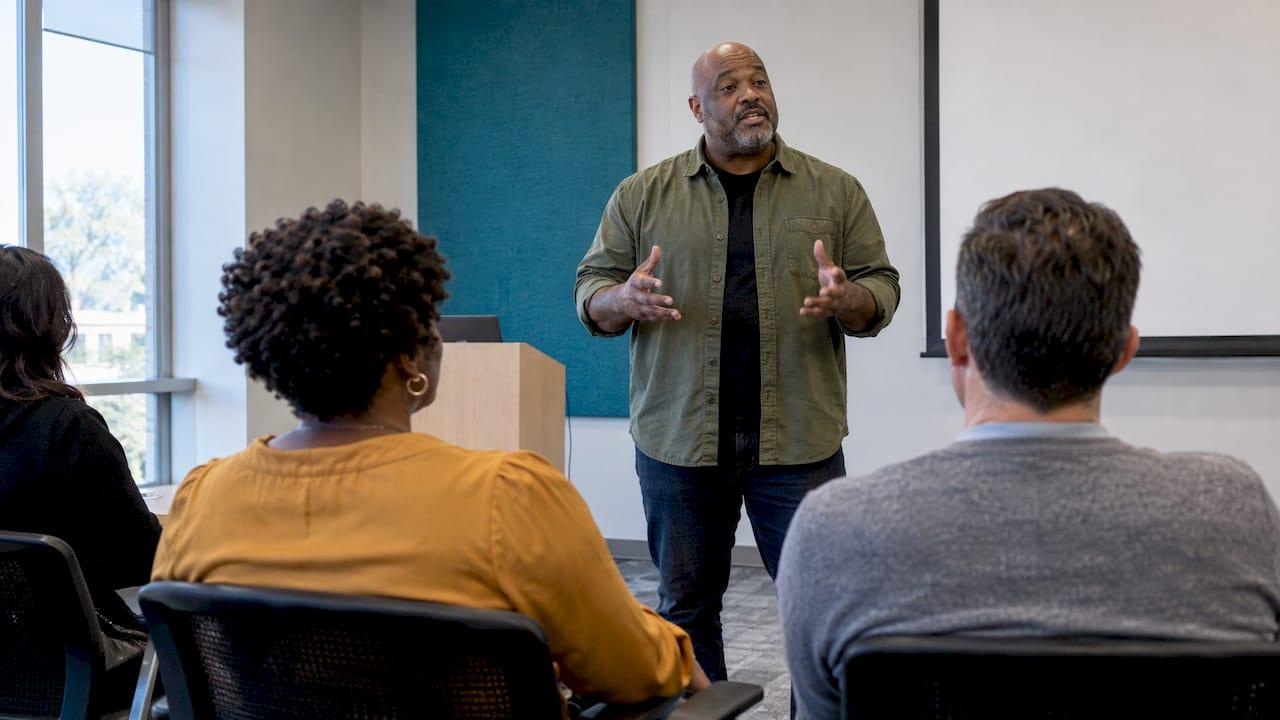
A guest speaker series for a corporate recruiting team works when each session answers a specific problem the team faces, the speaker is chosen on evidence rather than a bio, and the budget and lead time are set before the search begins. Teams that do not want to carry that work alone can use the expert guest speaker sessions that IX Communities offers to its members, in a setting restricted to in-house corporate recruiting leaders.
This guide covers what a series costs, how to select and brief speakers, how to run virtual sessions and how to measure results. It is written for heads of talent acquisition, executive recruiting and HR leaders at mid-size to large companies.
TL;DR
- Set the outcome for each session first, then the topic. A speaker who can move a room toward a defined result is easier to assess than one who simply knows a subject.
- Speaker fees vary widely. Published executive fee bands run from $10,000 to $100,000 or more per engagement, and travel is billed on top for in-person talks.
- Allow at least four months to recruit a speaker, and score finalists against written criteria rather than reels or name recognition.
- Virtual sessions cost less and work best at 30 to 45 minutes with a question plan that does not depend on attendees unmuting.
- Members of IX Communities can access expert guest speaker sessions inside peer communities for corporate recruiting leaders, without building the program internally.
Table of Contents
- What a guest speaker series does for a TA team
- Designing the program
- What guest speaker sessions cost
- How to find and select speakers
- Running virtual sessions
- Briefing speakers
- Measuring impact
- Perspective
- Guest speaker sessions through IX Communities
- FAQ
- Sources
What a guest speaker series does for a TA team
A recruiting function has three common reasons to run a speaker series. The first is to bring outside experience into the team on a topic it is still learning, such as AI in sourcing, pay transparency rules or executive search practice. The second is to give recruiters and sourcers development without sending them to a conference. The third is to give TA leaders a view of how other large employers handle the same decisions.
Each purpose calls for a different speaker. A development session for recruiters needs a practitioner who can teach a method. A session for TA leaders needs someone who has run a function of similar size. Settling the purpose first prevents the most common failure: a well-known speaker with a polished talk that does not connect to the work the audience does.
The event-planning guidance on this point is consistent. A vetting checklist from a speaker marketplace recommends defining the event purpose as a specific, measurable outcome, writing the speaker's role in a sentence such as what attendees should be able to do by the end, and profiling the audience by industry, career level, prior knowledge and current challenges. For a TA team, that profile is straightforward to write: recruiters by requisition volume, hiring managers, TA leadership, and the mix of seniority and company size in the room.

Designing the program
Choose the cadence and format
A series needs a rhythm the team can sustain. Monthly or quarterly sessions are common patterns. The format should follow the purpose: a keynote for a broad update, a fireside conversation for a leader's perspective, a workshop for skills, a panel of practitioners for comparison of approaches.
A workshop adds cost. According to SpeakUp's 2026 executive speaker guidance, a 60 to 120 minute working session add-on typically carries a 20 to 30% premium over the fireside alone. Decide at the outset whether the series needs that depth or whether a shorter conversation meets the goal.
Build the topic list from the team's problems
Start with three to five challenges the audience faces this year. Examples for a corporate TA function include time to fill for specialized roles, hiring manager engagement, recruiting technology consolidation, candidate experience and executive hiring. Then map each challenge to a session type and a speaker profile. The same list becomes the core of the speaker brief later.
Speaker selection also benefits from variety. Within a year, a series that mixes practitioners from different industries, company sizes and career stages gives the audience more to compare than one that repeats a single viewpoint.
Set the fee band before the search
Decide what you can pay before you contact anyone. It narrows the field and avoids spending weeks on speakers outside the budget. The next section covers what the figures look like.
What guest speaker sessions cost
Fees depend on the speaker's profile, the format, the location and the lead time. Published bands from SpeakUp for 2026 put practitioner executive speakers, meaning current or recently retired CEOs and division presidents, at $10,000 to $25,000 per engagement. Recognized executive voices are listed at $25,000 to $60,000, and globally known executive speakers at $60,000 to $100,000 or more. The same source reports lead times averaging 8 to 12 weeks.

These are fee bands for executive speakers, which sit at the higher end of the market. A recruiting team looking for a practitioner with a specific skill, such as structured interviewing or sourcing strategy, will often find lower fees than these figures, so treat them as a ceiling for planning rather than a standard.
Other cost points to put in the budget:
- Travel and expenses. Talkadot's booking guidance says a speaker fee normally covers the session and preparation, with travel billed on top. It puts domestic travel at $500 to $3,000 in its experience.
- Virtual delivery. The same source notes that virtual sessions cost less because there is no travel and less time is committed.
- Compensation for every talk. Inside Higher Ed's guidance on invitations advises offering compensation up front rather than making the speaker ask, covering travel, lodging and registration for in-person talks, and compensating virtual talks as well.
A useful planning exercise is to price a year of sessions: the number of sessions, the fee band for each, travel for any in-person events, and staff time for sourcing, briefing and moderation. For many teams, the staff time is the largest figure that is not on any invoice.
How to find and select speakers
Allow four months
Talkadot's 2026 industry data shows a median of about 4.5 months between an audience member first seeing a speaker and the organization booking that speaker. Its guidance is to allow at least four months to recruit a speaker. Executive speakers booked through an agency are faster, at 8 to 12 weeks according to the fee-band source above, but a team that wants to compare candidates should plan for the longer window.
Build a list, then cut it
A workable sourcing process looks like this:
- Set the fee band.
- Build a list of 8 to 12 candidates from a speaker marketplace, a bureau, referrals from peer planners and speakers you have seen live.
- Cut the list to three based on evidence of how past audiences responded, not on the speaker's own marketing.
- Interview the three, including a question about a session that went badly.
That sequence comes from Talkadot's booking FAQ. For a TA team, the referral step is often the strongest one. Heads of TA at peer companies have seen which speakers held a recruiting audience and which did not. Sourcing speakers outside the usual recruiting circle, for example on leadership or workforce topics, can also broaden the series: coaching practices that address burnout prevention for leaders and teams are one example of a topic that touches recruiters directly.
Score on written criteria
A scoring rubric keeps the choice based on evidence. Engineerica's July 2026 vetting guide recommends scoring each candidate from 1 to 3 on five criteria and setting a minimum of 10 out of 15:
| Criterion | What to check |
|---|---|
| Audience relevance | Has the speaker worked with an audience like yours, by role and seniority? |
| Content recency | Has the speaker published, spoken or shipped something in the last 12 months? |
| Stagecraft | Watch at least 15 minutes of unedited video. |
| Customization willingness | Will the speaker adapt the content to your team's challenges? |
| Reliability | Can a recent event organizer give a reference? |
For TA topics, add questions specific to the field. Crimson Speakers' guidance for AI speakers at talent acquisition events suggests asking whether the speaker can distinguish current AI recruiting tools by functionality, has spoken at a TA-specific conference and not only an HR-wide one, holds a clear point of view on algorithmic bias in hiring, and will customize for the seniority mix in the room. It also advises confirming cancellation terms.
When watching video, look at the audience as well as the speaker. The espeakers checklist recommends noting whether attendees lean forward, take notes and react, and treating slide-reading as a red flag. Where scores are close, it weights customization and reference quality most heavily.
Ask for an outline
A clear outline is a stronger signal than a highlight reel. A Talent Bureau survey of 250 working professionals in October 2025 found that 57% trusted a clear talk outline and defined learning outcomes most when assessing a keynote speaker before booking. A highlight reel ranked fourth, and name recognition did not appear in the top three. Asking each finalist for an outline tied to your stated outcome therefore gives you better information than a biography does.
Running virtual sessions
Virtual sessions suit distributed TA teams and widen the candidate pool, since the speaker does not need to travel. They also need a different design from in-person events.
- Length. Talkadot notes that remote audiences disengage faster, so virtual sessions are usually cut to 30 to 45 minutes. The CIF guidance note on online events reports 60 minutes as the most common session length, so choose by how much interaction the format needs.
- Timing. The same CIF note identifies Tuesday to Thursday as the best days for virtual events and 1 to 3 PM Eastern as a good window for US audiences. For teams across time zones, Inside Higher Ed advises choosing dates and times with time zones in mind.
- Questions. Plan questions so the session does not rely on people unmuting. A moderator can read questions from chat, and a poll can open the discussion.
- Opening and closing. The Conversation Project's virtual event guide advises opening the session 15 to 20 minutes early and keeping it open 10 to 15 minutes after, and sharing objectives, agenda and speaker bios days in advance.
- Technical preparation. Sprout Social's virtual event guide recommends test runs for internet speed, technology familiarity and mic checks, a separate comment moderator, a backup plan for technology failures, and a run-of-show document listing every session, cue, handoff and fallback by the minute.
- Accessibility. Inside Higher Ed suggests offering a tech check 30 minutes early, plus captioning or a sign language interpreter.
Run-of-show documents and registration tracking become heavier as a series grows. Teams that manage their own series often use a platform for planning an annual event so that registration, messaging and reporting sit in one place.
Briefing speakers
A speaker's session is shaped largely before the day. Crimson Speakers' guidance holds that the preparation stage is where keynote quality is determined, and that briefing works best as a collaboration. For a TA audience, a brief should cover:
- The three to five challenges the audience is working through.
- The seniority and company-size range of attendees, and the companies represented.
- What the audience has already heard this year.
- The specific takeaway, the format and any topics to handle carefully.
- The run of show, dry-run times, audience size and presentation guidance such as time allotted and slide template.
The CIF guidance note recommends documenting these items in a briefing document and a signed speaker agreement. Brett Wiskar's guide reduces the brief to five questions: why the event exists, who the audience is, what success looks like, what the speaker should anchor to, and how the day runs. Many speakers appreciate help in shaping the talk. Preparing speakers through collaborative briefing and coaching takes time on the host side, which belongs in the staffing plan.
Measuring impact
A series that is not measured is hard to defend at budget time. Speaker Agency UK's 2026 guide describes four levels of measurement:
| Level | Method | Timing |
|---|---|---|
| Reaction | Post-session survey | Same day, within 24 hours |
| Learning | Pre and post assessment | Same day to 1 week |
| Behavior | Manager observation | 1 to 3 months |
| Results | Business KPI tracking | 3 to 6 months |
It also suggests a 30-day follow-up after the event. For a recruiting team, the results level can tie to metrics the function already tracks, such as time to fill, hiring manager satisfaction or offer acceptance, for the topic the session addressed.
Inside Higher Ed recommends collecting attendee feedback after each talk and sharing it with the speaker, with an option for attendees to permit use of their comments as quotes. It also advises asking speakers to approve any promotional material before it is posted.
Perspective
Corporate recruiting leaders often tell us the same thing about outside speakers: the content is useful when the speaker understands the in-house function, and less useful when it is built for a general HR audience or tied to a product.
This is the reason IX Communities operates as a vendor-free environment exclusive to in-house corporate recruiting leaders. Our communities, TLIX for talent leaders, ESIX for executive recruiting and DSIX for diversity strategy, have operated for nearly three decades on peer-sourced, confidential exchange. Guest speaker sessions are one part of that membership, alongside benchmarking reports, mentorship programs and guidebooks.
A speaker series built by one team requires a budget, four months of lead time per speaker, a brief, a moderator and a measurement plan. A series built inside a peer community spreads that effort across the members and puts the speaker in front of leaders who face the same decisions.
Simon
Guest speaker sessions through IX Communities
IX Communities offers expert guest speaker sessions as part of its peer networking and benchmarking memberships for corporate talent acquisition, executive recruiting and diversity recruiting leaders. Members can attend sessions alongside peers from large corporate recruiting functions, in an environment separated from vendor influence. The IX Communities guest speakers page describes the sessions.
The membership options are:
- TLIX Membership for talent leaders.
- ESIX Membership for executive recruiting leaders.
- DSIX Membership for diversity strategy leaders.
Membership prices are not published. For team development, IX Academy recruiter training is available as on-demand courses from $350, live online courses from $750 and team intact courses from $3,000, all one-off prices on the recruiter training page.
FAQ
How much should a recruiting team budget for a guest speaker?
Budget by speaker type. Published 2026 bands for executive speakers start at $10,000 per engagement and reach $100,000 or more for globally known names, with travel billed on top. Virtual sessions cost less. Set your fee band before you search, and include staff time for briefing and moderation.
How long does it take to book a speaker?
Allow at least four months to compare candidates. Booking an executive speaker through an agency can take 8 to 12 weeks. Start earlier for sessions tied to a fixed date, such as a leadership meeting.
What criteria should we use to select a speaker for TA professionals?
Score audience relevance, content recency, stagecraft, willingness to customize and reliability, with a minimum threshold set in advance. Add field-specific checks: experience with a TA audience, a clear view on topics such as AI and bias in hiring, and a written outline tied to the outcome you want.
Are virtual guest speaker sessions effective for HR teams?
They can be, with a shorter format and a plan for questions. Sessions of 30 to 45 minutes, a comment moderator, a tech check and a backup plan address the most common problems. Virtual delivery also lowers cost and widens the choice of speakers.
Can corporate recruiting leaders access guest speakers without building a program?
Yes. IX Communities members can attend expert guest speaker sessions within peer communities for in-house corporate recruiting leaders. The membership pages for TLIX, ESIX and DSIX describe each community.
Sources
- The Ultimate Speaker Vetting Checklist for Corporate Events
- CEO & Executive Speakers for Offsites
- Speaker Booking FAQ: 22 Questions Event Planners Ask
- How to send thoughtful guest speaker invitations
- How to Find Speakers for Events: Sourcing & Vetting Guide
- AI Keynote Speakers for Talent Acquisition and Recruiting
- What Makes a Great Keynote Speaker?
- How to Host Engaging Online Events (CIF guidance note)
- 13 Steps to Running an Effective, Engaging Virtual Event
- How to Host a Virtual Event in 9 Steps
- How to Hire a Keynote Speaker in the UK (2026 Guide)