

The fastest path to a productive recruiter is a staged program built on preboarding, a 30/60/90-day curriculum, mentor pairing, role play, and measurable milestones. Start this week with three moves: preboard the new hire before day one, give them one meaningful task on day one, and schedule a manager check-in at the seven-day mark.
TL;DR:
- A structured 30/60/90-day onboarding program accelerates recruiters' independence and can reduce ramp-up time to placement by providing clear milestones and activities.
- Preboarding logistics, early tasks, and manager check-ins within the first week are critical for building momentum and setting realistic expectations.
- Practice through role play, supervised calls, and microlearning modules effectively translate training into consistent, independent performance.
- Measuring key KPIs such as time to first submission and activity ratios enables early identification of onboarding issues and progress tracking.
- Benchmarking against peer organizations and standardizing processes across teams improve onboarding consistency, scalability, and retention outcomes.
Table of Contents
- What Is Recruiter Onboarding, and Why Does the First 90 Days Matter?
- Preboarding and Day-One Checklist for New Recruiters
- A Practical 30/60/90 Recruiter Onboarding Program
- Training Methods That Actually Speed Up Recruiter Ramp Time
- Making Recruiter Onboarding Repeatable and Scalable
- How to Measure Onboarding Success and Ramp Time
- How Peer Benchmarking Improves Your Onboarding Program
- Where Recruiter Onboarding Usually Breaks Down
- A Faster Path to Onboarding Templates and Peer Benchmarks
- Sources
What Is Recruiter Onboarding, and Why Does the First 90 Days Matter?
Recruiter onboarding is the structured process that takes a new hire from signed offer letter to independent, quota-carrying producer. It differs from simple orientation, which covers paperwork and building access. Onboarding covers the skills, relationships, and systems a recruiter needs to source, screen, and place candidates without constant supervision.
The U.S. Office of Personnel Management recommends a phased structure: preboarding before day one, Phase I covering the first seven days, Phase II extending through the first 30 days, and continued engagement and training through 90 days and beyond. That framework applies directly to recruiting teams, where ramp time is the single biggest lever on revenue per headcount.
Recruiting firm owners often treat onboarding as an HR checklist item rather than a training strategy. That's a mistake. A recruiter who takes four months to place their first candidate costs a firm real money in salary, benefits, and lost desk capacity. A structured recruitment orientation process, paired with a 30/60/90-day plan template, cuts that ramp window substantially by giving new hires a clear sequence of skills to master and checkpoints to hit.
Preboarding and Day-One Checklist for New Recruiters
Preboarding starts the moment an offer is accepted, not on the first morning. AIHR's guidance on job orientation treats preboarding and orientation as distinct from onboarding itself, and argues that getting the early logistics right removes friction that otherwise eats into a new recruiter's first productive weeks.
Preboarding checklist (complete before start date):
- Send the offer packet, benefits enrollment forms, and I-9/W-4 documentation electronically.
- Provision CRM, ATS, phone system, and email access so credentials work on day one.
- Ship or stage hardware (laptop, headset, monitor) at the recruiter's desk or home office.
- Send a welcome email with the day-one agenda, dress expectations, parking or building access, and the name of their assigned mentor or buddy.
- Assign a training account or sandbox environment in the applicant tracking system for practice before live client work.
Day-one agenda that balances admin and real contribution:
- Morning: facilities tour, badge and equipment setup, benefits walkthrough with HR, introduction to the team.
- Midday: CRM and ATS orientation with the assigned buddy, covering how records, pipelines, and activity logging work.
- Afternoon: one meaningful task, such as reviewing three live requisitions and drafting candidate search strings, or shadowing a client intake call.
- End of day: a 15-minute check-in with the manager to answer questions and confirm week-one expectations.
Assign clear owners so nothing falls through the cracks. HR handles paperwork and benefits. IT handles systems access and hardware. The hiring manager owns the week-one training schedule and the first performance conversation. The buddy or mentor handles day-to-day questions that feel too small to bring to a manager, like how to format a submission note or where the call scripts live.
Pro Tip: Draft one welcome email template and one day-one agenda template now, and reuse them for every new recruiter. The five minutes you spend customizing names and start dates beats rebuilding the plan from scratch every time you hire.
A Practical 30/60/90 Recruiter Onboarding Program
The strongest recruiter onboarding program breaks the first quarter into three distinct phases, each with its own goals, activities, and success criteria. This mirrors the federal phased model, adapted for the pace and metrics of a recruiting desk.
Phase 1: Days 1 through 30, foundations
The goal here is competence with tools and process, not results. A new recruiter should leave this phase knowing how to source, log, and communicate, even if they haven't placed anyone yet.
- Week 1: CRM and ATS setup, sourcing basics (Boolean search, LinkedIn Recruiter, job board syntax), and shadowing two to three client or candidate calls per day.
- Week 2: First independent sourcing assignments on live but low-risk requisitions, with the buddy reviewing every submission before it goes out.
- Week 3: Practice candidate screening calls using role play, then real screening calls with the manager or buddy silently monitoring.
- Week 4: First full-cycle attempt, from sourcing through submission, on a single requisition with close supervision.
Example success criteria for day 30: the recruiter can independently source a slate of five qualified candidates for a straightforward requisition, has completed at least ten mock or supervised candidate calls, and has submitted at least one candidate to a hiring manager under review.
Phase 2: Days 31 through 60, supervised production
This phase increases volume and independence while keeping a safety net in place. The recruiter should be making live calls and submissions weekly, with a manager or mentor still reviewing quality.
- Weekly one-on-one feedback sessions reviewing call recordings or submission notes.
- Live client calls, initially with the manager or buddy on the line, tapering to solo calls with a debrief afterward.
- Monitored submissions: every candidate write-up gets a quick review before it reaches the client.
- Introduction to negotiation and closing conversations through role play before attempting them live.
Success criteria for day 60: at least one active submission per week, a first candidate interview scheduled, and consistent, unsupervised use of the CRM for pipeline tracking.
Phase 3: Days 61 through 90, independent production
By this phase, the recruiter should be carrying real quota expectations, even if scaled below a tenured recruiter's target. The manager shifts from active coaching to spot-checking and escalation support.
- Set a scaled quota, often 50 to 70 percent of a fully ramped recruiter's target, tied to activity metrics and submissions.
- Give the recruiter full pipeline ownership on two to three requisitions with no required pre-submission review.
- Establish clear escalation rules: when to loop in the manager on a stalled deal, a client conflict, or a compensation negotiation.
- Hold a formal 90-day review comparing actual output against the milestones set in week one.
Success criteria for day 90: at least one placement or a strong late-stage pipeline (final-round candidates with multiple clients), a submission-to-interview ratio in line with team averages, and demonstrated independent judgment on candidate quality.
SHRM's research on structured onboarding finds that organizations assigning mentors during this kind of staged process see faster integration and stronger retention than those relying on informal, ad-hoc training. Don't stop at 90 days, either. Many high-performing organizations extend formal check-ins and development planning through a recruiter's first year to fully cement the skills built in the first quarter.
Training Methods That Actually Speed Up Recruiter Ramp Time
Not every training method delivers the same return. Watching a webinar recording teaches recognition, not skill. What moves a new recruiter to independent production fastest is practice under realistic conditions, repeated often enough that the behavior becomes automatic.
Role play and live coaching top that list. The American Staffing Association's guidance on recruiter onboarding points to role play and supervised production as uniquely effective, because they let a new hire rehearse the exact client and candidate conversations they'll eventually own alone, from cold outreach to compensation negotiation. Structure these sessions with a clear script or scenario, a manager or senior recruiter playing the counterpart role, and immediate feedback after each run. Ten minutes of role play before a real call beats an hour of passive reading every time.
Microlearning modules fill the gaps between live coaching sessions. Short, focused templates covering LinkedIn outreach scripts, phone opening lines, interview guides, and objection-handling frameworks let a new recruiter reference exactly what they need in the moment, rather than trying to recall a full training manual. AIHR's research on new employee orientation supports this approach, recommending prepopulated systems and short-form training content to reduce downtime during the ramp period.
Shadowing and supervised production protect your top billers' time while still giving new hires exposure to real client work. A few practical guardrails:
- Cap shadowing sessions at 30 to 45 minutes so top performers aren't derailed from their own pipeline.
- Rotate which senior recruiter hosts shadowing days, rather than always pulling from your single best biller.
- Use recorded calls where compliance allows, so new hires can review without requiring a live senior recruiter present.
- Move to solo work with post-call debriefs as soon as competence, not comfort, allows it.
Some staffing organizations run this training in a compressed cohort format, sometimes 10 to 18 weeks of structured, coach-led sessions, which the Recruitment Coach Training Academy argues moves recruiters to consistent billing faster than scattered, ad-hoc coaching. Whether you run a formal cohort or a lighter version internally, the principle holds: structured practice with feedback beats unstructured exposure.
Making Recruiter Onboarding Repeatable and Scalable
A recruiter onboarding program that lives in one manager's head isn't a program. It's a habit that disappears the day that manager gets busy or leaves. Building repeatability means writing the process down and assigning enforcement, not just intent.
A working playbook needs three parts: a stated purpose for each phase, a step-by-step sequence of activities with owners attached, and the artifacts that prove each step happened (a signed checklist, a completed role-play log, a submission review note). Without artifacts, you have no way to audit whether onboarding actually occurred the way it was designed.
Ownership should be explicit and spread across roles rather than resting entirely on one manager:
- Onboarding owner (often a TA leader or ops manager): maintains the playbook and templates, updates them quarterly.
- Hiring manager: runs weekly check-ins, sets quota ramp targets, conducts the 90-day review.
- Buddy or mentor: handles daily tactical questions and reviews early submissions.
- HR and IT: own preboarding logistics and systems access, with a hard deadline tied to start date.
SHRM's benchmarking finds that organizations pairing new hires with mentors or coaches during onboarding see stronger retention outcomes than those without a formal mentoring structure. A simple manager scorecard, tracking completion of each onboarding milestone against the calendar, catches drift early. If a recruiter is at day 45 and still hasn't completed their first supervised submission, that scorecard flags it before the 90-day review turns into a surprise.
How to Measure Onboarding Success and Ramp Time
Measurement separates a real recruiter onboarding program from a well-intentioned checklist that nobody tracks. The core KPIs worth watching:
- Time to first submission: days from start date to first candidate submitted to a client.
- Time to first placement: days from start date to first closed deal.
- Submission-to-placement conversion rate: how efficiently a new recruiter's pipeline converts, compared against team averages.
- Activity-to-result ratios: calls made, candidates sourced, and submissions per placement, which reveal whether a slow ramp is an activity problem or a quality problem.
Pair those KPIs with a fixed check-in cadence rather than reviewing progress only when something goes wrong.
| Checkpoint | Primary goal | Sample question to ask |
|---|---|---|
| Day 7 | Confirm systems fluency and comfort | "What's still confusing about the CRM or process?" |
| Day 30 | Verify sourcing and screening competence | "Walk me through your last five candidate conversations." |
| Day 60 | Assess submission quality and independence | "What's blocking your pipeline from moving faster?" |
| Day 90 | Formal review against quota and milestones | "Are you tracking toward a full ramp by month six?" |
| — | Confirm full integration and sustained output | "What would help you hit a senior recruiter's numbers?" |
A simple dashboard tracking these fields by hire date lets a talent acquisition leader spot problems early. If three consecutive new hires miss the day-30 submission target, the issue likely sits in the training program itself, not in the individuals. Early activity data, calls per day, candidates sourced per week, tends to predict quota attainment months before the quota number itself confirms it.
How Peer Benchmarking Improves Your Onboarding Program
Building a recruiter onboarding program from scratch means guessing at what "good" looks like. Benchmarking against peer organizations removes that guesswork by showing what actually works across firms of similar size and structure.
Running a benchmarking exercise on ramp time starts with a shared definition: agree with peer organizations on how "time to first placement" or "days to full quota" gets measured, then compare your numbers against theirs. Differences often reveal whether a slow ramp is a training gap, a market issue, or a hiring quality problem.
Templates worth requesting from a peer benchmarking group include:
- A 30/60/90-day plan template already adapted for recruiting roles, rather than a generic corporate version.
- A manager scorecard format that tracks onboarding milestone completion against calendar days.
- Role-play scripts covering cold outreach, candidate screening, and offer negotiation, tested and refined by other firms' training teams.
- Sample check-in question sets for the 7, 30, 60, and 90-day meetings.
Member case studies within a benchmarking community often show the specific adjustments that cut ramp time, whether that's a change in cohort size, a shift in who runs the buddy program, or a tweak to which activities get measured first. Comparing your own onboarding data against a peer group's puts a real number on whether your program is fast, average, or lagging, rather than relying on internal assumptions about what "normal" ramp time looks like.
Where Recruiter Onboarding Usually Breaks Down
Three mistakes show up repeatedly across recruiting firms building or rebuilding an onboarding program. The first is skipping preboarding entirely, then wondering why the first week feels chaotic. A recruiter who spends their first two days waiting on system access or chasing HR paperwork loses momentum before they've placed a single call, and that early drag is entirely avoidable.
The second is inconsistent coaching. One manager runs weekly role play; another checks in once a month if time allows. That inconsistency means outcomes depend on who a recruiter happens to report to, not on the strength of the program itself. Standardizing the coaching cadence across every manager on the team removes that variance.
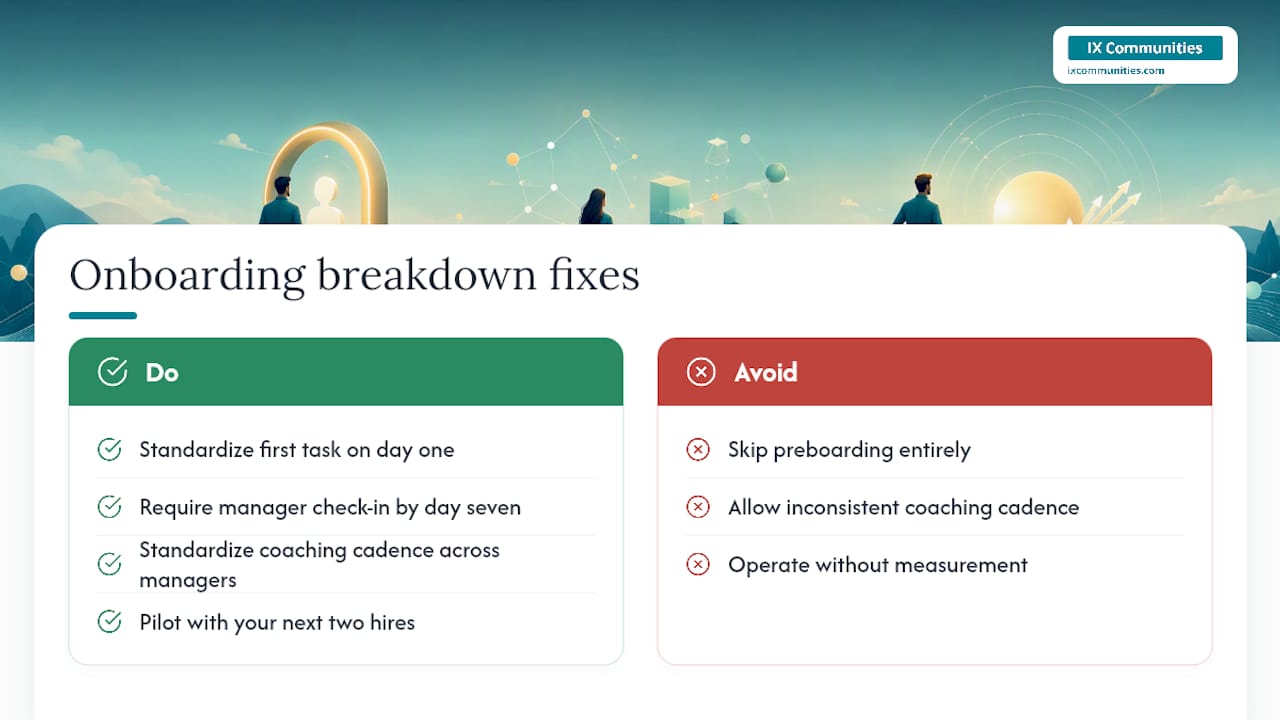
The third, and most damaging, is the absence of measurement. Firms that don't track time to first submission or activity ratios have no early warning system. They discover a ramp problem only when a recruiter misses quota at month six, by which point the fix costs far more than it would have at day 30.
If a talent acquisition leader has bandwidth for exactly one change this week, standardize the first meaningful task every new recruiter gets on day one, and require a manager check-in no later than day seven. That single pairing forces preboarding to happen (because the task requires system access), forces early engagement (because the check-in needs something to discuss), and creates the first data point in a measurement system that didn't exist before. Pilot it with your next two hires before rolling it out firm-wide. Small cohorts let you catch what doesn't translate from plan to practice before it becomes policy.
— Simon
A Faster Path to Onboarding Templates and Peer Benchmarks
Building a recruiter onboarding program from a blank page takes months of trial and error that most talent acquisition teams don't have time for. There is an option to access peer benchmarking groups and recruiter training courses and guidebooks specifically built for structuring a 30/60/90-day onboarding program without reinventing it from scratch.
Membership provides talent acquisition leaders and recruiting firm heads a secure community to benchmark onboarding metrics, first submission time, placement conversion, quota ramp, against peers running similar-sized teams, and access to manager scorecard formats and role-play frameworks. This is intended for talent acquisition leaders at mid-size to large organizations who need a repeatable program that scales beyond a single team, rather than a one-off fix for a single new hire. For a manager building an escalation policy alongside onboarding, guidance on high-risk performance conversations is worth reviewing before day 90 arrives.
Visit the Ixcommunities membership page to explore current training courses and see which peer community fits your organization's onboarding goals.
Sources
The OPM orientation elements guide lays out the phased preboarding-through-90-day structure referenced throughout this piece, useful as a template starting point. SHRM's onboarding research backs the mentoring and retention data cited above. AIHR's job orientation guide offers practical preboarding checklists. The American Staffing Association's recruiter onboarding webinar applies these principles specifically to staffing and recruiting firms.