

A recruiter coaching program built for in-house talent acquisition leaders is a layered, peer-enabled initiative: diagnostic, facilitated peer leadership sessions, team workshops, mentoring, and a closing benchmark review. It serves heads of TA and their recruiting teams directly, not independent recruiters working solo desks. Done well, it produces operational routines, documented leader action plans, and KPI movement you can defend in front of the CHRO.
TL;DR:
- Peer coaching programs should focus on structured, case-based sessions with clear ownership and deadlines to ensure operational change and follow-through.
- External benchmarks like SHRM and Gartner help measure progress in key areas such as time-to-offer, offer acceptance, and quality-of-hire, which are critical for demonstrating ROI.
- Building a successful pilot involves a needs analysis, stakeholder alignment, a small targeted cohort, and a consistent session cadence over three to six months.
- Most coaching efforts fail when sessions conclude with insights but lack specific owners, deadlines, and follow-up actions to translate discussions into practice.
- Participating in established peer networks with confidentiality protections and targeted benchmarking resources accelerates program success compared to launching internal efforts alone.
Table of Contents
- Why a Layered Recruiter Coaching Program Fits In-House TA Teams
- What Goes Into the Program: Diagnostic, Peer Sessions, Workshops, and Benchmarking
- How to Design and Pilot a Program in Months 0 to 6
- Measuring ROI: Metrics, Benchmarks, and Reporting Cadence
- The Case for Peer Communities: an Ixcommunities Perspective
- What Most TA Leaders Get Wrong About Coaching Programs
- Where to Start With Ixcommunities
- Sources
- FAQ
Why a Layered Recruiter Coaching Program Fits In-House TA Teams
Most recruiter training fails the same way: it teaches a concept, everyone nods, and nothing changes in the next sourcing cycle. A layered program avoids that by separating two audiences that need different levels of candor. Talent acquisition leaders need a confidential space to discuss budget pressure, headcount politics, and vendor performance without their own teams in the room. Their recruiters need practical, repeatable workflows they can apply the next morning. Keeping those two streams distinct, then reconnecting them through shared benchmarks, is what "layered" means here.
The evidence backs the structure over ad hoc networking. A 2025 implementation evaluation of a peer coaching intervention found that when groups moved through a defined sequence, barrier discussion, strategy formulation, and follow-up tracking, participation and follow-through stayed high across nearly all groups involved. Unstructured peer chats rarely produce that kind of consistency because nobody owns the outcome.
TA leaders piloting this kind of program should look for movement in a specific set of outcomes:
- Faster hiring velocity on roles the team previously struggled to fill
- Better alignment between recruiting and hiring managers on role requirements
- Measurable growth in recruiter capability, not just satisfaction scores
- Improvement against external benchmarks, not just internal year-over-year comparisons
What Goes Into the Program: Diagnostic, Peer Sessions, Workshops, and Benchmarking
A working program has five parts, and skipping any one of them tends to show up later as a stalled pilot.
- Confidential diagnostic and goal-setting. Before anyone joins a session, leaders complete a structured assessment of current recruiting maturity, staffing constraints, and technology gaps. The output should be a short written goal statement, not a slide deck nobody rereads.
- Facilitated peer leadership sessions. Cohorts of 6 to 12 TA leaders meet biweekly or monthly. Each session runs on a real case one member brings, not a generic discussion prompt. A trained facilitator keeps the group inside a case, barrier, strategy, owner sequence and enforces confidentiality ground rules.
- Team workshops. These are intact-team sessions where a leader's decisions get translated into recruiter-level practice, sourcing strategy changes, interview scorecard calibration, or rollout of a new applicant tracking tool.
- Mentoring and expert sessions. Bring in a subject-matter expert or senior peer when a topic exceeds the group's collective experience, executive search economics or diversity sourcing law, for example. Quarterly is usually enough.
- Closing benchmark review. The cohort compares its metrics against external data and against each other, then sets the next cycle's priorities.
The competency research behind internal team coaching supports this sequencing directly. A 2024 integrative review of internal team coaching competencies recommends a needs analysis before any coaching begins, followed by practice-based, simulation-style training rather than lecture formats.
Pro Tip: Assign one peer-session member as the "case owner" for the next meeting before the current one ends. Groups that leave case ownership ambiguous lose momentum within two cycles.
How to Design and Pilot a Program in Months 0 to 6
Building this internally does not require a large budget or a full year of planning. It requires a disciplined pilot.
- Run a needs analysis. Interview hiring managers, TA leaders, and a sample of recruiters. Pull existing time-to-fill and offer-acceptance data before you design a single session.
- Align stakeholders. Get sign-off from HR leadership and one or two hiring manager sponsors who will care about the results.
- Build the pilot cohort. Select 6 to 12 leaders or recruiters with comparable seniority so the group can speak candidly. A pilot of 3 to 6 months is long enough to show change without losing sponsor patience.
- Set session cadence. Monthly leader sessions plus two or three team workshops embedded across the pilot window works for most mid-size TA functions.
- Use a consistent session template. Every session needs a case brief, an assigned owner, a between-session commitment, and a verification task for the next meeting.
Accountability is where most coaching efforts quietly die. Peer-coaching literature and practitioner experience both point to the same failure mode: sessions that end at insight, with no owner and no deadline, rarely produce operational change. Build these into the pilot from day one:
- A named owner for every commitment, not "the team"
- A hard deadline attached to each action item
- A short between-session check-in, even a two-line email update
- Evidence of implementation reviewed at the start of the next session, not just a verbal recap
- Defined pilot success criteria agreed before the first session, not after the last one
Measuring ROI: Metrics, Benchmarks, and Reporting Cadence
A pilot that cannot show numbers will not survive budget season. Track a compact metric set rather than everything your ATS can export:
- Time-to-offer for roles inside the pilot scope
- Offer acceptance rate
- Quality-of-hire proxies (90-day retention, hiring manager satisfaction scores)
- Completion rate of leader action plans from peer sessions
- Hiring manager satisfaction with the recruiting process itself
External benchmarks give those numbers meaning. SHRM's recruiting executive research surveyed 292 recruiting executives and found sourcing strategy and alignment to business objectives dominate leadership priorities, which makes those the metrics worth benchmarking first. Gartner's HR Score offers a separate, structured maturity assessment that converts diagnostic results into a prioritized action plan, useful for comparing your recruiting function's maturity against a broader population rather than only against last year's numbers.
The 2025 peer coaching evaluation cited above found nearly all groups successfully discussed implementation barriers and a majority went on to formulate concrete strategies, evidence that structured format, not motivation alone, drives follow-through.
Report monthly on action-item completion and quarterly on benchmark position. Every reported metric needs an owner, a deliverable, and evidence attached to it. A dashboard full of insights with no attached action item is a reporting exercise, not a coaching program.
The Case for Peer Communities: an Ixcommunities Perspective
Building this program from scratch inside a single organization is possible, but it is slower and lonelier than doing it inside an established peer network. A vendor-free environment built specifically for senior in-house recruiting leaders maps directly onto the layers described above.
- Membership programs can function as the confidential peer-session layer: leader-level cohorts, benchmarking access, and vendor-free discussion.
- Recruiter training courses (on-demand, live online, or team-intact) cover the team workshop layer, where recruiter-level practice gets built and calibrated.
- A proprietary database and guest speaker sessions support the mentoring and expert-input layer when a topic needs outside expertise.
- Benchmark review draws on data shared across the membership base itself, comparisons built from peer organizations facing similar hiring conditions, not generic industry averages.
Confidentiality and peer composition matter as much as content. Groups of leaders from comparable-size organizations, kept apart from vendors and recruiters selling into the space, tend to produce more candid case discussion than a mixed audience.
What Most TA Leaders Get Wrong About Coaching Programs
The common mistake is treating a coaching program as a training event instead of an operating rhythm. Leaders bring in a speaker, run a workshop, collect positive feedback scores, and call it done. Nothing about that sequence changes what a recruiter does on Tuesday morning.
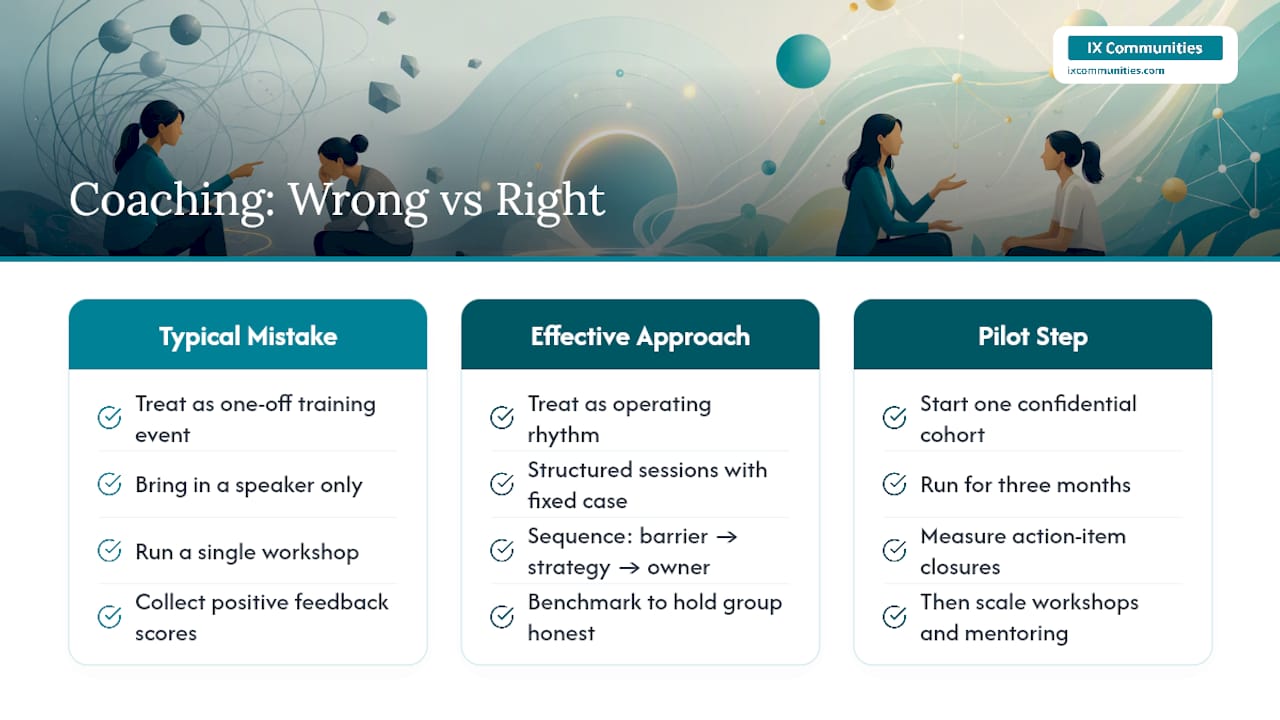
What the evidence actually supports is narrower and more demanding: structured sessions with a fixed case, barrier, strategy, owner sequence, and a benchmark that holds the group honest about progress. The peer coaching research is consistent on this point, participation stays high, but only when the format enforces follow-through rather than hoping for it.
If you're starting from zero, resist the urge to build the full five-layer program before piloting anything. Run one confidential leader cohort for three months first. Measure whether action items actually close. Everything else, workshops, mentoring, formal benchmarking, scales more easily once that core discipline exists.
— Simon
Where to Start With Ixcommunities
Some peer networking communities offer heads of TA a closed, vendor-free peer environment built around in-house recruiting, executive search, and diversity recruiting leaders at large corporations, rather than a mixed room of vendors and independent recruiters.
If you're evaluating where to start, check three things on any membership or vendor page before committing: confidentiality protections for peer discussion, whether the peer mix matches your organization's size and complexity, and what benchmarking deliverables actually come with membership versus what's promised in a sales call. TLIX Membership covers the facilitated leader peer-session layer, while ESIX Membership and DSIX Membership serve executive search and diversity recruiting leaders specifically. For the team workshop layer, browse IX Academy's recruiter training courses, available on-demand from $350, live online from $750, or as team-intact sessions from $3,000. If you want to see what a full membership bundle includes, including the ExecSmart database and benchmarking resources, start at the membership overview page.
Sources
- Process evaluation of a peer coaching intervention (BMC Health Services Research, 2025)
- Integrative review on internal team coaching competencies (MDPI, 2024)
- Recruiting executives: priorities and perspectives (SHRM, 2024)
- Measure your HR function’s effectiveness (Gartner HR Score)
FAQ
What Is a Recruiter Coaching Program for In-House Teams?
It's a layered initiative combining a diagnostic, facilitated peer leadership sessions, intact-team workshops, mentoring, and a closing benchmark review, built for heads of TA and their recruiting teams rather than solo agency recruiters.
How Long Should a Pilot Program Run?
A minimal pilot that proves value typically runs three to six months with a cohort of 6 to 12 peers, monthly facilitated sessions, and a handful of team workshops tied to a closing benchmark review.
What Metrics Should We Track First?
Start with time-to-offer, offer acceptance rate, quality-of-hire proxies like 90-day retention, and the completion rate of leader action items from peer sessions. Benchmark those against sources like SHRM's recruiting research or Gartner HR Score.
How Much Does Recruiter Coaching Training Cost?
Ixcommunities' IX Academy courses run from $350 one-off for on-demand training, $750 for live online sessions, and $3,000 for team-intact courses, listed on the IX Academy training page. Membership pricing for TLIX, ESIX, and DSIX is available on request through their respective membership pages.
What Makes a Coaching Program Fail?
Sessions that end at insight without an assigned owner, a deadline, or a between-session check-in rarely produce lasting change. Programs that build case, barrier, strategy, owner sequencing into every session see far higher follow-through, according to the 2025 peer coaching implementation study.