

Prompt engineering gives recruiters a reliable drafting co-pilot for sourcing, screening, and outreach. It speeds up job description writing, expands Boolean search coverage, and helps personalize outreach at scale. It only works when every output is grounded in verified facts and a human signs off before anything reaches a candidate.
TL;DR:
- Using prompt engineering for sourcing improves Boolean string variants and niche channel searches, requiring iterative prompts and verification of candidate profiles.
- Effective job descriptions must be context-specific, layered with inclusivity checks, and reviewed by humans to ensure legal accuracy and tone.
- Summarizing resumes and building scorecards demand structured, verifiable outputs, with provenance tracked and flagged for uncertain evidence.
- Outreach messages referencing verified candidate details outperform generic ones and should always include a low-pressure call to action.
- Implementing governance involves grounding prompts with real data, logging all AI activity, and requiring human approval to prevent the spread of fabricated facts.
Table of Contents
- What Is Prompt Engineering for Recruiters?
- Sourcing Prompts: Boolean Strings, Niche Channels, and Validation
- Writing Job Descriptions That Convert and Include
- Screening Prompts: Summaries, Scorecards, and Structured Data
- Candidate Engagement: Outreach That Doesn't Sound Like a Bot
- Guardrails: Grounding, Provenance, and Human Sign-Off
- A Starter Prompt Library for Recruiting Tasks
- Rolling Out Prompt Engineering Across Your TA Team
- A Talent Leader's Take on AI Prompts in Recruiting
- Learn Governance and Get Templates Through Ixcommunities
- Sources
- FAQ
What Is Prompt Engineering for Recruiters?
Prompt engineering for recruiters means writing structured instructions that turn a language model into a usable drafting tool for hiring work. The most reliable prompts follow a Context, Task, Format pattern: give the model the situation (role, seniority, must-have skills), state the specific task (write three Boolean variants, summarize a resume), then specify the exact output shape you need. Constraints are what make the output usable. An open-ended request produces generic text; a bounded one produces a draft you can act on.
Gem's prompting guide makes a useful distinction here: describe your ideal hire conversationally, the way you'd brief a search partner, rather than feeding the model a rigid keyword list. That framing consistently produces better sourcing and outreach output than treating the AI like a filter.
A general-purpose LLM is fine for one-off drafting, brainstorming alternate titles, or rewriting a paragraph. For anything at scale, scored, or logged for audit, you need a system built for recruiting that can track provenance and enforce validation. Immediate applications include:
- Drafting and rewriting job descriptions
- Generating Boolean search strings and channel lists
- Summarizing resumes and building scorecards
- Writing outreach sequences and follow-up messages
- Drafting interview questions tied to specific competencies
Sourcing Prompts: Boolean Strings, Niche Channels, and Validation
Boolean search is where prompt engineering pays off fastest, mostly because most recruiters write one string and stop. Asking a model for variants forces it to test synonyms, adjacent titles, and exclusions you'd otherwise miss.
- Start simple: "Write a Boolean search string for a [job title] with [X years] experience in [skill]." Use this as your baseline.
- Go layered: "Generate 5 Boolean variants for this role, each emphasizing a different synonym set for the core skill, plus one variant that excludes common false positives like [title confusion, e.g., 'sales engineer' vs 'engineer']."
- Go niche: "List 8 online communities, Slack groups, Discord servers, or forums where [persona] professionals discuss their work, ranked by likely candidate density."
The Undercover Recruiter's prompt guide recommends this iterative approach over a single "perfect" prompt, since Boolean logic almost always needs a second pass once you see real results come back.
Validation matters just as much as generation. Add a line to every sourcing prompt: "For each candidate suggestion, cite the source (LinkedIn URL, GitHub profile, or ATS ID) and flag confidence as HIGH, MEDIUM, or LOW." A model with no access to live data will sometimes invent plausible-sounding profiles, so never treat a name as real until you've verified it.
Pro Tip: Keep a running list of your best-performing Boolean variants by role family. Reusing what worked last quarter beats reinventing search logic every time a similar req opens.
Writing Job Descriptions That Convert and Include
A job description prompt only works if you feed it real context first: company size, team structure, salary band, remote policy, and benefits. Skip that step and you get a generic template that reads like every other posting on the internet.
A workable prompt looks like this: "Write a job description for a [title] at a [company size] company. Include a 2 sentence hook, a bulleted responsibilities section (max 6 bullets), a qualifications section split into required and preferred, and a closing paragraph on benefits and salary range [EX to $Y]. Keep total length under 500 words."
From there, layer in inclusivity and conversion checks:
- "Rewrite this JD to remove gendered or exclusionary language (e.g., 'ninja,' 'rockstar,' 'must have 10+ years') without softening the actual requirements."
- "Suggest 3 alternate job titles that candidates might search for instead of [current title]."
- "Extract a flat list of hard skills and soft skills mentioned in this JD, formatted as a table with a column for 'required' vs 'nice to have.'"
- "Rewrite the opening paragraph to lead with impact and growth opportunity instead of company history."
Salary is direct on this point: drafts save real time, but every JD still needs a human pass for legal accuracy and tone before it posts.
Screening Prompts: Summaries, Scorecards, and Structured Data
Screening is where structured output stops being a nice-to-have and becomes the whole point. If a model's response can't be parsed and checked, it can't be trusted at scale, and every recruiter running high volume knows what unstructured AI notes look like after 40 resumes.
Use a strict resume summary prompt: "Summarize this resume in exactly 5 bullets, under 100 words total. For each bullet, quote the specific line from the resume that supports it. If a claim can't be traced to the resume text, mark it UNCERTAIN instead of guessing."
For scorecards, specificity in the scale itself matters more than the prompt wording: "Score this candidate 1 to 5 against these three competencies: [X, Y, Z]. For each score, write one sentence defining what a 3 versus a 5 looks like, and cite the resume evidence used."
Then force the output into a format your systems can actually check:
- Request JSON or a markdown table with fields for candidate name, role dates, employer, and evidence quote.
- Require a provenance field naming where each data point came from.
- Insist on an UNCERTAIN flag anywhere the model lacks solid evidence, rather than letting it smooth over gaps.
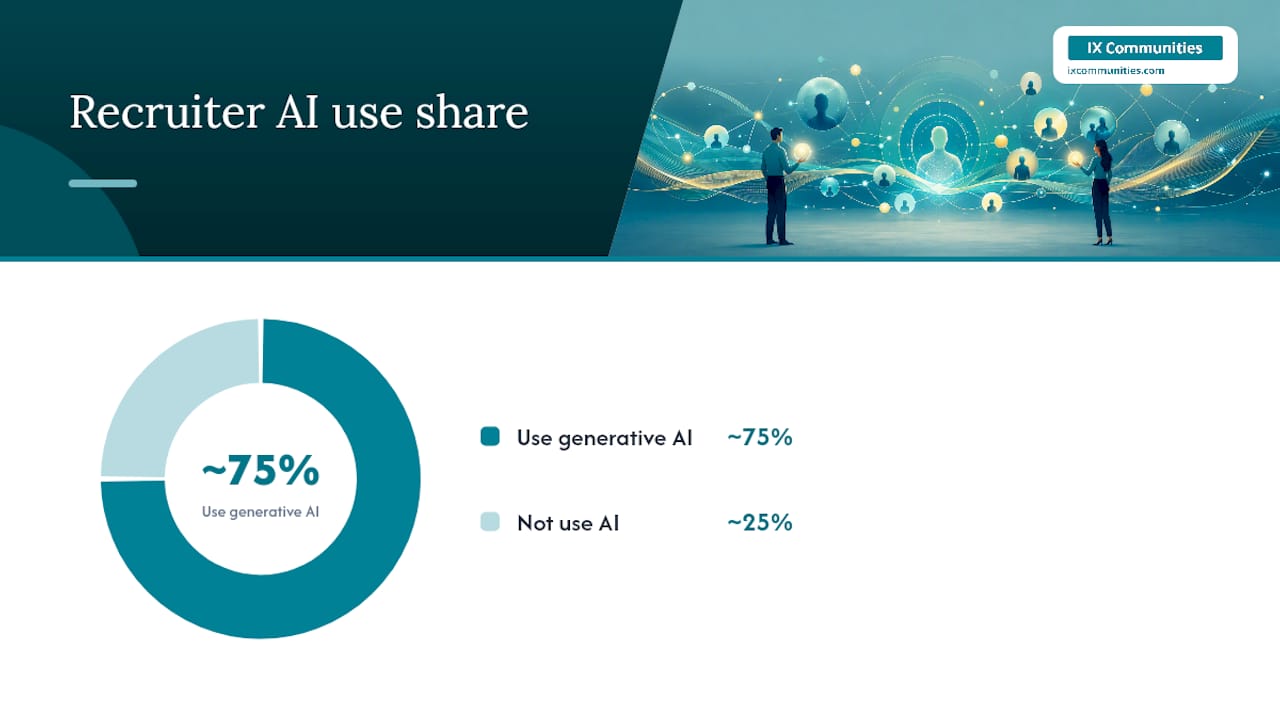
Adoption of this kind of AI-assisted screening is already mainstream. One industry estimate puts recruiter use of generative AI for at least some tasks at roughly three-quarters, which means the risk isn't whether your team will use these tools. It's whether anyone is checking the output.
Candidate Engagement: Outreach That Doesn't Sound Like a Bot
Personalized outreach is the highest-leverage use of prompt engineering, and also the easiest place to get sloppy. A message that references one real, verified detail about a candidate reads as researched. A message stuffed with three generic compliments reads as automated, because it is.
- Draft the message: "Write 3 variants of an outreach message to a [role] candidate. Each should reference exactly one verified fact about their background, stay under 80 words, and end with a low-pressure call to action like 'open to a quick chat?' rather than a hard ask."
- Sequence the follow-up: "Write a 3-touch follow-up cadence for a candidate who hasn't responded. Touch 1 at day 3 (light nudge), touch 2 at day 7 (add new information about the role), touch 3 at day 14 (final, polite close). Vary the tone from casual to slightly more direct."
- Build passive-candidate content: "Suggest 5 LinkedIn post ideas that would attract [persona] passive candidates without mentioning a specific open role, plus a one-line visual concept for each."
One rule sits above all three: never paste a candidate's personal identifying information into a public or third-party model, and never reference private data in outreach without documented consent. A resource on humanizing AI-generated text is worth a look if your outreach drafts keep coming back sounding stiff. The fix is usually shorter sentences and one specific detail, not more adjectives.
Guardrails: Grounding, Provenance, and Human Sign-Off
The single biggest failure mode in recruiting AI isn't a bad prompt. It's a model confidently inventing a fact, then a recruiter spending an hour untangling the mess before it reaches a candidate or a hiring manager. Practitioner research calls this the "cleanup trap," and the fix is architectural, not just better wording.

Ground every fact-dependent prompt in retrieval-augmented generation (RAG), pulling from your ATS or CRM records rather than the model's general training, and set a time-to-live on cached data so nothing stale gets reused. PeopleTech's operational guidance recommends pairing RAG with deterministic model settings for anything factual, plus structured outputs an automated validator can actually check.
Build these controls into your workflow now, not after something goes wrong:
- Log source ID, model version, prompt version, and timestamp for every AI-generated candidate record.
- Require human approval before any AI-drafted content reaches a candidate, hiring manager, or scorecard file.
- Run a bias audit on prompt outputs quarterly, checking for skewed language or scoring patterns across demographic groups.
- Confirm consent and disclosure requirements before referencing any personal candidate data.
Pro Tip: Version your prompt templates the same way you'd version code. A small wording change can shift output tone or accuracy, and you'll want to know exactly which version produced a given candidate record if it's ever questioned.
A Starter Prompt Library for Recruiting Tasks
A handful of well-built prompts cover most day-to-day recruiting work. Keep these five as your baseline, then adapt the bracketed placeholders per role:
- Sourcing: "Give 3 Boolean variants for [role], each testing a different synonym set for [core skill], plus 1 exclusion variant."
- JD drafting: "Write a JD for [title] at a [size] company, structured as hook, responsibilities, required/preferred qualifications, and closing benefits paragraph, under 500 words."
- Resume summary: "Summarize this resume in 5 bullets under 100 words, quoting supporting evidence for each, flagging UNCERTAIN where evidence is thin."
- Scorecard: "Score this candidate 1 to 5 on [competencies], defining each score level and citing evidence."
- Outreach: "Write 3 outreach variants referencing one verified fact, under 80 words, ending with a low-pressure CTA."
Store these centrally with a version number and an owner, not scattered across individual recruiters' notes apps. Test each template on 10 to 15 real cases before rolling it to the full team, and revise the wording whenever you notice a recurring gap between the model's output and what you actually needed.
Rolling Out Prompt Engineering Across Your TA Team
Scaling this responsibly means treating it as a pilot with governance attached, not a tool everyone gets access to on day one.
- Pilot narrow: Choose 1 to 3 roles, set up RAG grounding and a validation step, and require human review on every output before it ships.
- Govern before scaling: Build a shared prompt library with an approval workflow, plus retention rules and an audit trail for every AI-touched candidate record.
- Measure what matters: Track edit count per draft, auto-approval rate, candidate response rate, and time saved per hire, then expand only once those numbers hold steady.
A Talent Leader's Take on AI Prompts in Recruiting
A well-built prompt template can cut job description drafting time dramatically. The trap is assuming that speed means the output is trustworthy without a second look; a fast draft with a fabricated skill requirement is still a fabricated skill requirement.
Treat AI as a co-pilot, not a decision-maker, and validate before anything reaches a candidate. What separates teams that scale this safely from teams that don't is usually not the prompt quality. It's whether anyone benchmarked their governance approach against peers instead of building it alone. That's a conversation worth having inside Ixcommunities.
— Simon
Learn Governance and Get Templates Through Ixcommunities
Ixcommunities gives talent leaders something no AI vendor can: a vendor-free room of peers who've already tested these prompts and hit the same validation problems. If your team is past the "should we use AI" question and into "how do we govern it," the fastest path isn't another blog post. It's benchmarking your prompt library and approval workflow against other in-house TA leaders who've already built theirs.
If you need your team trained on the mechanics, the ON-DEMAND, live online, and team-intact courses start from $350 for individual on-demand access up to $3,000 for a team-intact session. If you're leading talent acquisition and want ongoing peer benchmarking on AI governance, prompt libraries, and hiring policy, TLIX Membership puts you in a confidential room with other corporate TA heads doing the same work. Executive recruiting leaders should look at ESIX Membership instead. Start by reviewing the TLIX membership page and see which peer group fits your team's stage.
Sources
- AI prompting guide for recruiters — Gem
- The Recruiter’s Guide to Prompt Engineering — The Undercover Recruiter
- Salary
- 8 Generative AI Prompts Every Recruiter Should Have in Their Back Pocket — LinkedIn Talent Blog
FAQ
What Are Some Effective AI Prompts for Recruiters?
The most effective prompts follow the Context, Task, Format pattern: give the model your role details, ask for a specific output like "3 Boolean variants" or "a 5 bullet resume summary," and specify the exact format you need. The LinkedIn Talent Blog's prompt list covers eight of the highest-value ones, spanning sourcing, job descriptions, and outreach.
Are Prompt Engineers Still in Demand?
Dedicated "prompt engineer" as a standalone title has narrowed as models have gotten better at interpreting plain instructions, but the underlying skill of writing precise, grounded prompts is more valuable than ever inside recruiting teams specifically. For TA leaders, the demand isn't for a new hire. It's for every recruiter on the team to build this into their existing workflow.
Which AI Tool Is Best for Recruiters?
There's no single best tool, because sourcing, screening, and outreach have different requirements around grounding, scale, and audit trails. A general LLM works fine for one-off drafting, while high-volume or scored tasks need a system with structured output and provenance logging built in. Ixcommunities members compare notes on specific tool performance inside peer forums like TLIX, which tends to be more useful than any single vendor's own claims.
Do Recruiters Care if You Use AI for a Resume?
Most recruiters care less about whether AI helped draft a resume and more about whether the content is accurate and specific to the candidate. A resume that reads as generic AI output, with vague accomplishments and no concrete numbers, raises more concern than one that's clearly been polished. The same principle applies in reverse: recruiter-side AI drafts need a human check for accuracy before anything reaches a candidate, a point Salary.com's guidance makes explicitly.