

Pay transparency laws now require employers in more than a dozen U.S. states and D.C. to disclose pay ranges in job postings, and a growing number of jurisdictions also ban asking candidates about salary history. If your company hires across state lines, some of these rules almost certainly apply. Audit your job postings and applicant forms against the states where you have roles posted or supervisors located, and correct any gaps before your next round of hiring by following a practical payroll compliance checklist for Finnish small businesses to adapt effective operational controls.
TL;DR:
- Most states with pay transparency laws now require including pay ranges in job postings, especially where employers hire remotely or across multiple states.
- Employers must map jurisdictional requirements carefully, considering location, supervisor, and reporting site to ensure compliance with all applicable laws.
- Dropping salary history questions and standardizing pay-range disclosures into ATS templates significantly reduces compliance risks.
- Enforcement varies by state but typically involves labor departments investigating complaints and imposing fines, with remote roles often triggering specific state laws.
- Leading companies often centralize pay policy approval, use standardized templates, and monitor internal metrics like range width to maintain consistent compliance.
Table of Contents
- What Are Pay Transparency Laws and Salary-History Bans?
- How Do State Pay-Transparency Laws Differ by Category?
- Salary-History Bans vs. Pay Transparency: What's the Difference?
- What Should HR Do to Comply This Week?
- How Are Pay Transparency Laws Enforced?
- When Does a Remote Role Trigger Another State's Law?
- What Do Large Employers Benchmark on Pay Transparency?
- Where to Verify Current Pay Transparency Requirements
- Why Most Compliance Advice on This Topic Misses the Point
- Sources
What Are Pay Transparency Laws and Salary-History Bans?
Pay transparency laws require employers to disclose compensation information tied to a job. Depending on the state, that disclosure has to happen in the job posting itself, on request from an applicant, after an interview, or to existing employees who ask about a role. Salary-history bans work differently: they don't require employers to share anything. Instead, they prohibit asking candidates what they currently earn or previously earned, and in most cases bar employers from relying on that history to set an offer even if a candidate volunteers it.
The two rules often overlap in the same state, and that's not a coincidence. Lawmakers designed salary-history bans to interrupt the pattern where a worker's underpayment at one job followed them into the next, compounding over a career. Pay transparency laws attack the same problem from a different angle, forcing employers to anchor offers to a role's market value rather than a candidate's negotiating position. Several jurisdictions had salary-history bans in place by mid-2026, according to tracking by Reveal Background, and a similar cluster of states now require some form of pay-range disclosure.
Where employers get tripped up is assuming these are niche state quirks. They're not. California, Colorado, Connecticut, Illinois, Maryland, Massachusetts, Nevada, New Jersey, New York, Oregon, Rhode Island, Virginia, Vermont, Washington, and the District of Columbia all have active disclosure or history-ban statutes, and several more states are considering similar bills. If you post jobs nationally or hire remote workers, you're very likely already covered by at least one of these laws.
Here's the practical breakdown of how disclosure obligations differ by trigger point, with employer-size thresholds and effective dates where they apply.
Posting duty states now outnumber "on request" states, and the gap keeps widening. If your postings don't already include a range, you're behind the curve rather than ahead of it. According to Clear Money Guide's 2026 breakdown, the trend since 2021 has been toward pairing posting duties with salary-history bans in the same statute, which means a single compliance fix (adding ranges, dropping history questions) often satisfies two separate legal requirements at once.
How Do State Pay-Transparency Laws Differ by Category?
Not every state pay-transparency requirement functions the same way, and lumping them together is how compliance gaps happen. Four categories cover almost every statute on the books:
- Posting duty: the employer must include a pay range directly in the job listing, whether it's an internal posting or an external job board.
- Disclosure on applicant request: the employer doesn't have to publish a range but must provide one if the candidate asks, sometimes at a specific stage (before the interview, after an offer).
- Disclosure after interview: a narrower version of the request rule, where the obligation only triggers once the candidate has actually interviewed.
- Disclosure to existing employees: some states extend the same range-sharing duty to current employees who ask about the pay range for their own position or one they're considering.
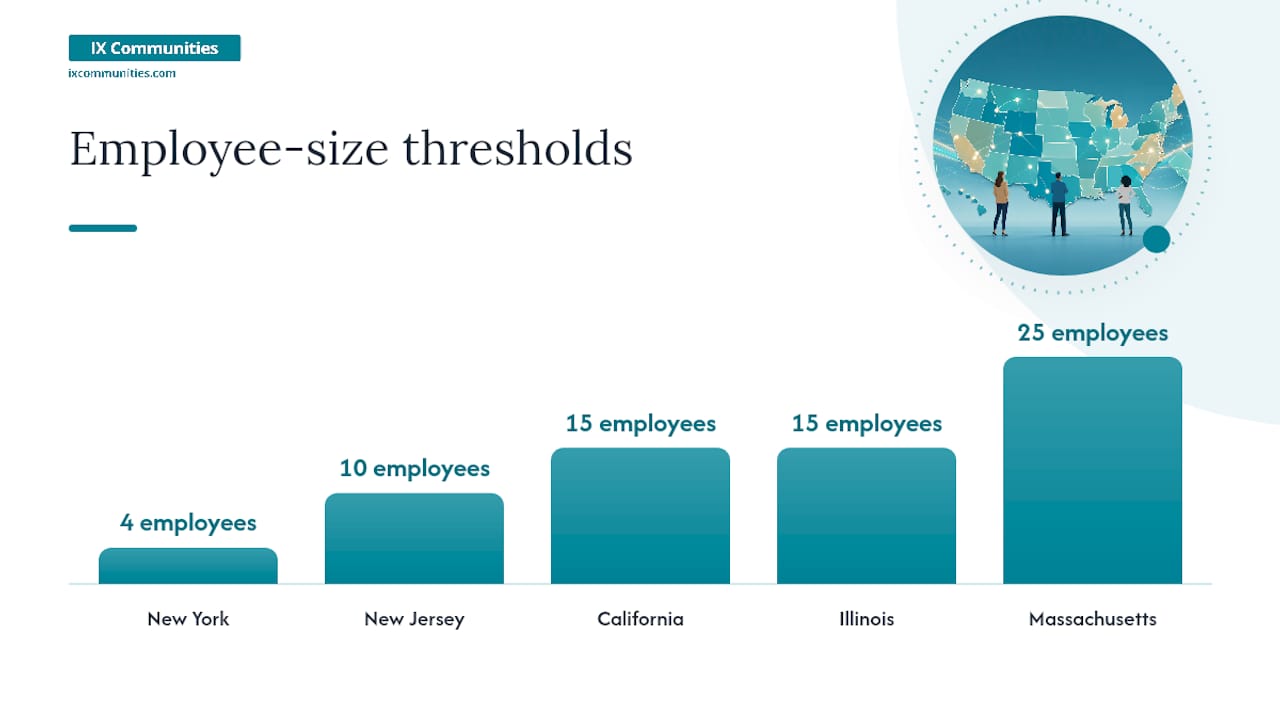
California's law under Labor Code Section 432.3 requires employers with 15 or more employees to include pay scale in every job posting, whether posted directly or through a third-party recruiter. Colorado's Equal Pay for Equal Work Act goes further by dropping the size threshold entirely, meaning a two-person startup in Denver has the same posting duty as a national retailer. Illinois' amended Equal Pay Act applies at 15 employees and adds a wrinkle many employers miss: it requires internal notice of open positions to current employees, not just external posting compliance.
Massachusetts' Wage Transparency Act sets its threshold at 25 employees but bundles in EEO reporting duties that started February 1, 2025, with the posting requirement itself taking effect October 29, 2025. New York's threshold is the lowest on this list at four employees, catching far more small and mid-size companies than most HR teams expect. New Jersey requires 10 or more employees. Virginia's rule is narrower and locality-dependent, applying mainly to specific job categories rather than blanket coverage. D.C. mirrors Colorado's no-threshold approach.
Pro Tip: Don't rely on your company's total headcount to determine threshold coverage. Several states count only employees physically working in that state, while others count anyone the company employs nationally. Check the statute's own definition before you assume you're exempt.
The size threshold isn't a technicality. It determines whether a 12-person regional office in Illinois has to post ranges (no, it's under 15) while the same company's New York satellite office of five people does (yes, New York's threshold is four).
Salary-History Bans vs. Pay Transparency: What's the Difference?
A salary-history ban stops the conversation before it starts. It prohibits employers from asking a candidate what they currently make or previously made, and in most banning states, it also bars employers from using that number even if the candidate offers it unprompted. Pay transparency duties work in the opposite direction: they force the employer to share information rather than withhold a question.
The practical effect for recruiters is a mirror image of the old process. Instead of asking "What's your current salary?" to gauge whether a candidate fits the budget, recruiters now need to state the range up front and ask the candidate whether it aligns with their expectations.
- Confirm which states ban salary-history questions. Most posting-duty states also carry a history ban, but not all, so check both statutes separately for each jurisdiction where you hire.
- Watch for voluntary-disclosure exceptions. Several states allow a candidate to volunteer their salary history without penalty, but the employer still can't ask for it or use it to justify a lower offer.
- Remove salary-history fields from applications entirely. Practitioners increasingly recommend a single nationwide application process that drops history fields altogether, rather than maintaining state-specific versions, since it eliminates the risk of a form defaulting to the wrong jurisdiction's rules (Reveal Background).
- Replace history questions with expectation questions. Asking "What are your salary expectations for this role?" gathers the same negotiating information without touching banned territory.
Legal analysis on interview practices notes that very few questions are actually illegal on their face. The bigger risk is how an answer gets used afterward. A recruiter who asks about salary history and then sets an offer based on it has created evidence of exactly the practice these bans exist to stop, according to analysis published in the Journal of Employment Law.
What Should HR Do to Comply This Week?
Treat this as an operational sprint, not a policy memo that sits in a shared drive. Here's the order that actually reduces risk fastest.
- Map every jurisdiction where you have hiring nexus. This includes states where a role is physically based, where the supervisor sits, and where the reporting office is located, not just where your headquarters is.
- Audit current postings and applicant forms. Pull every live job listing and flag any missing pay ranges or lingering salary-history fields.
- Build documented pay ranges tied to market data. Ranges need an internal rationale, ideally benchmarked against real market data, so they hold up if challenged.
- Update your ATS templates and add jurisdiction tags. A posting template that auto-populates a range field for Colorado but leaves it optional for Texas prevents accidental omissions.
- Train recruiters and hiring managers with real scripts. Give them exact replacement language for the interview questions they're used to asking, and keep a record that training happened.
- Set a recordkeeping and review cadence. Quarterly checks catch new hires into supervisory roles that shift a team's jurisdictional coverage before it becomes a violation.
Pro Tip: Keep a dated log of every posting template change tied to a specific statute. If a state agency ever asks for evidence of good-faith compliance, a timestamped audit trail is worth far more than a verbal assurance that "we fixed it."
How Are Pay Transparency Laws Enforced?
Enforcement mostly runs through state labor departments and attorneys general rather than a single federal agency, though claims can escalate to the EEOC when a pay dispute overlaps with a discrimination allegation under Title VII or the Equal Pay Act.
- Massachusetts built in a compliance runway: employers get a cure period to fix a first violation before civil penalties attach, per state guidance.
- Colorado accepts complaints directly through the CDLE, which can investigate and order remedies, with no minimum employer size shielding a company from a complaint.
- Illinois ties penalties to its Equal Pay Act framework, including fines tied to job-posting recordkeeping failures.
- California allows statutory penalties per violation and gives the Labor Commissioner authority to investigate complaints.
If your company receives a notice or complaint, the response sequence matters. Start with an internal review of the specific posting or hiring file in question, correct the underlying template company-wide (not just the flagged listing), document the remediation, and loop in employment counsel before responding formally to any state agency.
When Does a Remote Role Trigger Another State's Law?
Remote hiring is where most multi-state employers get caught off guard. New York's guidance makes clear that a role can trigger the state's disclosure duty if it reports to a supervisor or office located in New York, even when the employee works from another state entirely, according to NY DOL's pay-transparency FAQ. Applicability tracks the reporting relationship more often than the worker's mailing address.
Three fields your ATS should capture for every requisition:
- Worker location, meaning the physical state the employee will work from.
- Supervisor location, since that's the state whose rules often govern regardless of where the worker sits.
- Job reporting site, the office the role is formally attached to for organizational purposes.
Tag every open requisition with all three, adjust posting language to match whichever jurisdiction's rule is strictest, and build this into your regular compliance review rather than treating it as a one-time fix.
What Do Large Employers Benchmark on Pay Transparency?
Inside Ixcommunities' peer networks, talent leaders at large corporate employers converge on a few shared practices rather than reinventing compliance separately at each company. A centralized pay-policy owner, usually someone in compensation or HR compliance, signs off on every range before it goes live, which prevents the drift that happens when individual recruiters set their own numbers. Standardized pay-range templates get built once and reused across job families instead of recreated per requisition. ATS jurisdiction tagging, the same practice described above for remote nexus, shows up consistently as a shared control across member companies.
Metrics worth tracking internally include range width (how wide a spread you're publishing, since an unreasonably broad range invites scrutiny), the percentage of live postings that actually include a compliant range, and your cadence for EEO-related reporting where states like Massachusetts require it. These are the numbers that surface a compliance gap before a regulator does.
Where to Verify Current Pay Transparency Requirements
Bookmark the primary sources rather than relying on secondary summaries alone: the DOL's brief on salary-history bans, each state's own labor agency page, and your employment counsel for final interpretation. Statutes change, and this article is not a substitute for legal advice on your specific situation.
Why Most Compliance Advice on This Topic Misses the Point
The conventional advice treats pay transparency laws as a legal problem to hand off to counsel once a year. That's backwards. The states move faster than annual review cycles can track, Massachusetts alone shifted its posting deadline and EEO reporting schedule within the same statute, and a company that only checks in annually will always be finding out about a gap after it's already a liability.
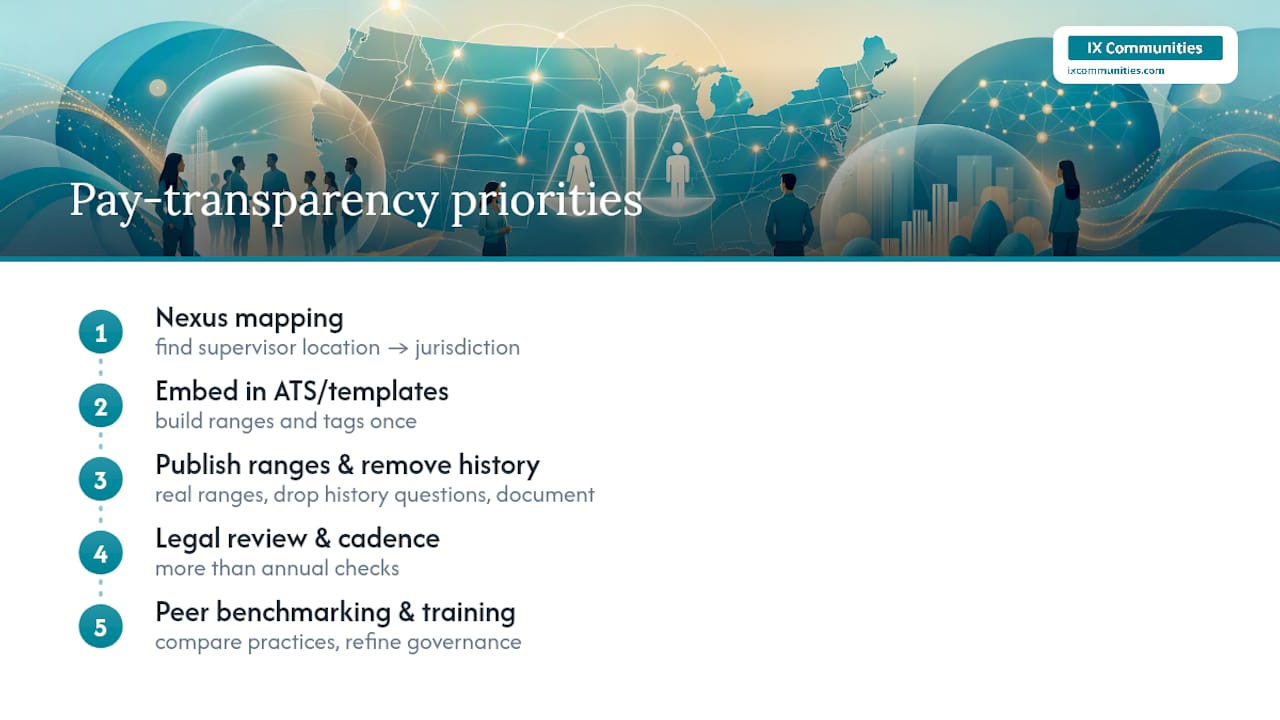
The bigger miss is treating disclosure and history-ban compliance as separate projects. They're the same operational fix: publish real ranges, drop history questions, and document both. Companies that build this once into their ATS and posting templates stop treating each new state law as a fire drill.
What I'd prioritize first, ahead of legal review, ahead of training decks, is the nexus mapping. Most compliance failures I'd expect to see aren't about not knowing a law exists. They're about not realizing a remote hire's supervisor location quietly pulled that role into a jurisdiction nobody flagged.
— Simon
Members of peer networking and benchmarking communities get access to data and discussion on compliance questions, comparing how large talent teams structure pay-range governance and ATS tagging in practice. If your team is building or refining a multi-state pay-transparency compliance process, explore peer networking and benchmarking memberships to see how other corporate talent leaders are handling it.