

The most effective interviewer training program combines structured interview guides, anchored scorecards, deliberate practice with coaching, and quarterly calibration sessions. That model consistently produces more reliable hiring decisions than one-off workshops or generic tips-and-tricks sessions. Leaders should expect measurable gains in scoring consistency within one or two hiring cycles, and organizations like Ixcommunities give talent teams a peer-tested starting point for the rubrics and question banks this model requires.
TL;DR:
- Nearly all effective interviewer training programs include structured question banks, anchored scorecards, and calibration sessions to ensure consistency and reduce bias.
- Building a successful program requires clear, measurable outcomes, focus on high-volume roles, and ongoing supervised practice with feedback to change interviewer behavior.
- Regular calibration, coaching, and recertification are essential to prevent scoring drift and maintain interview quality over multiple hiring cycles.
- Peer benchmarking and shared templates through groups like Ixcommunities can significantly accelerate the development and refinement of effective interview tools.
- Most training efforts fail if they omit supervised repetition, as real skill transfer depends on repeatedly practicing, receiving feedback, and aligning scoring standards.
Table of Contents
- What an Effective Interviewer Training Program Includes
- How to Design an Internal Interviewer Training Program Step by Step
- Core Curriculum Modules and a Sample Lesson Plan
- Choosing the Right Delivery Format and Scaling Across Managers
- Turning Practice Into Lasting Interviewer Skill
- Measuring Impact: Which Metrics Actually Matter
- How Peer Benchmarking Speeds Up Program Design
- Primary Sources and Further Reading
- What This Research Actually Tells HR Leaders to Prioritize
- Get Peer-Tested Templates Through Ixcommunities Membership
- Sources
What an Effective Interviewer Training Program Includes
A structured interview asks every candidate for a given role the same core questions, scores their answers against a predefined rubric, and requires interviewers to document evidence before forming a judgment. That discipline is the opposite of the free-flowing conversation most hiring managers default to.
The case for structure isn't theoretical. DDI's research on behavioral interview techniques identifies four elements that separate structured interviewing from casual conversation: job-related behavioral questions, standardized scorecards, calibration sessions, and predefined competency rubrics. Each element closes a specific gap. Standard questions stop interviewers from improvising based on rapport. Scorecards force a written judgment instead of a gut feeling. Calibration catches the interviewer who scores everyone a 4 out of habit.
HBR's practitioner commentary on interviewing makes an important point that still holds decades later: experienced managers tend to overestimate their own interviewing skill, a pattern worth calling "habit lulling." Years of conducting interviews create false confidence, not better judgment, unless the interviewer is actively trained and coached against a standard.
A high-impact interviewer training program should give hiring managers all of the following before they run a live interview:
- A validated question bank tied to the specific competencies for that role.
- A scorecard with anchored rating levels, not a blank 1 to 5 scale.
- At least one coached mock interview with recorded feedback.
- Clear guidance on what they can and cannot legally ask.
- A calibration session where they compare scores against peers on the same recorded interview.
Omitting any of these elements can reduce the structure of the interview back toward an unstructured conversation.
How to Design an Internal Interviewer Training Program Step by Step
Building a program from scratch is less about content creation and more about sequencing. Skip a step and the training looks polished but fails to change what happens in the room.
- Set measurable outcomes before writing a single slide. Decide what "success" means: fewer failed hires in the first 90 days, tighter score agreement between interviewers, faster time-to-decision. Vague goals like "better interviews" produce vague training.
- Define scope precisely. Identify which hiring managers need training first (usually those hiring the highest volume or the most senior roles), which job families are in scope, and whether contractors or panel members are included.
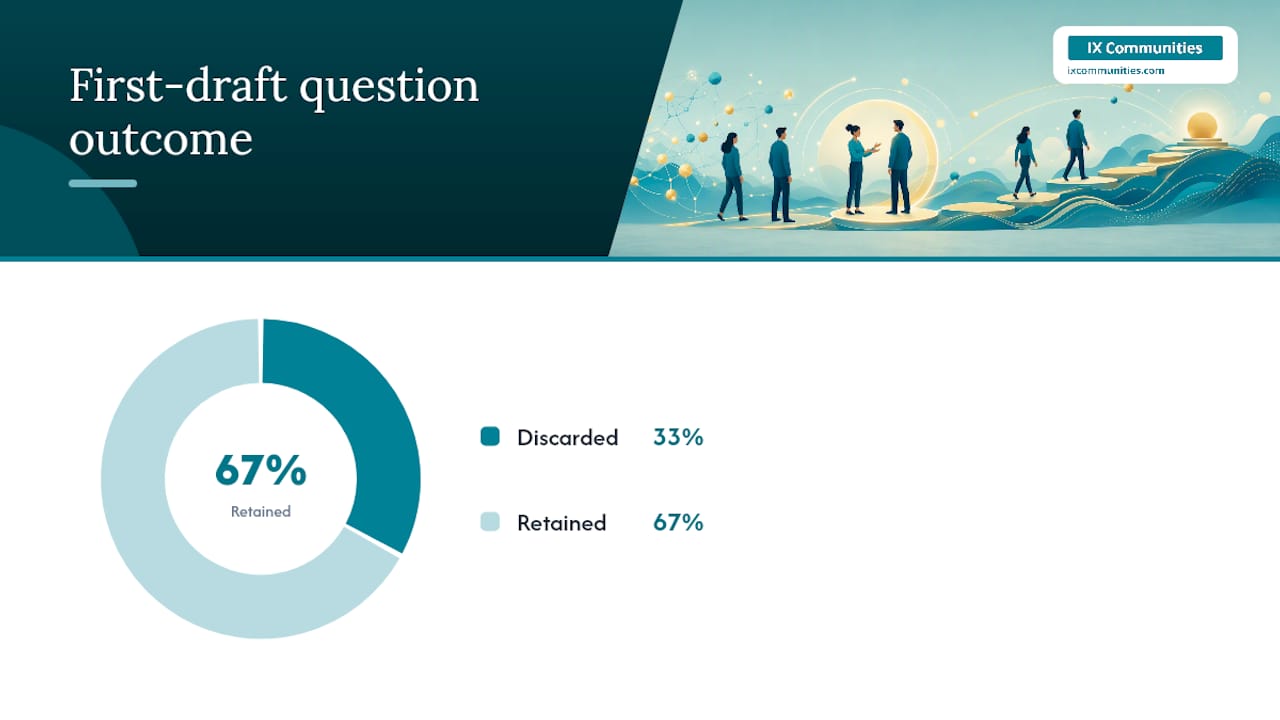
- Build question banks with subject matter experts, not HR alone. Practitioner guidance from Re:Work's structured interviewing guide recommends overproducing candidate questions, piloting them with actual hiring managers, and discarding any that fail to reliably surface job-relevant evidence. Expect to cut a third of your first draft.
- Create anchored rubrics and standardized scorecards. A rubric that just says "1 to 5" invites five different interpretations of a 3. Anchor each level with an observable behavior: what does a "meets expectations" answer to a specific prompt actually sound like?
- Plan a delivery cadence with reinforcement built in. One workshop does not create a skill. Pair an initial session with coached practice on live interviews and a recertification checkpoint every six to twelve months.
Pro Tip: Build your first question bank for the highest volume role in your pipeline, not the hardest one. You will pilot and refine questions faster when you have more candidates flowing through the process to test them against.
The order matters here. Teams that jump straight to scheduling workshops, before defining what they are training toward, end up with content that feels comprehensive but doesn't move any metric. Set the outcome first, then build backward.
Core Curriculum Modules and a Sample Lesson Plan
A complete interviewer training curriculum has seven modules, and skipping any one of them leaves a predictable gap in interviewer behavior.
- Job analysis and competency mapping — what does success actually look like in this role?
- Behavioral question design — writing prompts that require candidates to describe real past behavior, not hypotheticals.
- STAR-based probing — using Situation, Task, Action, Result to dig past a rehearsed answer and get specific evidence.
- Scoring practice — rating sample answers against the anchored rubric until interviewers converge on similar scores.
- Bias mitigation — recognizing halo effect, similarity bias, and first-impression anchoring in real time.
- Legal do's and don'ts — what questions are off-limits and why.
- Mock interviews with scored feedback — the highest-value module, and the one most programs shortchange.
Sample lesson plans from OPM's structured interview guidance and the DOL's TEAMS interview skills workshop both structure sessions around a before, during, and after framework, with heavy emphasis on note-taking standards and documentation.
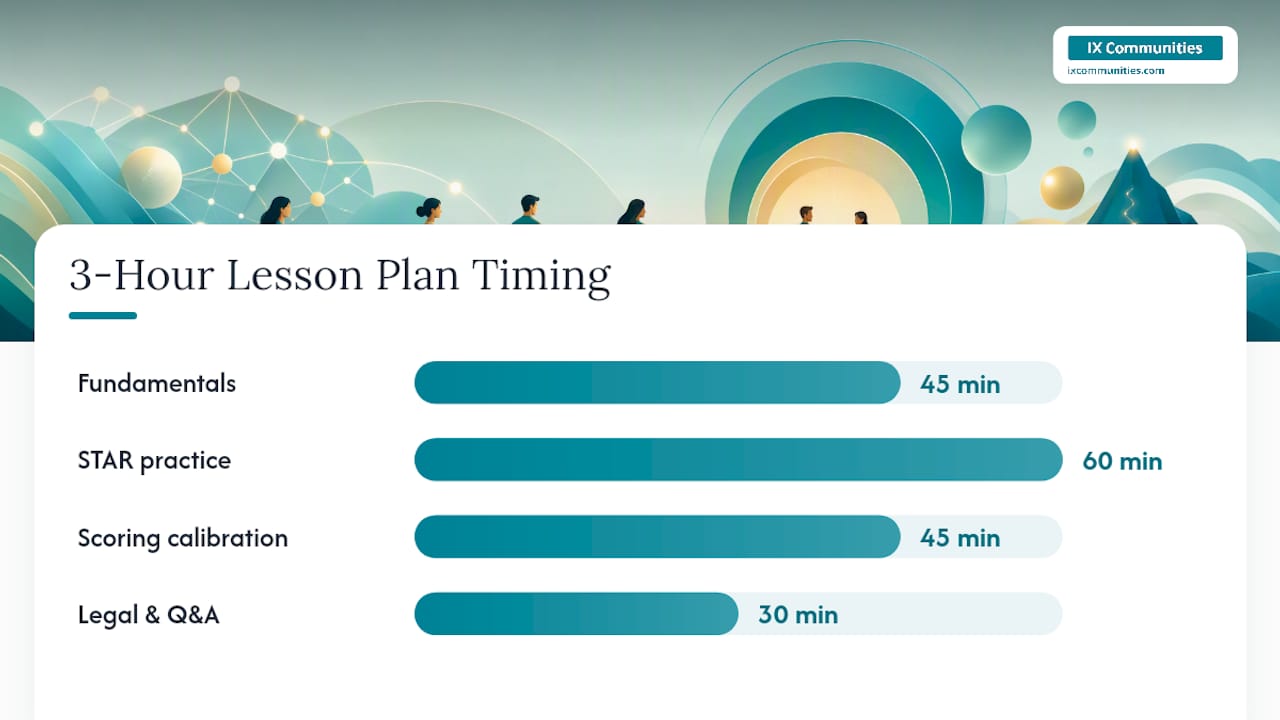
For a compact 3-hour module, plan roughly 45 minutes on structured interviewing fundamentals, 60 minutes on STAR-based question practice in pairs, 45 minutes on scoring calibration using a sample transcript, and 30 minutes on legal boundaries and Q&A.
For a fuller 4 to 8 hour workshop, add a comprehensive mock interview segment where each participant practices and receives scored feedback, followed by group debrief. This is the piece Re:Work's guidance points to repeatedly: interviewers improve fastest when they see their own scoring compared against peers on the exact same conversation. A workshop that skips this and stays lecture-based rarely changes behavior once managers return to their desks.
Choosing the Right Delivery Format and Scaling Across Managers
Format choice depends less on preference and more on how many managers you need trained and how often your hiring cadence demands fresh interviewers. There's no single right answer, but there is a wrong one: picking a format that doesn't match your hiring volume.
- Micro-modules (15 to 30 minutes) work well for refresher content and just-in-time prep before a specific interview loop, but they cannot carry a full mock-interview practice session.
- Half-day workshops fit teams onboarding a new cohort of hiring managers or refreshing a curriculum after a compliance update.
- Cohort-based virtual training scales well across distributed teams and lets you run calibration exercises with interviewers from multiple offices scoring the same recording.
- Train-the-trainer models make sense once you have more than a handful of hiring managers to certify each year; a small group of certified coaches can run local sessions without HR being present at every one.
Recorded role-plays and interview transcripts speed up coaching turnaround considerably. Rather than scheduling a live observation for every new interviewer, a coach can review a recorded mock interview on their own schedule and return written feedback within a day. Some teams are experimenting with AI-based transcript analysis to flag missed probing opportunities or leading questions before a human coach even reviews the session, which cuts the coaching backlog that kills most training programs by month three.
Turning Practice Into Lasting Interviewer Skill
Training sticks when it's followed by supervised repetition, not when the workshop ends. This is the piece most programs underfund, and it's exactly where behavior actually changes.
- Mandate coached reviews for the first three to five live interviews a newly trained manager conducts. A coach reviews the recording or scorecard and gives specific feedback before the next interview, not a general "good job" after the fact.
- Run quarterly calibration sessions where multiple interviewers independently score the same recorded interview, then compare results as a group. DDI's research treats this step as essential precisely because scoring drift happens silently. An interviewer who has quietly inflated every score for six months has no idea until a calibration session shows the gap.
- Set certification rules with a recertification cadence. A one-time certification that never expires is functionally worthless two years later, especially after role definitions or competency models change.
- Run spot audits on a sample of completed scorecards each quarter to catch interviewers who have drifted back into old habits.
Pro Tip: Keep calibration sessions to 45 minutes and use the same recorded interview across every cohort for a full quarter. Comparing fresh scores against a known baseline surfaces drift far faster than a new recording every time.
A practical benchmark worth building toward: A practical benchmark is to build several behavior-based questions for an interview of typical length, each with a rubric anchored at four or five levels using concrete, observable descriptors rather than adjectives like "good" or "strong." That level of specificity is what actually reduces the gap between two interviewers scoring the same candidate.
Measuring Impact: Which Metrics Actually Matter
Four metrics tell you whether an interviewer training program is working, and none of them require exotic tooling to track.
- Interviewer readiness, measured by pass rates on a certification assessment or calibration exercise.
- Candidate experience, tracked through short post-interview surveys asking whether questions felt relevant and fair.
- Time-to-hire, since structured processes with clear scoring criteria tend to shorten decision cycles by eliminating the "let's discuss again next week" loop.
- Quality of hire at 90 days, correlated back against interview scorecards to see whether high scorers are actually performing well on the job.
Collecting this data doesn't require a new system. Aggregate scorecards by interviewer and by role, then correlate scores against 90-day performance ratings once that data exists. Pair it with a short candidate survey sent immediately after the interview, while the experience is still fresh, rather than weeks later when memories blur.
Realistic timelines matter here too. Expect the first calibration session to reveal wider scoring gaps than anyone predicted; that's the point of running it. Meaningful convergence in scoring consistency typically shows up over two to three hiring cycles, not the first one. Quality-of-hire correlations take longer still, since you need a full 90-day performance cycle to complete before the data means anything. Programs that abandon measurement after one quarter never see the payoff that the second and third quarter deliver.
How Peer Benchmarking Speeds Up Program Design
Building question banks and rubrics from a blank page takes months. Most of that time gets spent reinventing content another company already tested and refined.
Peer benchmarking groups shortcut this. When talent leaders compare notes on which behavioral questions actually surfaced useful evidence, which rubric language reduced scoring drift, and which mock-interview formats got managers to change their habits, the design cycle for an internal program shrinks considerably. Someone else has already piloted the weak questions out of their bank.
Ixcommunities gives talent acquisition and recruiting leaders a few specific ways to use that peer knowledge:
- Peer benchmarking sessions where member organizations compare interviewer training approaches and outcome metrics directly.
- Practitioner guidebooks covering recruiting best practices, including structured interview design.
- Expert guest speaker sessions on topics like bias mitigation and rubric calibration.
- A secure community for sharing templates and lessons learned without exposing proprietary hiring data publicly.
Applying behavioral science principles from adult-learning research, like the approach detailed in this guide to behavioral science in employee development, can sharpen how reinforcement and spaced practice get built into a recertification cadence.
Primary Sources and Further Reading
- OPM's structured interview guide supplies sample lesson plans and note-taking standards used throughout the curriculum section.
- DDI's behavioral interview research backs the core structured-interviewing elements and calibration guidance.
- HBR's commentary on interviewing strategy informs the argument for practice-focused, systematic training over conversational habit.
- DOL's TEAMS interview skills workshop materials provide the lesson-sequencing model referenced in the sample workshop plans.
- Re:Work's structured interviewing guide supports the guidance on SME involvement, question piloting, and anchored rubrics.
What This Research Actually Tells HR Leaders to Prioritize
The evidence points somewhere most training budgets don't go: coaching on real interviews, not classroom content. A workshop teaches the concept of a structured interview in an afternoon. It does not teach a hiring manager to stop finishing a candidate's sentence for them, or to probe past a rehearsed answer, or to resist scoring the candidate they liked a point higher out of habit. Only supervised repetition does that.
Conventional advice tends to treat interviewer training as a compliance box: run the session, check attendance, move on. That approach produces interviewers who can define STAR on a quiz and still run a completely unstructured conversation the next week. The "habit lulling" problem HBR describes doesn't get fixed by information. It gets fixed by feedback on a real recording, from a real coach, more than once.
If a team can only fund one part of this model well, fund the coached mock interviews and the calibration sessions. The question bank matters, the rubric matters, but neither one changes behavior without someone checking the work against a standard, repeatedly.
— Simon
Get Peer-Tested Templates Through Ixcommunities Membership
Building an interviewer training program from scratch means writing question banks, testing rubrics, and hoping your calibration approach actually catches scoring drift, without knowing whether another talent team already solved that exact problem. Ixcommunities gives mid to large corporate talent and recruiting leaders a shortcut: a peer network where members benchmark their interviewer training approaches directly against other large TA and recruiting functions, instead of guessing in isolation.
Membership includes access to secure peer communities, benchmarking reports, and guidebooks covering recruiting best practices, along with recruiter training courses and expert guest speaker sessions on topics like structured interviewing and bias mitigation. For a talent leader building or refreshing an interviewer training program right now, that means comparing notes with peers who have already piloted their question banks and calibrated their rubrics, rather than starting from a blank page. Visit Ixcommunities to see current membership options and find the peer group that matches your organization's scale.