

An interview debrief template is a single standardized record that turns independent interviewer evidence into a clear hire or next-step decision. It replaces gut-feel discussion with locked, evidence-based scorecards reviewed against consistent competency anchors. Used correctly, it cuts decision time and reduces bias. The reusable template and step-by-step playbook below are ready to copy into your applicant tracking system today.
TL;DR:
- Locked, competency-specific scorecards and evidence-based discussions prevent anchoring, groupthink, recency bias, and lack of ownership during debriefs.
- Using a standardized template with clear ratings, evidence, and decision fields ensures consistency and defensibility in hiring decisions.
- Conducting debriefs within 24 hours of the final interview preserves evidence quality and reduces bias, especially when decisions are made asynchronously.
- Resolving disagreements through evidence review and role-specific rubrics helps maintain fairness and speeds up consensus without stalling the process.
- Enforcing debrief completion through ATS integration and linking it to offer approval improves compliance and decision quality across large talent teams.
Table of Contents
- What Is an Interview Debrief and Why It Matters?
- Copy-Ready Interview Debrief Template
- How to Run the Debrief: A 30 to 45 Minute Agenda
- Resolving Disagreements Without Stalling the Decision
- Asynchronous vs. Synchronous Debriefs: Choosing the Right Format
- What to Log and Who Owns Follow-Up
- Rolling Out the Debrief Process Across a Large TA Team
- Where Debrief Rollouts Usually Break
- How Ixcommunities Supports Structured Hiring at Scale
- Sources
- FAQ
What Is an Interview Debrief and Why It Matters?
An interview debrief is the structured meeting where a hiring panel converts individual interview notes into a hiring decision. Typical participants include each interviewer, a facilitator who runs the meeting, and a decision owner, usually the hiring manager, who holds final authority. The output is a documented recommendation, not just a conversation that fades from memory by Friday.
Written evidence tied to job-related competencies matters because it keeps the discussion defensible. The EEOC's guidance on prohibited employment policies and practices makes clear that hiring decisions need to rest on job-related criteria, not vague impressions or characteristics unrelated to the role. A debrief built on documented, competency-specific evidence gives you that record automatically.
Unstructured debriefs fail in predictable ways:
- Anchoring: The first interviewer to speak sets the tone, and everyone else drifts toward that opinion instead of forming an independent one.
- Groupthink: Panels converge on consensus quickly to end the meeting, burying real disagreement instead of resolving it.
- No assigned owner: Decisions get made verbally, then nobody follows up, and the candidate waits.
- Recency bias: The last interview of the day dominates the discussion regardless of how it compares to earlier rounds.
A well-run debrief avoids all four by locking evidence before anyone talks and assigning clear ownership before anyone leaves the room.
Copy-Ready Interview Debrief Template
The fields below form a complete interview debrief template you can drop into a shared doc, an ATS custom field set, or a simple spreadsheet. Each interviewer fills in their section independently before the group meets. Nothing in the "evidence" column should be filled in during the meeting itself.
Header fields:
- Candidate name and role
- Interview date and panel members
- Each interviewer's assigned focus area (so two people aren't both scoring "communication" while nobody covers "technical depth")
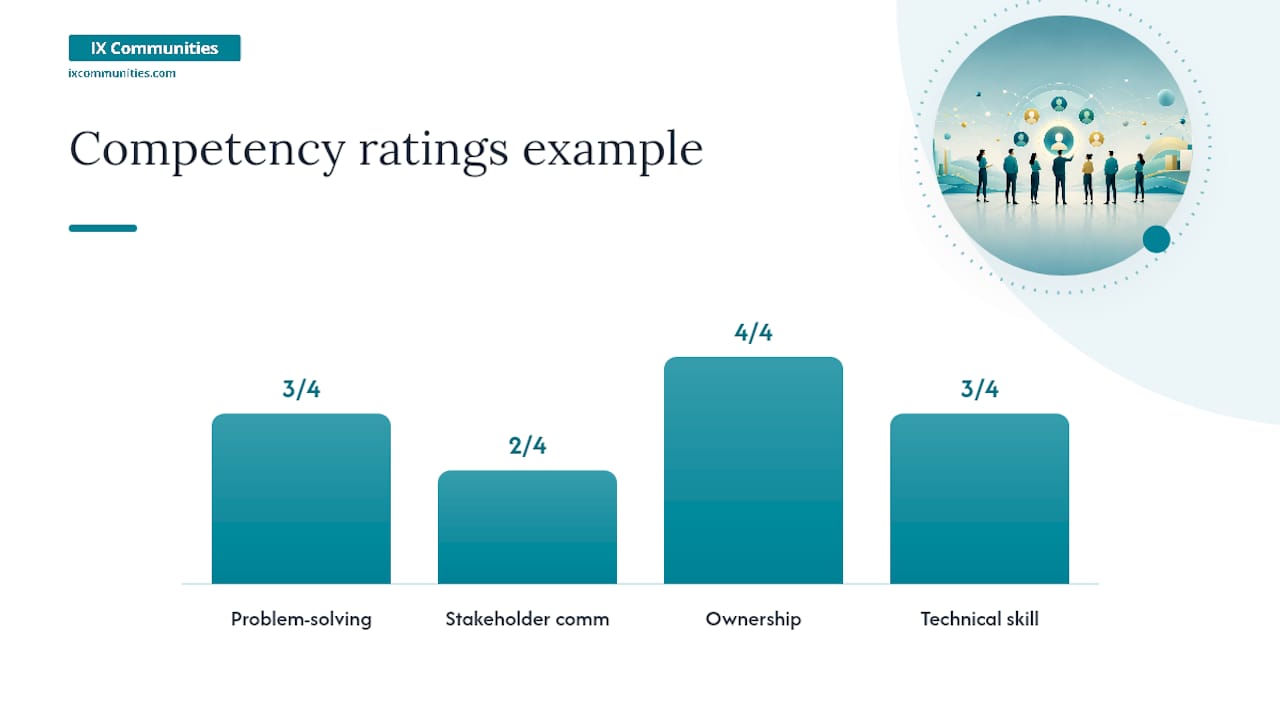
Competency scoring table. Pick four to six competencies tied directly to the role's success profile, not generic traits. A 1 to 4 anchor scale forces real differentiation and avoids the clustering that happens with 5-point scales, where everyone lands on 3.
| Competency | Rating (1 to 4) | Evidence (STAR format, one line) |
|---|---|---|
| Problem-solving | 3 | Walked through a supply chain delay using a structured root-cause approach; identified two contributing factors unprompted |
| Stakeholder communication | 2 | Answered clearly but struggled to adapt explanation when asked to simplify for a non-technical audience |
| Ownership | 4 | Described taking over a failing vendor relationship, rebuilding the scorecard, and cutting response time from 5 days to 1 |
| Role-specific technical skill | 3 | Correctly diagnosed the case study's core issue but missed one edge case |
Rating anchors should be defined once, in writing, and reused across every interview for that role. A "1" means no evidence or evidence of a gap; a "4" means clear, strong evidence exceeding the bar for the level. Anything softer than that invites drift.
Evidence guidance: each line should follow a STAR structure (Situation, Task, Action, Result) compressed into a single sentence. Practitioner guidance on interview debrief documentation notes that dictation or speech-to-text capture during the interview itself increases how often interviewers actually write evidence down, rather than relying on memory an hour later.
Closing fields:
- Overall recommendation (advance, reject, or collect more signal)
- Decision owner (name)
- Deadline for final call
- Candidate communication status (not yet contacted, offer pending, rejection sent)
That last section is where most teams lose the thread. A recommendation without an owner and a date is not a decision. It's a placeholder.
How to Run the Debrief: A 30 to 45 Minute Agenda
A well-prepared debrief runs short because the hard work happens before anyone sits down. The Metaview debrief framework outlines a six-step model, prepare, go around the room, summarize, dive deeper, decide, assign action, that keeps meetings tight because pre-reads and locked scorecards absorb most of the synthesis work upstream.
Before the meeting:
- Every interviewer submits their scorecard and locks it, no edits after the deadline, no peeking at colleagues' notes.
- The facilitator reads all scorecards in advance and drafts a one-page synthesis: where ratings agree, where they conflict, and which competencies have thin evidence.
- Required artifacts (résumé, take-home assignment if used, prior round notes) are circulated so nobody arrives cold.
During the meeting:
- The facilitator opens by framing the decision at stake: hire, reject, or gather more signal, and states the role's must-have competencies.
- Round-robin sharing starts with the most junior interviewer first. This single rule matters more than most teams realize: research on anchoring and social influence shows that early-spoken opinions bias how later speakers frame their own judgment. Junior-first ordering protects that voice from being steamrolled by a senior interviewer's confidence.
- The facilitator summarizes where signals agree and where they conflict, out loud, so everyone hears the same picture.
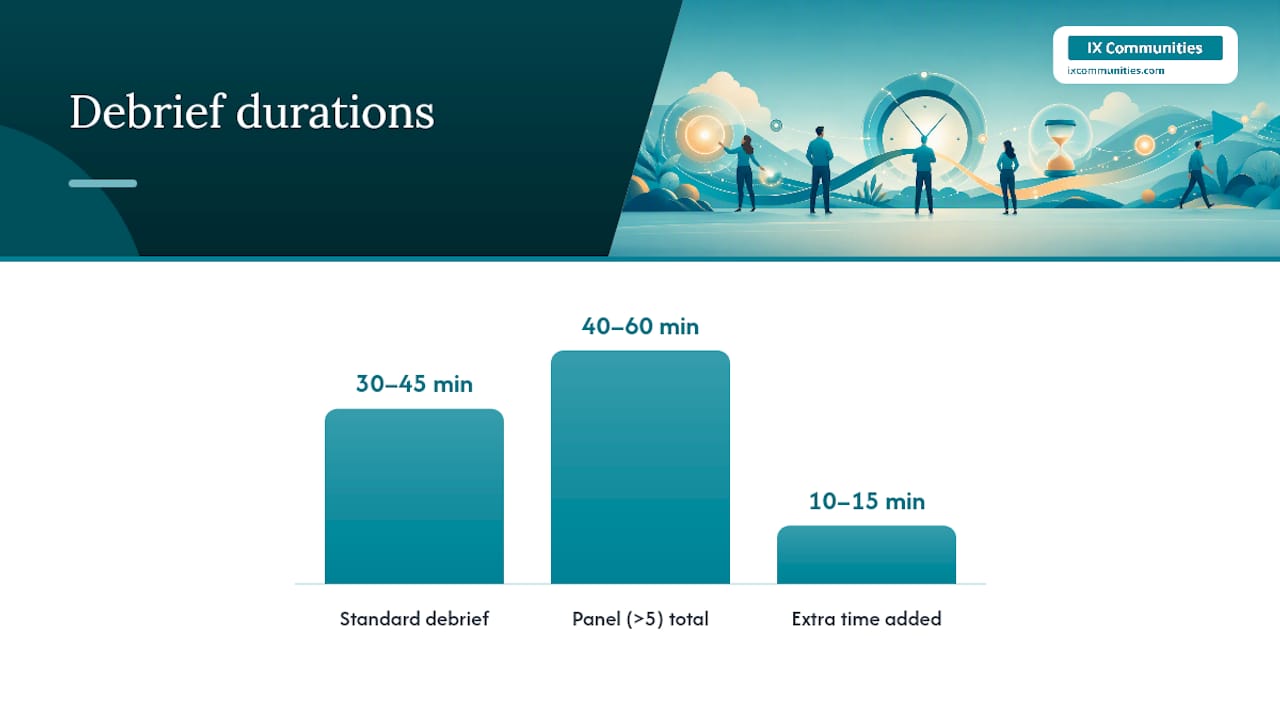
- The group dives into real conflicts only, not competencies everyone already agrees on. This is where most of the meeting's 30 to 45 minutes should go.
- The decision owner calls the outcome: advance, reject, or hold for more evidence.
- The facilitator assigns action items, who communicates with the candidate, by when, and logs the decision in the shared record before the meeting ends.
ClarityHire's guidance on running debrief meetings recommends strict timeboxing and a single named decision owner as non-negotiable rules; without them, debriefs drift toward 90 minutes of relitigating settled points. For panels larger than five interviewers, add 10 to 15 minutes and consider splitting into two rounds: a quick alignment check first, then a focused conflict-resolution session with only the interviewers who disagree.
Pro Tip: Schedule the debrief within 24 hours of the final interview. Evidence degrades fast, interviewers start reconstructing impressions instead of recalling specifics, and that's exactly when anchoring creeps back in.
Resolving Disagreements Without Stalling the Decision
Disagreement between interviewers isn't a failure of the process. It's the process working, as long as you resolve it with evidence instead of seniority or volume. A five-step sequence keeps conflict resolution fast and fair:
- Name the disagreement out loud. "We're split on problem-solving, Maria rated a 2, James rated a 4."
- Read the actual evidence lines, not the rating, not the general impression. What did the candidate specifically say or do?
- Reapply the rubric anchor to that evidence together, as a group, rather than defending the original score.
- Classify the gap: is this a genuine difference in what was observed (different interview, different question), or a genuine difference in interpretation of the same event?
- Decide and record the minority view. The decision owner still makes the call, but a dissenting rating gets logged in the record rather than quietly dropped.
Cogniver's interview debrief framework recommends testing every contested rating against role-specific evidence before anyone changes their score, which keeps the resolution evidence-first rather than authority-first.
Quarterly calibration sessions keep this consistent across a growing team. Pull two or three real, anonymized debrief records, play back the evidence and ratings, and discuss where the group would score differently today. This keeps rubric anchors from drifting apart across different hiring managers over time.
Asynchronous vs. Synchronous Debriefs: Choosing the Right Format
Not every debrief needs a live meeting. Choose asynchronous review when scorecards are complete, competencies are fully covered across the panel, and ratings are closely aligned with no major conflicts. A facilitator can review the synthesis, confirm agreement in writing, and log the decision without convening anyone.
Choose a synchronous meeting when:
- Ratings conflict on a core competency
- A required competency has no evidence from any interviewer
- The role is senior, high-visibility, or carries outsized business risk
Operating rules either way: asynchronous decisions still need a locked deadline, typically 24 to 48 hours after the last scorecard arrives, and a clear escalation trigger, if agreement isn't reached async within that window, it automatically converts to a scheduled meeting. Document the decision the same way regardless of format; an asynchronous call deserves the same rigor as one made in a room.
What to Log and Who Owns Follow-Up
The debrief record needs six fields at minimum, and skipping any one of them creates a gap that shows up later, usually during a calibration review or an audit.
- Decision line: advance, reject, or hold, stated plainly
- Reasoning trace: which competencies drove the call, with evidence references
- Dissent: any minority rating or disagreement, even if overruled
- Owner: who is accountable for next steps
- Deadline: the date by which action happens
- Communication status: has the candidate been contacted, and how
Store this inside your ATS whenever possible rather than a standalone document; ATS entries timestamp automatically and stay linked to the candidate's full file, which matters if a decision gets questioned months later. A shared doc works as a fallback but needs a manual timestamp on every entry.
Set a decision-to-communication window of 24 to 48 hours. NACE's research on time-to-offer trends shows candidate response behavior stays fairly steady, but employer-side delay is where most drop-off risk sits. A named owner and a firm deadline close that gap.
Rolling Out the Debrief Process Across a Large TA Team
Peer benchmarking across large talent organizations consistently points to the same rollout sequence: pilot with one or two hiring teams, embed the template directly into the ATS once it's proven, then secure executive sponsorship before mandating it company-wide. Tying debrief completion to offer authority, no completed debrief record, no approved offer, is the single strongest enforcement lever available.
Track three metrics as you scale:
- Debrief completion rate across all open requisitions
- Time from last interview to decision, watching for drift past your 24 to 48 hour target
- Calibration variance between hiring managers on the same competency, tracked quarterly
SHRM's 2025 recruiting benchmarking research confirms that structured processes and consistent measurement correlate with shorter time-to-hire and stronger decision quality across larger TA functions, exactly the outcomes a disciplined debrief process is built to protect.
Where Debrief Rollouts Usually Break
The template rarely fails on paper. It fails in practice, in three predictable ways.
First, no enforcement: teams write a great template, then never require it, so it gets used inconsistently. Fix it by tying debrief completion to offer approval, full stop.
Second, poor rubric design: competencies get reinvented by every hiring manager instead of standardized across a role family, which makes calibration meaningless. Fix it by locking competencies and anchors once per role family and reviewing them annually, not per requisition.
Third, tool friction: if the template lives in a document nobody can find, it dies quietly. Embed it in the ATS or give interviewers a dictation shortcut so capturing evidence takes seconds, not minutes.
— Simon
How Ixcommunities Supports Structured Hiring at Scale
Building a debrief template is the easy part. Getting a 500-person recruiting organization to use it consistently, calibrate it across regions, and enforce it without a mandate from the top is where most rollouts stall. Ixcommunities gives large talent teams a vendor-free peer network to benchmark exactly that kind of operational rollout against organizations solving the same problem.
Recruiter training courses at Ixcommunities, available on-demand starting at $350, live online starting at $750, or as a team-intact session starting at $3,000, walk your interviewers through evidence-based scoring and structured debrief facilitation directly. If you lead a talent acquisition function, TLIX Membership connects you with peer heads of TA benchmarking rollout tactics like calibration cadence and completion enforcement. Executive recruiting leaders can look at ESIX Membership, and diversity recruiting leaders at DSIX Membership, for the same peer-benchmarked support in their specific domain. Visit the membership page to see current training schedules and start the conversation about rollout support for your team.
Sources
- EEOC: Prohibited employment policies and practices
- SHRM recruiting benchmarking (2025)
- Metaview: How to run an effective interview debrief
FAQ
What Is an Effective Debrief for an Interview?
An effective debrief starts with locked, independent scorecards submitted before anyone talks, then uses a facilitator to synthesize agreement and conflict for group discussion. It ends with a documented decision, an owner, and a deadline, not just a verbal consensus that nobody writes down.
What Are the Five Key Points of a Debrief?
While frameworks vary, most structured debrief processes share five core elements: independent scorecards locked before discussion, role-specific competency evidence, a round-robin sharing order, evidence-first conflict resolution, and a recorded decision with a named owner. The Metaview six-step model, prepare, go around, summarize, dive deeper, decide, and assign action, covers all five in practice.
What Is the 30 to 60 to 90 Rule in an Interview?
The 30/90 rule typically refers to a candidate's onboarding plan covering their first 30 and 90 days in a role, rather than a debrief scoring method. It sometimes comes up during interviews when hiring managers ask candidates to outline their early priorities, and panels can capture that answer as evidence under a "planning" or "role readiness" competency on the debrief scorecard.
What Are the Five C's of Interviewing?
Definitions of the "five C's" vary by source and aren't standardized across the hiring industry the way STAR or competency-based interviewing are. Rather than relying on an unverified acronym, most structured debrief templates hold up better when built around role-specific competencies drawn from the actual success profile of the job.
How Long Should an Interview Debrief Meeting Take?
Most structured debriefs run 30 to 45 minutes when scorecards are locked and submitted in advance. Larger panels, five or more interviewers, may need an extra 10 to 15 minutes, and splitting into an alignment check followed by a focused conflict session keeps the meeting from stretching past an hour.
Does Ixcommunities Offer Training on Running Interview Debriefs?
Yes. Ixcommunities offers recruiter training courses covering evidence-based interview scoring and structured debrief facilitation, available on-demand, live online, or as team-intact sessions starting at $350, $750, and $3,000 respectively.