

An intake meeting is the structured kickoff between a recruiter and hiring manager that locks the role profile, decision criteria, and interview plan before sourcing begins. The single outcome recruiters must leave with is a finalized scorecard, agreed decision criteria, and a calendared first-profile review. Run this intake meeting in 30 to 45 minutes, and have the recruiter lead the agenda while the hiring manager supplies the judgment calls.
TL;DR:
- Conduct the intake meeting before sourcing begins to prevent scope creep, misaligned criteria, and costly delays by locking decision criteria early.
- Prepare with a draft scorecard, market data, and candidate examples in advance to ensure a focused, efficient discussion that clarifies role success and non-negotiables.
- Limit attendees to core stakeholders like the recruiter and hiring manager, adding others only for sensitive or complex roles to keep decision-making lean.
- After the meeting, promptly document decisions, lock in a decision chain, and schedule the first profile review to keep the process on schedule.
- Use peer benchmarking and templates to calibrate your intake criteria, avoiding common mistakes and refining your process for more predictable hiring outcomes.
Table of Contents
- Why Does an Intake Meeting Matter for Recruiting Success?
- Who Should Attend and When Should You Run It?
- How Should You Prepare Before the Intake Meeting?
- What Questions Should You Ask in an Intake Meeting?
- What Should You Walk Away With After Intake?
- What Are the Warning Signs of a Bad Intake Meeting?
- How Do You Document and Enforce Intake Decisions?
- How Does Peer Benchmarking Improve Intake Outcomes?
- What Do Experienced Recruiters Get Right About Intake?
- Get Peer Benchmarks and Templates for Your Intake Process
- Sources
Why Does an Intake Meeting Matter for Recruiting Success?
A rushed intake meeting costs more than the 30 minutes it saves. Recruiters who skip a proper recruiting intake session usually pay for it later, in the form of rewritten job descriptions, rebuilt candidate pools, and rescheduled interview panels after the hiring manager changes the bar mid-search. A focused intake meeting can prevent roughly three weeks of delay tied to those exact three failure points.
The math is straightforward. Every week a requisition sits open costs money in idle headcount, overworked teams, and slipping deadlines. An intake meeting front-loads the disagreements that would otherwise surface after ten resumes have already been screened.
Skipping intake tends to produce a specific, predictable pattern of damage:
- Endless interview rounds because nobody agreed in advance what "good" looks like.
- Candidate ghosting when slow, undefined feedback loops let strong applicants accept offers elsewhere.
- Scope creep where the hiring manager adds new must-haves after the recruiter has already built a pipeline around the original brief.
- Wasted panel time rescheduling interviewers because the evaluation criteria shifted mid-search.
Each of these failure modes traces back to one root cause: nobody wrote anything down and got sign-off before sourcing started. An intake meeting is the mechanism that forces that sign-off to happen early, when it's cheap to fix, rather than after ten interviews, when it's expensive.
Who Should Attend and When Should You Run It?
Run the intake meeting once per requisition, before you write a single search string or post a job ad. This is not a check-in you can do after sourcing begins. The whole value of the meeting depends on locking decisions before the recruiter invests hours building a pipeline around assumptions nobody confirmed.
The attendee list should stay lean for most roles. A bloated meeting slows decisions down instead of speeding them up.
- Recruiter and hiring manager: the non-negotiable core pairing for any standard requisition.
- HR business partner: add when the role touches a sensitive policy area, like a reorg backfill or a role with compliance exposure.
- Team lead or a peer on the team: add when the hiring manager isn't close enough to the day-to-day work to describe what success looks like in month three.
- Compensation owner: add when the budget range is uncertain, contested, or likely to require an exception.
Complex or executive searches change the math. A search intake questionnaire for a VP-level or specialized technical role deserves 45 minutes instead of 30, and it usually benefits from a second stakeholder, such as a skip-level manager, sitting in to confirm the mandate matches what the organization actually needs. When an executive search agreement is involved, that extra time also gives the recruiter room to walk through retained-search terms, exclusivity, and fee structure without cutting into the substantive scoping conversation.
How Should You Prepare Before the Intake Meeting?
The quality of an intake meeting is decided before anyone joins the call. A hiring manager who walks in cold will ramble, hedge, and default to vague language like "strong communicator" that gives the recruiter nothing to score against. Preparation fixes that.
- Send the job description and two to three example candidate profiles 24 to 48 hours ahead. Real profiles at different seniority levels help a hiring manager clarify level and scope faster than a hypothetical job description ever will.
- Pull comp bands, market supply signals, and comparable postings. Walking in with real numbers prevents a budget debate from derailing the meeting later.
- Draft a starter scorecard and interview stage plan before the call. Give the hiring manager something to react to and edit rather than a blank page to fill.
- Fill out a short search intake questionnaire ahead of the meeting where possible. A recruiting intake form sent in advance means the live conversation can focus on trade-offs instead of basic facts.
- Set expectations at the top of the invite. State the timebox, the outputs you expect to leave with, and who owns follow-up actions, so the hiring manager knows this is a working session, not a status update.
Skipping the pre-read is the single most common reason intake meetings run long and still produce vague outputs. A hiring manager who has already seen the draft scorecard walks in ready to sharpen it, not invent it from scratch.
What Questions Should You Ask in an Intake Meeting?
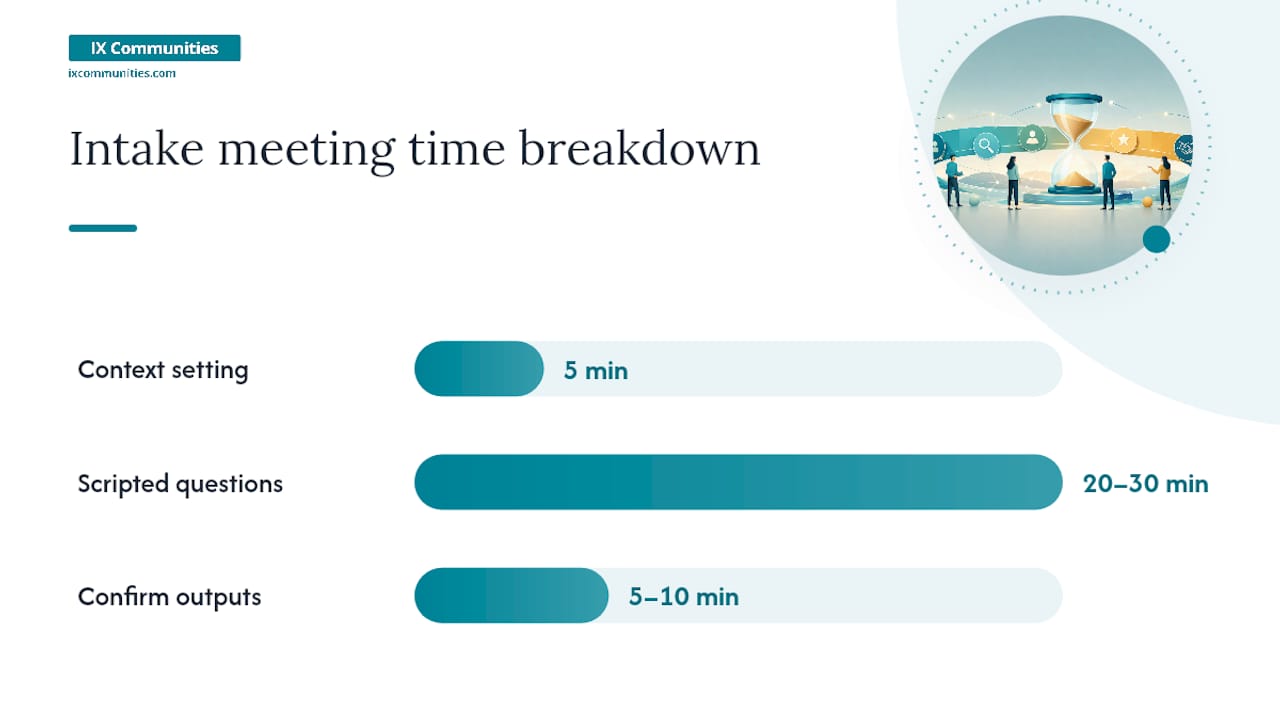
A 30-minute intake with a fixed set of questions works for the large majority of standard requisitions. A 35-minute average is common, and 45 minutes is reasonable for senior, technical, or unfamiliar roles. Structure the time in three blocks: five minutes of context setting, 20 to 30 minutes of scripted questions, and five to ten minutes to confirm outputs and the next review date out loud before anyone leaves the call.
Here are the eight to ten core questions worth asking in nearly every recruiting intake session, along with how to convert each answer into something usable.
- "What does success look like in the first 90 days?" Convert this directly into your first scorecard criterion. If the manager can't answer, that's your first red flag.
- "What are the three non-negotiables for this hire?" Anything beyond three gets filed as "nice to have," not "must have." This single question does more to prevent scope creep than any other in the meeting.
- "What killed the last candidate who almost got this offer, or the last hire who didn't work out?" This reveals the real bar far better than a wish list does. Translate the answer into a specific scorecard evidence point.
- "What's the true budget range, including flexibility for an exceptional candidate?" Lock this number before sourcing starts, not after you've found someone great.
- "Who has to sign off on the final offer?" Write down every name. This becomes your decision chain for the entire search.
- "How will we measure success in this role at six and twelve months?" These become your longer-horizon scorecard entries, distinct from the 90-day criteria.
- "What's the team culture, and what makes someone struggle here even if they're technically qualified?" This surfaces fit risks that a resume can't show.
- "What evidence, not just a title or years of experience, would convince you this candidate can do the job?" Frame the scorecard around observable evidence, phrased as whether a candidate demonstrates a specific behavior or outcome, rather than credentials.
- "What's realistic on timeline, and what happens if we don't fill this in that window?" This tells you how much political capital you have if the search runs long.
- "Is there anything about this role that hasn't been finalized yet?" Flag every open item explicitly rather than letting it surface three weeks into sourcing.
Roughly six of these questions are the load-bearing ones. Fewer than six risks missing a major evaluation axis; more than ten tends to overwhelm a hiring manager and produces rushed, low-quality answers on the back half of the meeting.
Pro Tip: If a hiring manager is genuinely too time-constrained for a full live session, send the search intake questionnaire and accept written answers on the lower-stakes questions, like timeline flexibility or team culture. Reserve the live conversation for the three or four questions where tone and hesitation tell you more than the words do, such as the budget range and the non-negotiables.
What Should You Walk Away With After Intake?
An intake meeting that ends without written artifacts didn't actually happen, no matter how good the conversation felt. The recruiter's job is to convert discussion into documents the hiring manager can be held to later.
- A scorecard with four to six observable criteria, each marked clearly as must-have or nice-to-have, phrased as evidence rather than adjectives.
- A named decision chain, listing exactly who holds veto power on the final offer and who simply gets informed.
- A communication SLA, specifying the feedback window (48 hours is a common standard) and naming who owns enforcing it when a hiring manager goes quiet.
- A calendared first-profile review, booked before anyone leaves the room, not "sometime next week" left to chase down later.
That last item does more work than it looks like it should. A drafted scorecard and a calendared calibration review are the two outputs that keep a search on schedule, because a booked date on the calendar creates accountability that a vague promise never does. Without it, the first slate tends to sit in the hiring manager's inbox for a week while other priorities take over.
What Are the Warning Signs of a Bad Intake Meeting?
Certain answers in an intake meeting should make a recruiter pause before opening a single search string. These are patterns worth watching for in real time, not discoveries you want to make three weeks into sourcing.
- The hiring manager can't describe the first 90 days. If they can't picture the role in action, they haven't thought it through enough to evaluate candidates against it fairly.
- The manager refuses to rank requirements. A list where everything is "critical" gives the recruiter no way to triage, which usually means every resume gets rejected for a different reason.
- Sign-off authority is unclear. If nobody can say definitively who approves the final offer, expect the process to stall at the finish line regardless of candidate quality.
- No review date gets booked before the call ends. This is one of the most common and costly errors recruiters make, and it's entirely preventable within the meeting itself.
- Documentation is vague or missing entirely. "Strong culture fit" and "self-starter" without supporting evidence points are not scorecard criteria; they're placeholders that will cause disagreement later.
When these signals show up, the right move is not to push forward and hope things clarify themselves. Escalate to the hiring manager's own leadership if the role lacks clear sign-off authority, require written answers to fill the gaps before sourcing starts, or pause the requisition entirely rather than build a pipeline against a brief that will change.
How Do You Document and Enforce Intake Decisions?
The meeting isn't finished when the call ends. What happens in the next 24 hours determines whether the intake actually holds up once sourcing gets underway.
- Send a written summary within 24 hours. Include every agreed decision, the scorecard draft, and any open questions still unresolved, so nothing relies on memory.
- Save the scorecard and intake brief directly in the ATS, attached to the requisition record, where any interviewer on the panel can reference them without asking the recruiter to resend a document.
- Set change control explicitly. Name who must approve any scope or compensation change after intake, and treat a significant shift, like a new must-have requirement or a revised budget, as a trigger to re-run a shortened intake rather than letting the change drift in informally.
A simple three-column format works well here: one column for what's locked, one for what stays open, and one for who owns closing each open item. That structure keeps everyone honest about what was actually decided versus what still needs a follow-up conversation, and it prevents the quiet scope creep that turns a clean intake into a messy search three weeks later.
How Does Peer Benchmarking Improve Intake Outcomes?
Recruiters running intake in isolation tend to reinvent the same scorecard mistakes their peers already fixed years ago. Benchmarking against other talent acquisition teams shortens that calibration curve considerably, because it replaces guesswork about what a "reasonable" comp band or interview stage count looks like with real peer data.

Ixcommunities members get access to shared intake templates, market benchmarking reports, and recruiter training built specifically around this kind of process discipline. Instead of drafting a scorecard from scratch, a member can compare their draft against how peer organizations structure evaluation criteria for a similar role, then adjust before the meeting rather than after a failed search. That kind of calibration is difficult to build alone, no matter how experienced the recruiter running the intake happens to be.
What Do Experienced Recruiters Get Right About Intake?
The best intake meetings aren't the polite ones. They're the ones where the recruiter pushes back on an unfillable list of "non-negotiables" and asks the manager to actually rank them, or refuses to let a requisition move to sourcing without a confirmed budget sign-off in writing. Vague answers in the room become vague, unfillable requisitions three weeks later, and by then the cost of fixing the problem has multiplied.
Good judgment also means knowing when a written search intake questionnaire beats a live meeting, and when it doesn't. The instinct to skip friction in the moment is exactly what causes rework later.
— Simon
Get Peer Benchmarks and Templates for Your Intake Process
Ixcommunities membership gives corporate talent acquisition leaders access to peer benchmarking reports, proven intake and scorecard templates, and recruiter training built by practitioners who run these searches every day. Instead of building your intake process alone and guessing whether your comp bands, question sets, or decision criteria hold up against comparable organizations, you get real benchmarks from peer talent leaders working the same problems.
If your team is refining how it runs a search intake questionnaire, a scorecard, or a communication SLA, compare your current process against what peer organizations are doing before your next requisition opens. Visit the Ixcommunities membership page to learn more about benchmarking access, templates, and training for your talent acquisition team.