

Fair chance hiring laws require employers to remove conviction-history questions from initial job applications, delay background inquiries until later in the hiring process, and complete a documented individualized assessment before rescinding a conditional offer. Federal rules under Title VII and the FCRA set a procedural floor, while state and local statutes, including recent Washington amendments, layer on stricter timing and notice requirements. HR teams need to update job postings, application forms, and adverse-action workflows now, not after the next audit.
TL;DR:
- Employers must delay criminal-background questions until after a conditional offer and conduct a written, job-specific assessment before rescinding offers.
- Variations in state and local laws mean employers need tailored policies and workflows for each jurisdiction and job type.
- Proper training, documentation, and system configurations are essential to ensure fair chance compliance and avoid common legal pitfalls.
- Missing or inconsistent assessments, and failing to record decision rationales, significantly increase legal risk and undermine fair chance policies.
- Adopting a thorough, documented process benefits recruitment by expanding the applicant pool and supports community reintegration efforts.
Table of Contents
- What Fair Chance Hiring Laws Require at the Federal and State Level
- The Legal Mechanics: Delayed Inquiry and Individualized Assessment
- State and Local Rules Every Multistate Employer Should Track
- Building a Compliance Checklist: Policy, Timing, Notices, Records
- An Implementation Playbook Your HR Team Can Use This Quarter
- How to Respond If a Complaint or Investigation Lands on Your Desk
- Impact of Fair Chance Hiring Laws Across Industries and Job Types
- Common Challenges and Risks in Fair Chance Compliance
- Why Fair Chance Hiring Benefits Employers and Communities
- Legal Consequences and Penalties Beyond a Filed Complaint
- The Editorial Take: Stop Treating This as a Legal Afterthought
- Get access to peer-tested fair chance hiring templates and resources
- Sources
What Fair Chance Hiring Laws Require at the Federal and State Level
Title VII bars hiring practices that produce a disparate impact on protected groups unless the employer can show the practice is job related. The Fair Credit Reporting Act adds its own layer, requiring disclosure, authorization, and specific pre-adverse and adverse-action notices whenever a third-party background check factors into a decision.
At the federal level, the Fair Chance to Compete Act blocks most federal agencies and many federal contractors from asking about arrests or convictions until after a conditional offer. HHS OIG's guidance confirms the same delayed-inquiry standard applies across covered federal employment.
Beyond that baseline, coverage splits into three patterns. Some states extend delayed-inquiry and individualized-assessment duties to all private employers. Others limit coverage to public-sector jobs and government contractors. Many cities layer additional ordinances on top of state law, which means a multistate employer can face three different rule sets for the same job requisition.
The Legal Mechanics: Delayed Inquiry and Individualized Assessment
A fair chance policy rests on two mechanisms: keeping conviction-history questions off the initial application (often called ban the box or delayed inquiry), and running an individualized assessment before any adverse decision. Neither piece works without the other.
Delayed inquiry means the employer cannot ask about criminal history, and often cannot run a background check, until after a conditional job offer. NELP's fair chance research shows this timing shift is the most common feature across state and local laws.
The individualized assessment is where most employers stumble. Reviewers must weigh:
- The nature and gravity of the offense
- Time elapsed since the offense or completion of sentence
- The specific duties of the job in question
- Evidence of rehabilitation, training, or references
A checkbox that says "assessment completed" is not a defense. Regulators and courts expect a written rationale tying the conviction to specific job duties, not a generic policy statement applied uniformly to every applicant.
State and Local Rules Every Multistate Employer Should Track
Coverage differs sharply by jurisdiction, and the differences change what your intake forms and offer letters need to say.
California requires private employers to delay conviction-history inquiries until after a conditional offer, then complete an individualized assessment before withdrawing that offer. Employers evaluating criteria tied to conviction history should review California's hiring-discrimination rules alongside state Fair Chance Act guidance to confirm which job criteria hold up.
Washington governs this under RCW 49.94, and the law changed meaningfully in 2025. The amendments narrow employer defenses and tighten notice obligations, taking effect July 1, 2026 for employers with 15 or more employees and January 1, 2027 for smaller employers.
New York City goes further on documentation. The NYC Fair Chance Employment Act requires a written analysis of the conviction and the specific job duties at issue, plus a real opportunity for the applicant to respond before any adverse action becomes final.
- Coverage ranges from full private-sector protection to public-sector-only rules
- State-by-state trackers show wide variation in scope and remedy
- Local ordinances frequently add stricter notice or timing rules than the state floor
Because coverage shifts by city and county as often as by state, verify local rules for every job posting location rather than relying on a single company-wide policy.
Building a Compliance Checklist: Policy, Timing, Notices, Records
Turning legal requirements into daily practice comes down to four checkpoints, each with its own paper trail.
- Fix the job posting and application. Remove blanket language like "no felons" or "must have clean record." Replace it with job-relevant language tied to actual duties, and strip conviction questions from the initial form entirely.
- Set a firm timing rule. Background checks and conviction-history questions happen only after a conditional offer. Build this checkpoint into your applicant tracking system so no recruiter can skip ahead.
- Document the individualized assessment. Record the specific offense, the job duties it might affect, time elapsed, and rehabilitation evidence, then attach a written rationale to the offer file rather than a checkbox.
- Run the FCRA sequence correctly. Disclose the check, get written authorization, provide a copy of the report before any pre-adverse action notice, then wait the required response period before finalizing an adverse decision.
Pro Tip: Store the individualized-assessment form directly with the conditional-offer file, and cite the specific job duties that make the conviction relevant. Recordkeeping habits like this hold up far better under review than a policy statement written after the fact.
Skipping any one of these four steps is the most common way an otherwise well-intentioned policy fails legal scrutiny.
An Implementation Playbook Your HR Team Can Use This Quarter
A workable rollout follows the hiring funnel itself, with a compliance checkpoint at each stage.
Posting the job comes first. Use duty-based language, not blanket exclusions. Application intake follows: no conviction questions, ever, at this stage. After a conditional offer, run the background check, complete the individualized assessment, and issue any pre-adverse notice with the report attached. Only after the applicant's response window closes does the employer finalize the offer or the adverse decision, in writing, with the reasoning documented.
Sample language matters more than most HR teams assume. A conditional-offer letter footer might read: "This offer is contingent on a satisfactory background check consistent with applicable fair chance laws. You will have an opportunity to respond to any information that may affect this offer." That single sentence, used consistently, does more compliance work than a ten-page policy nobody reads.
When choosing a background-check vendor, confirm three things: FCRA-compliant report formatting, customizable turnaround for conditional-offer workflows, and secure handling of records tied to an ongoing individualized assessment.
- Train every hiring manager and recruiter on the same job-relatedness rubric
- Retain assessment records for the same period your legal counsel sets for personnel files
- Audit a sample of adverse decisions each quarter for consistency
How to Respond If a Complaint or Investigation Lands on Your Desk
Complaints typically route through the EEOC for Title VII disparate-impact claims, a state attorney general's office for state fair chance violations, or a municipal commission like the NYC Commission on Human Rights for local ordinance issues. Each venue has its own filing window and remedy structure, from back pay to policy injunctions.
The moment a complaint arrives, freeze any pending adverse action tied to the same policy pattern and pull the individualized-assessment file for the applicant in question. Preserve every version of the job posting, application form, and notice sent. Loop in employment counsel before responding to any agency inquiry, and treat the complaint as a signal to audit similar decisions made in the same quarter, not just the one case named.
Impact of Fair Chance Hiring Laws Across Industries and Job Types
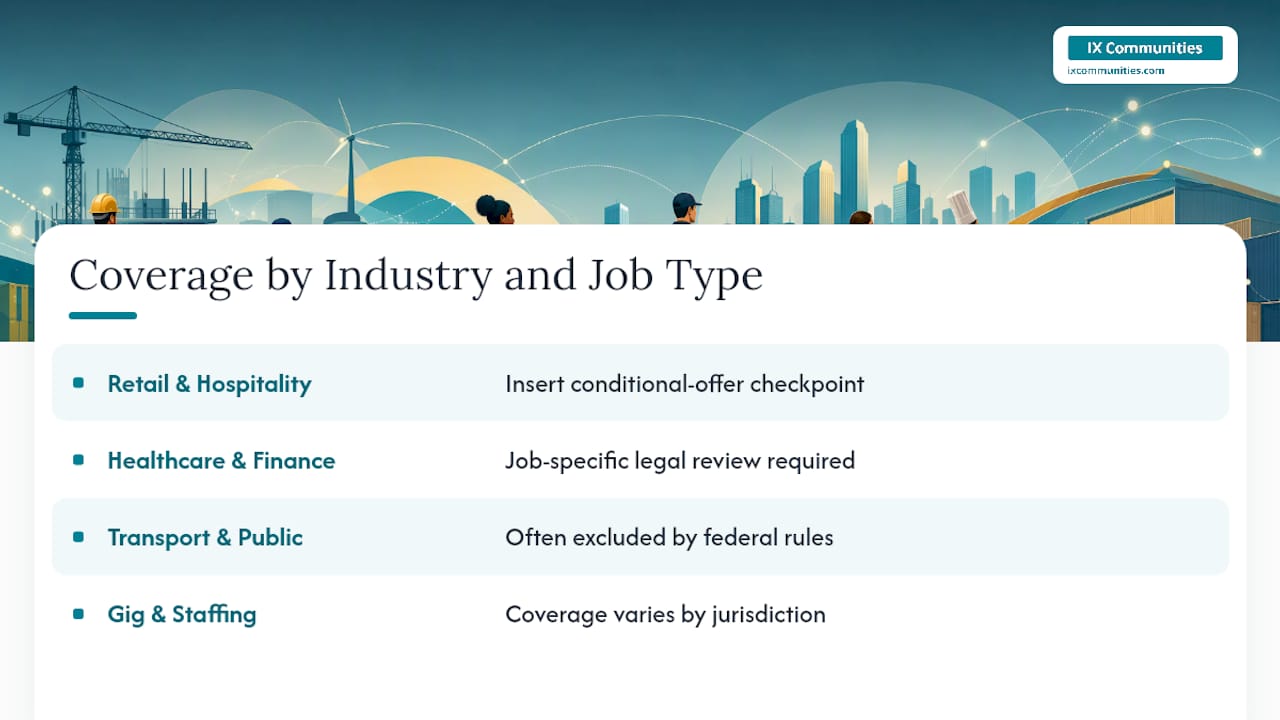
Coverage and risk look different depending on the role. Retail and hospitality employers, who hire high volumes through standardized application flows, see the biggest operational shift: mass-hire funnels built around quick screening now need a conditional-offer checkpoint inserted mid-process.
Healthcare and financial services face a harder tension. Federal and state licensing rules sometimes require criminal-history disclosure earlier than fair chance laws would otherwise allow, and many fair chance statutes carve out exceptions for positions involving vulnerable populations, controlled substances, or fiduciary duty. HR teams in these sectors need job-specific legal review rather than a single company-wide policy.
Transportation and logistics roles subject to federal safety regulation, and public-sector positions covered by security-clearance rules, often sit outside standard fair chance protections entirely. Meanwhile, gig and contract staffing arrangements raise a separate question: many state laws apply only to "employers," and coverage of staffing agencies or platform-based work varies by jurisdiction.
The practical result is that a single national hiring policy rarely fits every job category inside one company. A warehouse associate role, a nurse position, and a driver role covered by federal safety rules may each need a different version of the same conditional-offer workflow. Mapping coverage by job family, not just by state, prevents a compliant policy in one department from becoming a liability in another.
Common Challenges and Risks in Fair Chance Compliance
The biggest failure point is not ignorance of the law. It is inconsistency. A hiring manager who applies the individualized-assessment rubric loosely for one candidate and strictly for another creates exactly the kind of disparate outcome Title VII targets, even when no one intended discrimination.
Documentation gaps rank second. Many employers run a real individualized assessment in practice but never write it down in a form that would survive a records request. Without a paper trail showing the specific job duties considered and the rationale for the decision, the employer is left arguing intent after the fact, a weak position in any investigation.
Timing errors are the third recurring risk. Applicant tracking systems built years before fair chance laws expanded often allow conviction questions to appear on the initial application by default, or let a recruiter run a background check before an offer goes out. These are frequently system configuration failures, not policy failures, and they are easy to miss until an audit or complaint surfaces them.
Multistate employers face a compounding version of all three problems. A policy written to satisfy Washington's requirements may not satisfy New York City's written-analysis rule, and a single applicant-tracking configuration rarely handles both correctly without customization by location.
Why Fair Chance Hiring Benefits Employers and Communities
Removing conviction-history questions from the initial application widens the applicant pool without lowering job-relevant standards. Employers who screen based on actual duties rather than blanket exclusions consistently report access to qualified candidates who would have been filtered out under an older, cruder policy.
Research on ban-the-box policies in public-sector contexts found measurable reductions in reoffending alongside increased hiring of people with records, though labor-market effects varied and some employers shifted screening behavior in unexpected ways. The takeaway for HR leaders is not that fair chance hiring is a guaranteed productivity win. It is that a job-relevant, individualized process tends to outperform blanket exclusion, both for the employer's talent pipeline and for the applicant's odds of finding stable work.
Community-level benefits follow the same logic. Lower reoffending rates connect directly to stable employment, and employers who build a consistent, well-documented fair chance process often find it easier to expand into workforce partnerships, reentry programs, and public contracts that require demonstrated fair chance practices as a condition of eligibility.
Legal Consequences and Penalties Beyond a Filed Complaint
A complaint is often just the opening move. Disparate-impact claims under Title VII can escalate into class or collective litigation when the same flawed screening practice touches multiple applicants, and remedies can include back pay, injunctive relief, and mandated policy changes with ongoing court oversight.
State-level penalties vary by statute but frequently include civil fines per violation, and some laws allow a private right of action letting rejected applicants sue directly rather than waiting on an agency. FCRA violations carry their own exposure: statutory damages, actual damages, and attorney's fees are all available when an employer skips required disclosure or notice steps, regardless of whether the underlying hiring decision was otherwise defensible.
The reputational cost often outlasts the legal one. A published enforcement action or class settlement becomes public record, and it shapes how future applicants, current employees, and public-sector partners view the company's hiring practices for years afterward.
The Editorial Take: Stop Treating This as a Legal Afterthought
The research here points to one uncomfortable truth: most employers treat fair chance compliance as a legal checkbox rather than an operational rebuild. That is backward. The law does not just ask you to remove a question from a form. It asks you to change the sequence of your entire hiring workflow and to write down reasoning you previously kept in a hiring manager's head.
Conventional advice tends to stop at "update your application." That is necessary but nowhere near sufficient. The real exposure sits in the individualized assessment, where a company's practice either holds up under review or collapses into inconsistency the moment two similar cases get different outcomes.
If you take one thing from this guide, prioritize the documentation habit over the policy language. A well-written policy with no paper trail behind actual decisions is worse than no policy at all, because it creates the appearance of compliance without the substance. Fix the workflow first. The forms and job postings are the easy part.
— Simon
Get access to peer-tested fair chance hiring templates and resources
Building a defensible individualized-assessment process from scratch takes months most talent leaders don't have. Membership communities can offer corporate talent acquisition and recruiting leaders access to peer benchmarking data, sample policy language, and training modules that other employers have tested against real audits and complaints.
Membership can connect you with peers who have experience with various state and local fair chance hiring requirements, along with guidebooks and workshops on recruiting best practices. If your team needs to move fast on policy updates this year, visit Ixcommunities to review membership options and get started on benchmarking your current fair chance practices against peer organizations.
Sources
- Fair Chance Act | Washington State
- Fair Chance to Compete Act | U.S. Department of the Interior
- The Movement for Fair Chance Hiring | NELP
- Fair Chance Act campaign | NYC Commission on Human Rights
- Fair Chance Hiring Laws by State: What Job Seekers With a Criminal Record Need to Know | Outten & Golden