

Retained executive search typically costs 25% to 33% of a candidate's first-year total cash compensation, while contingency search runs 20% to 25%, and hybrid or engaged models land in between with a partial upfront retainer. Retained is the default for C-suite and other confidential, senior roles; contingency suits higher-volume, mid-level hiring. Billing schedule, guarantee length, and expense caps affect the real cost of executive search fees as much as the headline percentage.
TL;DR:
- Retained search fees usually range from 25% to 33% of the candidate's first-year salary, billed in thirds over the course of the engagement.
- Contingency search fees are typically 20% to 25%, with payment only due upon successful placement, making it suitable for mid-level roles.
- Hybrid models combine a modest upfront retainer of $25,000 to $50,000 with a placement fee totaling roughly 25% to 30%, balancing commitment and cost.
- Search durations generally take three to five weeks for a shortlist, with guarantees lasting six to twelve months, offering a window for replacements if needed.
- Negotiations often focus more on guarantee length, expense caps, and billing schedules rather than percentage fees, especially for high-level or confidential roles.
Table of Contents
- What Are Executive Search Fees, and Which Model Fits Your Search?
- How Are Executive Search Fees Billed, and How Long Does a Search Take?
- What Do Executive Search Fees Actually Cover?
- What Do Executive Search Fees Look Like by Role Level?
- How Do You Negotiate Executive Search Fees and Contract Terms?
- Which Fee Model Should You Choose for This Hire?
- How Do Talent Leaders Benchmark Executive Search Fees?
- What Talent Leaders Get Wrong About Executive Search Fees
- How Ixcommunities Helps You Validate Executive Search Fees
- Where These Executive Search Fee Benchmarks Come From
- Sources
What Are Executive Search Fees, and Which Model Fits Your Search?
Executive search fees are the professional charges a search firm bills for identifying, vetting, and delivering candidates for a role, structured under one of a few standard commercial models. Each model shifts risk differently between the client and the firm, which is why picking the wrong one for a given role often costs more than the percentage difference suggests.
Retained search is the standard for C-suite, board, and other high-confidentiality roles. The client pays an upfront retainer and commits to exclusivity with one firm, with fees commonly running 25% to 33% of first-year total cash compensation, typically billed in thirds across the engagement. The firm invests heavily in market mapping before it earns full payment, which aligns incentive with search quality rather than speed alone.
Contingency search flips that risk. The firm only gets paid on a completed hire, fees generally sit at 20% to 25% of compensation, and clients often run the same role with multiple firms simultaneously. It works well for mid-level roles with a reasonably deep talent pool, but the non-exclusive, pay-on-hire structure gives firms less reason to prioritize a hard-to-fill or highly confidential search.
Engaged or hybrid search blends the two: a modest upfront retainer, often $25,000 to $50,000, paired with a placement fee that brings the effective rate to roughly 25% to 30%. It buys partial commitment without full retained pricing.
Flat fees are less common but growing, usually offered by boutique firms or for roles with a predictable compensation ceiling. They give budget certainty but can undercut a firm's incentive to go deep into a market if the flat number was set too low relative to search difficulty.
How Are Executive Search Fees Billed, and How Long Does a Search Take?
Payment timing and search duration are where many procurement teams get surprised, since the invoicing schedule is tied directly to when the firm is expected to deliver value.
- Thirds billing is the market standard: one third at signing, one third when a shortlist is presented, and one third on placement or start date.
- Front-loaded 50/50 schedules shift more cash upfront, reflecting that most search-intensive work happens in the first few weeks.
- Milestone-based schedules tie payments to specific deliverables, such as completed market mapping or final-round interviews, rather than fixed calendar splits.
On timing, retained searches commonly deliver a shortlist in three to five weeks, with total placement often faster than the traditional 60 to 90 day norm many enterprise teams still budget for. Guarantee periods run alongside this billing structure, so a firm paid heavily upfront should also be the one offering a meaningful replacement window if the hire fails.
What Do Executive Search Fees Actually Cover?
The professional fee covers the search work itself; anything tied to logistics or third-party services is usually billed as a separate, reimbursable expense.
Included in the fee:
- Market mapping and target-company research
- Confidential outreach and candidate screening
- Shortlist development and structured interviews
- Reference checks and initial offer support
Billed separately as expenses:
- Candidate and consultant travel
- Psychometric or leadership assessments
- Background and credential checks
Most engagement letters cap expenses at a percentage of the fee, commonly 10% to 15%, and require receipts for anything above a set threshold. Push for that cap and an itemized deliverables list in the statement of work before signing. Firms that resist defining deliverables clearly are the same ones prone to scope creep once the search stalls.
What Do Executive Search Fees Look Like by Role Level?
Numbers matter more than percentages once you're building a budget line, and the gap between a Director search and a CEO search is bigger than most first-time buyers expect.
Boutique retained firms often quote toward the lower end of these bands, sometimes as low as 15%, while global retained firms with deeper research infrastructure tend to sit at the top of the range. That spread alone, 15% versus 33% on a $700,000 C-suite hire, can swing the fee by more than $125,000, which is exactly the kind of number worth putting in front of finance before a search kicks off.
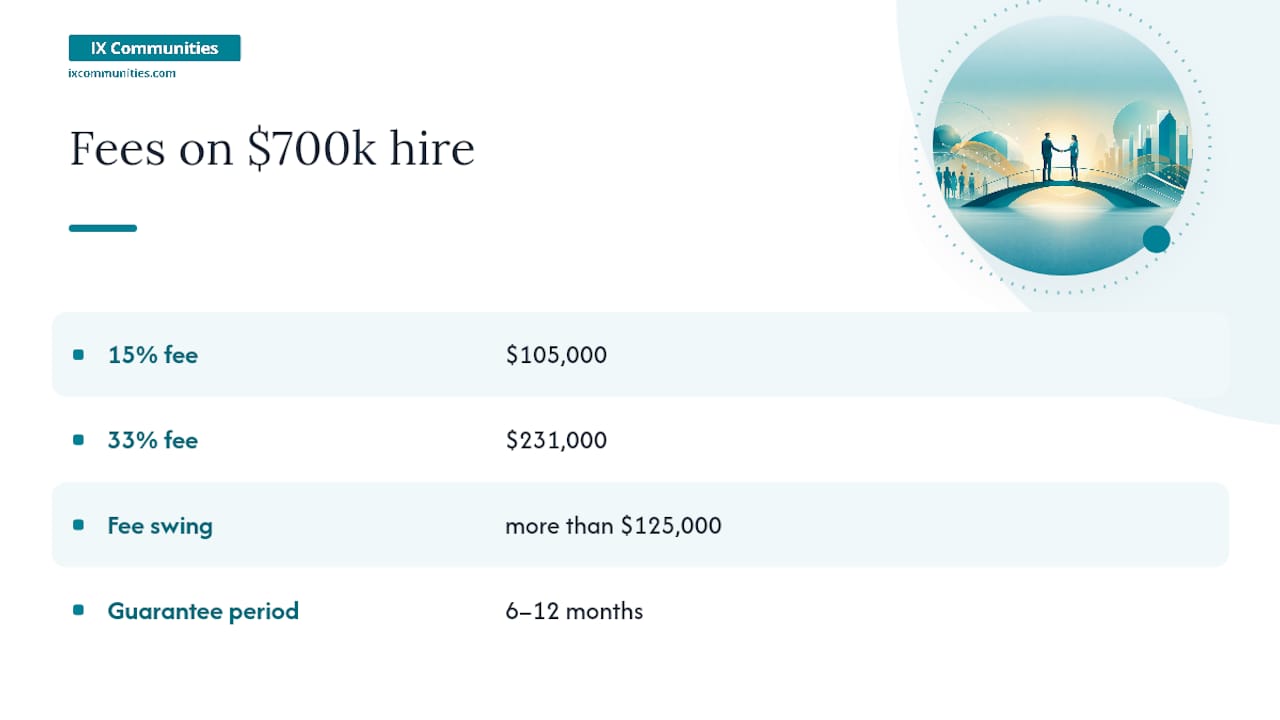
Guarantee periods typically run six to twelve months, and a longer guarantee is one of the most valuable concessions a firm can offer, often worth more to the client than a percentage point or two off the fee.
How Do You Negotiate Executive Search Fees and Contract Terms?
The percentage on the cover page is the least useful number to negotiate hard on. The mechanics buried in the engagement letter, guarantee length, expense caps, milestone definitions, tend to move more real dollars than shaving a point off the fee.
- Ask for volume pricing if you're running three or more searches a year with the same firm.
- Push guarantee periods toward twelve months for C-suite roles, where replacement cost is highest.
- Negotiate a hard expense cap with receipts required above a stated threshold.
- Consider a timeline bonus, a small premium for a shortlist delivered inside four weeks, in exchange for a slightly lower base percentage.
- Use diversity-slate requirements as a contract clause, not just a verbal expectation, if that's a hiring priority.
Pro Tip: Ask every finalist firm to quote guarantee length and expense cap alongside their percentage, not after. Firms sometimes counter with a stronger guarantee in exchange for holding their fee level, and that trade only surfaces if you ask for it upfront.
Which Fee Model Should You Choose for This Hire?
Match the model to the role before you talk numbers with any firm.
- Confidential or C-suite role: default to retained, with billing in thirds and a guarantee of at least six months.
- Mid-level or higher-volume role with a deep candidate pool: contingency is reasonable, especially across multiple firms.
- Role that needs speed and some cost certainty: engaged/hybrid, with a modest retainer and capped placement fee.
- Predictable, well-benchmarked role at a boutique firm: ask about flat fees, but confirm the firm's incentive to go deep is still intact.
Before signing, ask every firm for their average shortlist timeline, guarantee terms, and how they define a completed search. A single retained partner usually outperforms multiple contingency firms for confidential senior roles, where market coverage and discretion matter more than speed alone.
How Do Talent Leaders Benchmark Executive Search Fees?
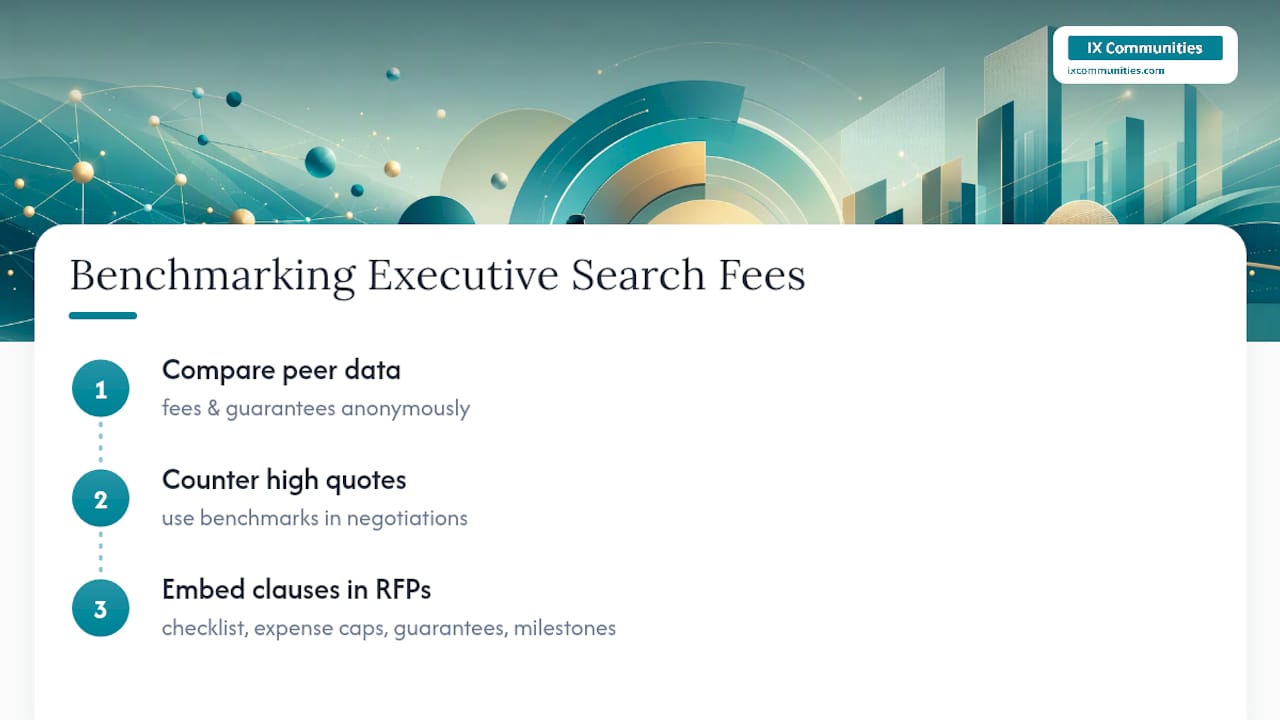
Talent leaders inside peer networks routinely compare anonymized fee and guarantee data before signing engagement letters, using that data to counter inflated quotes. Members bring specific checklist language, expense caps, guarantee minimums, milestone definitions, into RFPs rather than negotiating from a single firm's proposal alone.
What Talent Leaders Get Wrong About Executive Search Fees
The most common mistake is treating contingency and retained as interchangeable once you scale up compensation. They aren't. A $700,000 C-suite search run on contingency terms rarely gets the market-mapping depth a retained engagement requires. What experienced talent leaders consistently say matters most isn't the percentage. It's early market mapping and the quality of the first shortlist.
— Simon
How Ixcommunities Helps You Validate Executive Search Fees
Most enterprise talent teams negotiate executive search fees with one data point: whatever the firm in front of them just quoted. Some membership organizations give talent leaders access to peer benchmarking data on fee percentages, guarantee terms, and billing structures pulled from other large organizations running comparable searches.

Membership can provide a search consultant database to vet firms before issuing an RFP, plus benchmarking reports that show what peer companies actually paid, by role level and industry, not just what a vendor claims is standard. That data turns a negotiation from a one-sided pitch into an informed conversation grounded in real market terms. Managing the expense side of a search, including travel and assessment costs, is easier with dedicated accounting tools built for recruitment agency back-office needs.
If your team is preparing an executive search RFP this quarter, explore Ixcommunities membership and start pulling benchmark data before your next vendor call.
Where These Executive Search Fee Benchmarks Come From
- McKenny Group's retained search guide on billing structure and guarantee norms
- Excelon Associates' executive search benchmarks on fee percentages and shortlist timelines
- ExecSignals' analysis of retained search fee structures on hybrid models and payment variants
- Valuable Recruitment's cost breakdown on role-tier fee examples and expense caps
Triangulating fee benchmarks across multiple firm sources, rather than trusting a single guide, gives the clearest read on what a fair market rate actually looks like for your specific search.