

An effective diversity recruiting training program stands on four components: candidate evaluation scorecards, gender-neutral job description audits, standardized interview frameworks, and short bias-interruption exercises for recruiters and hiring managers. The right first move is not an organization-wide rollout. It's a pilot on one job family, using one or two objective tools, with recruiters, hiring managers, and interview panel members trained together before the first requisition opens.
TL;DR:
- Focusing on a pilot for one high-volume job family allows for clearer data collection and avoids the pitfalls of organization-wide rollouts.
- Implementing structured scorecards, gender-neutral language audits, and standardized interview frameworks reduces bias and promotes objective decision-making.
- Regular reinforcement through refresher sessions, audits, and documentation is essential to ensure tools are used consistently and behaviors change over time.
- Measuring diversity metrics such as slate-to-interview conversion rates, offer acceptance, and scorecard variance helps evaluate the training's effectiveness and guide improvements.
- Peer benchmarking within trusted networks accelerates adoption by providing real-world templates and data, making long-term progress more achievable than isolated efforts.
Table of Contents
- Core Components of Effective Diversity Recruiting Training
- Designing a Training Program That Fits Your Organization
- Rolling Out the Training: Checklist and Timeline
- Measuring Training Impact and Iterating
- Unconscious Bias Training for Recruiters
- Legal Considerations and Compliance in Diversity Recruiting Training
- Cultural Competency Training for Recruiters
- Training on Inclusive Workplace Culture and Retention Practices
- Use of Technology and Tools to Support Diversity Recruiting Initiatives
- Peer Benchmarking as the Multiplier
- How Ixcommunities Can Help: Training and Membership Options
- Sources
- FAQ
Core Components of Effective Diversity Recruiting Training
Most diversity recruiting training programs fail for the same reason: they lead with awareness and skip the tools. A half-day workshop on bias might change how people talk about hiring for a week. It rarely changes what they do on a Tuesday afternoon when they're scanning forty resumes. Programs that hold up over time build around a small set of instruments recruiters and hiring managers actually use inside the funnel.
Bias awareness still matters, but it works best as a short, active exercise rather than a lecture. A useful format asks recruiters to score two anonymized resumes, then reveals how demographic cues (a name, a graduation year, a gap in employment) shifted their read. Pair that with a decision checklist, one item recruiters answer before advancing any candidate: "Is this decision based on documented, job-relevant criteria?" Checklists built around that exact question have shown up in targeted gender-bias trainings as a practical way to interrupt assumptions in real time, not just in a training room.
Candidate evaluation scorecards do the heaviest lifting. A working scorecard needs required fields tied to the job description, not the candidate's résumé; a numeric scale (1 to 5 works better than pass/fail); and a rule that scores get submitted before panelists compare notes. Used at every stage, from phone screen through final round, scorecards convert gut instinct into a paper trail you can audit later.
Gender-neutral language decoders catch words like "ninja," "rockstar," or "aggressive," which research ties to lower application rates from women and older candidates. Run every open job description through a decoder before posting.
Standardized interview frameworks close the loop: every candidate for a role gets the same core questions, scored against the same rubric, by a panel that includes at least one person outside the hiring manager's usual circle.
- Evaluation scorecards with required, job-linked fields and a numeric scale
- Gender-neutral language audits applied to every job posting before it goes live
- Standardized interview questions and rubrics, used identically across candidates
- Short bias-interruption checklists at each decision point in the funnel
- Sourcing adjustments: targeted channels and outreach templates that don't rely on referral networks alone
Effective programs emphasize these exact tools precisely because they force objective, data-driven decisions instead of relying on individual judgment at each stage of the funnel.
Designing a Training Program That Fits Your Organization
Scope decisions come before curriculum decisions. Rolling out diversity recruiting training to your entire talent acquisition function on day one usually backfires: too many stakeholders, no baseline data, and no room to fix a broken scorecard before it's embedded in fifty job families. A pilot on one job family, ideally one with high volume and visible attrition, gives you clean data and a fast feedback loop.
- Pilot on one job family. Pick a role type with enough hiring volume to generate meaningful data within a quarter.
- Expand by job family or business unit. Once the pilot proves out, add adjacent roles rather than jumping to company-wide.
- Go organization-wide only after the tools are stable. Scorecards and interview guides should already be revised at least once before broader rollout.
Delivery format matters as much as content. On-demand modules work for baseline concepts (what a scorecard is, why gender-neutral language matters) but rarely change behavior on their own. Instructor-led cohorts and team-intact workshops, where recruiters and hiring managers train together, produce faster adoption because they include role-play against real job requisitions rather than hypothetical scenarios. Live, cohort-based inclusive hiring programs that build in role-play and ongoing toolkits tend to see quicker uptake among hiring teams than one-off sessions.
Curriculum should differ by role. Recruiters need deep training on sourcing and screening tools. Hiring managers need the scorecard and structured interview mechanics. Panel members need a condensed version focused on scoring discipline. Executives need a briefing on the metrics they'll be asked to sponsor, not the full curriculum.
Pro Tip: Build your scorecard and interview guide templates before you schedule a single training session. Teaching the concept without the tool in hand is the single most common reason pilots stall.
Rolling Out the Training: Checklist and Timeline
A rollout plan needs a named sponsor, a talent acquisition lead who owns the tools, and two or three hiring managers willing to run the pilot on live requisitions. Without a sponsor above the TA function, scorecards get treated as optional the first time a hiring manager is in a hurry.
Trainer selection depends on scale. Internal facilitators know your job families and existing tools, which speeds adoption. External experts bring calibration from outside your walls, useful for the bias-interruption modules where internal facilitators may share the same blind spots as the group they're training. Cohort-based options through peer networks split the difference: shared curriculum, outside perspective, and a group of practitioners solving the same problem.
- Identify a sponsor and a pilot job family before scheduling any sessions
- Assign prework: scorecard familiarization and one practice scoring exercise
- Schedule refresher sessions at 60 and 120 days, not just a single kickoff
- Audit scorecard completion rates monthly during the pilot
- Document every process change for legal and compliance review
The most common pilot failure is the token session: one workshop, no reinforcement, no audit of whether scorecards actually get used. Inclusive recruitment training that follows the recruitment cycle step by step, from job ad through final decision, produces more durable behavior change than a single lecture because it forces hands-on practice at each stage rather than abstract discussion. Build refreshers and audits into the plan from the start, not as a fix after adoption stalls.
Measuring Training Impact and Iterating
Diverse-slate-to-interview conversion is the metric that tells you whether sourcing changes are actually working. Track it alongside offer-acceptance rates by demographic group, scorecard score variance between panelists on the same candidate, and time-to-offer broken out by group. Wide variance in scorecard scores usually means the rubric itself needs revision, not more training.
Qualitative signals matter too: panel feedback after each hiring cycle, hiring manager confidence ratings in using the scorecard, and candidate experience ratings collected through post-interview surveys.
- Diverse-slate-to-interview conversion by job family
- Offer-acceptance rate by demographic group
- Scorecard score variance across panelists
- Time-to-offer by group, tracked against the pilot baseline
Set a baseline before the pilot starts, then compare a phased rollout against roles that haven't yet adopted the new tools. That gives you an internal control group instead of guessing whether results came from the training or from an unrelated hiring market shift.
Practical benchmark: Organizations that get diversity recruiting training right report improvements in innovation, engagement, and overall performance, largely because widening the talent pool reduces the cost of missed hires that a narrower funnel would have overlooked. Peer benchmarking through a group like Ixcommunities gives you a realistic target range instead of a number pulled from a press release.
Unconscious Bias Training for Recruiters
Unconscious bias training works when it's built around specific decision points, not general awareness. A recruiter reviewing resumes at 4 p.m. on a Friday is more susceptible to snap judgments than one working through a fresh batch Monday morning, and the training that changes behavior accounts for that reality with tools, not just concepts.
The strongest format pairs a short diagnostic exercise (scoring anonymized versus named resumes and comparing results) with a checklist recruiters apply at each stage: screening, phone interview, panel interview, and offer decision. Targeted unconscious gender-bias trainings that include reflection exercises and a simple data-based question at each decision point interrupt gendered assumptions more reliably than a single seminar on bias in the abstract.
Frequency matters more than length. A 90-minute session repeated quarterly, with a fresh case study each time, beats a single half-day training that recruiters attend once and never revisit. Bias doesn't get "fixed" by one session; it gets managed through repeated, structured practice.
Make the training role-specific. Recruiters need practice with sourcing and screening bias. Hiring managers need practice with interview scoring bias, particularly the halo effect that inflates scores for candidates who remind the interviewer of themselves. Train these groups on the same core framework, but with different practice scenarios drawn from the roles they actually fill.
Legal Considerations and Compliance in Diversity Recruiting Training
Diversity recruiting training needs to stay grounded in job-relevant, documented criteria. Training that pushes recruiters toward quotas or demographic targets tied directly to hiring decisions creates legal exposure; training that pushes them toward objective, criteria-based evaluation reduces it. That distinction should shape every module you build.
Document your process. Inclusive recruitment training run step-by-step across the funnel, from job posting through final decision, reduces legal risk specifically because it's practical and documented rather than aspirational. A scorecard with dated, job-linked criteria is evidence your hiring decisions were criteria-based, not memory-based.
Train your legal or compliance team into the design process early, not as a final sign-off. Interview questions, scorecard fields, and sourcing outreach templates should all get a compliance review before the pilot launches, not after a complaint surfaces. This is especially true for any exercise involving demographic data. Aggregate metrics for measurement purposes are standard practice; using demographic data to make individual hiring decisions is not.
Keep training records. If a hiring decision is ever challenged, documentation showing recruiters and hiring managers completed structured training, used a standardized scorecard, and followed a documented interview framework is far stronger evidence of good-faith process than an undocumented claim that "we care about diversity."
Cultural Competency Training for Recruiters
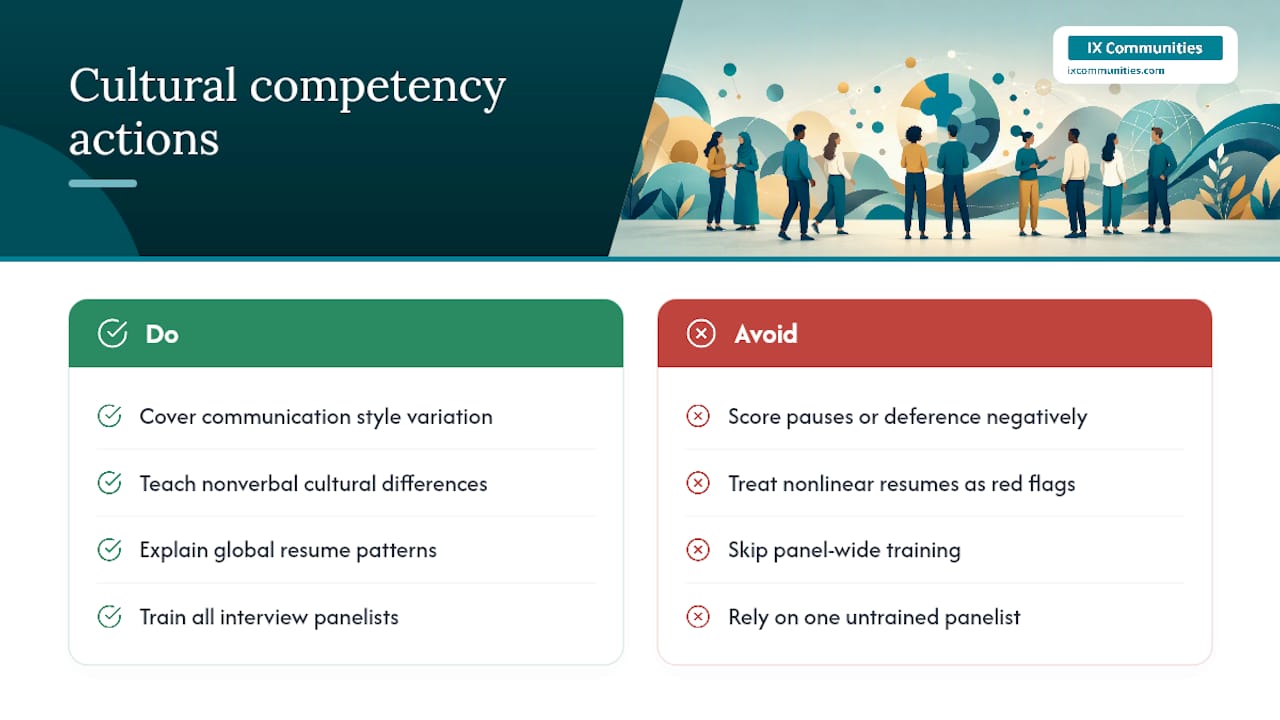
Cultural competency training addresses something bias training often misses: recruiters misreading communication styles, career paths, or interview behavior that differ across cultural backgrounds. A candidate who pauses before answering, defers credit to a team, or has a nonlinear resume shaped by immigration or caregiving gaps isn't giving a weaker answer. A recruiter without cultural competency training may score it that way anyway.
Effective modules cover communication style variation (direct versus indirect answering patterns), nonverbal cues that differ by culture (eye contact norms, for instance), and resume patterns that reflect global career paths rather than red flags. The goal isn't teaching recruiters to catalog every cultural difference; it's teaching them to recognize when their own default reading of "strong" or "confident" answers is a cultural preference, not a job-relevant criterion.
Build this into interview panel training specifically. Panels that include people from varied backgrounds catch these misreadings before they become rejection decisions, but only if every panelist has been trained to name the pattern out loud during debrief. A structured debrief question, "Did we score this candidate on job-relevant criteria or communication style?", works well as a standing agenda item.
Cultural competency training pairs naturally with the sourcing side of diversity recruiting training. Recruiters sourcing from international talent pools, historically Black colleges and universities, or veteran transition programs need context on how resumes and interview norms in those pools may differ from the recruiter's own experience.
Training on Inclusive Workplace Culture and Retention Practices
Diversity recruiting training that stops at the offer letter solves half the problem. If new hires from underrepresented groups leave within eighteen months, the recruiting program looks successful on paper while the underlying culture problem stays hidden. Training needs a retention component, and it needs hiring managers, not just recruiters, in the room for it.
Hiring managers should leave training with a concrete onboarding plan for new hires: a defined first-90-days check-in schedule, a named point of contact beyond the manager, and clarity on how performance will be evaluated. Vague onboarding is where a lot of early attrition starts, particularly for hires who are the only person from their background on a team.
Exit interview data deserves a place in the training curriculum itself. If turnover among a specific group clusters around a particular manager, team, or stage of tenure, that pattern belongs in the next cohort's training materials as a real case, not a hypothetical. Recruiters and hiring managers should see the retention data their hiring decisions eventually produce.
Inclusive culture training also means giving hiring managers language for addressing microaggressions and exclusionary team dynamics before they compound. This isn't a separate HR function bolted onto recruiting training. It's the same discipline applied past the hire date.
Use of Technology and Tools to Support Diversity Recruiting Initiatives
Software gets pitched as the fix for diversity recruiting gaps more often than it deserves. Applicant tracking systems with built-in scorecard fields, structured interview scheduling, and resume anonymization features can support the program, but they don't replace the human discipline of actually using them.
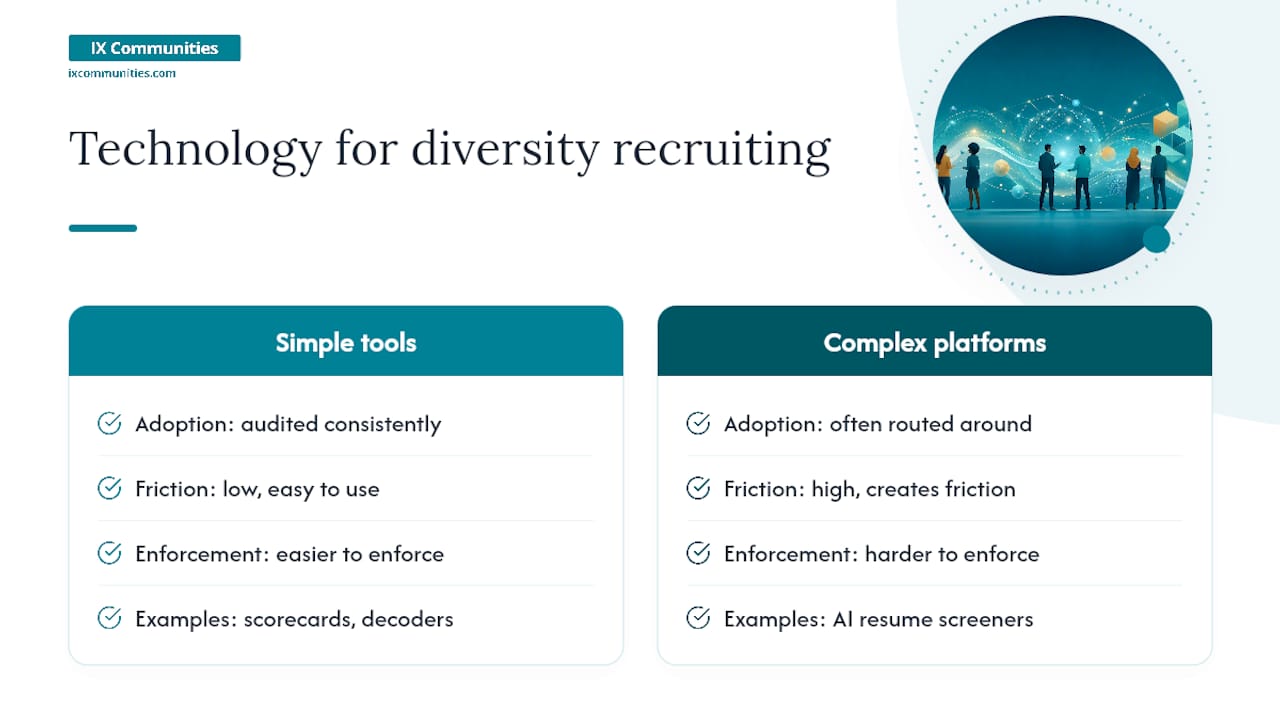
Practitioners find that simple tools like scorecards and gender-neutral language decoders get used and audited more consistently than sophisticated software platforms, largely because complex systems create friction that busy recruiters route around. The lesson for technology decisions: pick tools that make the simple practices easier to enforce, not tools that promise to automate judgment away entirely.
Resume anonymization software, structured scheduling tools that standardize interview length and format across candidates, and dashboards that surface scorecard variance in real time all earn their place. AI-driven resume screening tools deserve more scrutiny; several have been shown to replicate the same biases they're marketed to remove, since they learn from historical hiring data that reflects past inequities.
The strongest technology stack supports policy rather than substituting for it. If your applicant tracking system can flag a hiring manager who consistently skips the scorecard field, that's worth building. If it claims to score cultural fit automatically, that claim deserves a hard look before it enters your funnel. Cohort-based DEI courses that deliver templates alongside training content, rather than software alone, tend to see better long-term adoption across teams.
Peer Benchmarking as the Multiplier
Diversity recruiting training improves faster inside a peer group than in isolation. Confidential benchmarking, comparing scorecard variance, conversion rates, and retention data against organizations facing the same hiring challenges, gives talent leaders a realistic target instead of a guess pulled from a vendor's marketing page.
Some peer networks exist for this purpose: a vendor-free space where corporate talent and diversity recruiting leaders share what's actually working, not what's being sold. Cohort-based learning inside a peer network accelerates operational adoption because the templates and lessons come from practitioners running the same programs, not from theory. A scorecard template that a peer organization has already stress-tested against legal review saves months of internal iteration.
The gap between a training program that stalls and one that matures usually comes down to whether the team has somewhere to check its assumptions against real peer data.
— Simon
How Ixcommunities Can Help: Training and Membership Options
If you're building or refreshing a diversity recruiting training program, the fastest starting point is a structured course rather than an internal build from scratch. IX Academy's recruiter training offers three formats built for different needs: on-demand courses for recruiters who need baseline skills now, live online courses for teams that want instructor-led practice, and team-intact courses for hiring managers and panel members who need to train together on the same job requisitions.
For talent leaders who want more than a single course, ongoing peer benchmarking closes the gap between training and results. DSIX Membership connects diversity and recruiting strategy leaders in a confidential, vendor-free peer group where members compare scorecard templates, conversion metrics, and retention data. TLIX Membership suits talent acquisition leaders looking for broader benchmarking across the recruiting function, not just diversity-specific metrics.
If you're running a fast pilot, start with the on-demand or live course. If you're building a long-term measurement and iteration practice, request information on DSIX membership to see how peer organizations are calibrating their targets.
Sources
- DEI Recruitment Guide 2024 — University of California Global Health Sciences
- The surprising benefits of investing in diversity training programs — Diversity Leadership Alliance
- Unconscious gender bias training for recruiters — FSG
FAQ
What Should Diversity Recruiting Training Cover First?
Start with candidate evaluation scorecards and gender-neutral job description audits, since these are among the most consistently used bias-mitigation tools once teams adopt them. Structured interview frameworks and bias-interruption checklists follow once scorecards are in place.
How Long Does a Diversity Recruiting Training Pilot Take?
A pilot on one job family typically runs one fiscal quarter, long enough to gather scorecard completion data and at least one full hiring cycle. Expansion to additional job families depends on whether scorecard variance narrows and conversion metrics improve during that window.
Who Needs to Attend Diversity Recruiting Training?
Recruiters, hiring managers, and interview panel members all need training, but with different curriculum depth. Recruiters need sourcing and screening tools, hiring managers need scorecard and interview mechanics, and panelists need a condensed version focused on scoring discipline.
Does Diversity Recruiting Training Create Legal Risk?
Training built around documented, job-relevant criteria reduces legal risk rather than creating it, particularly when the process follows the recruitment funnel step by step with records at each stage. Risk increases when training pushes toward demographic targets tied to individual hiring decisions instead of criteria-based evaluation.
How Much Does Diversity Recruiting Training Cost?
Ixcommunities' IX Academy recruiter training starts at 350 USD for on-demand courses, 750 USD for live online courses, and 3000 USD for team-intact courses. Membership pricing for various peer groups is available upon inquiry from the provider.